Tear-Gassed on Live TV, Struck by Rubber Round in Chaotic ICE Showdown
By Sultan islam
January 30, 2026 — Downtown Los Angeles
What was supposed to be just another tense protest report turned into pure mayhem on live television Friday night, as CNN correspondent Veronica Miracle found herself in the crossfire of an explosive confrontation between ICE protesters and law enforcement in downtown Los Angeles.
In a shocking and chaotic scene that unfolded in real time on CNN, Miracle was tear-gassed at point-blank range while attempting to deliver a live report from the front lines of a rapidly escalating demonstration. The dramatic footage, which has already gone viral across social media platforms, shows her mid-sentence when a cloud of chemical irritant suddenly engulfs the crowd — and her along with it.
The moment is jarring.
One second, Miracle is calmly explaining the growing tension between protesters and federal authorities. The next, she is coughing violently, eyes watering, struggling to breathe, as thick white smoke fills the air. Her voice cracks as she gasps, “I can’t breathe,” before desperately trying to compose herself and continue with her broadcast.
But the danger didn’t end there.
As she pushed forward with her report, refusing to abandon her duty despite the chaos around her, something else struck. Viewers watching closely noticed a sharp impact near her leg — believed to be a rubber bullet or other non-lethal projectile fired by law enforcement attempting to disperse the crowd.
Miracle winced but did not fall. Instead, she steadied herself, visibly shaken but determined, and carried on — embodying the kind of fearless journalism that both earns admiration and raises serious questions about the risks reporters face in volatile environments.
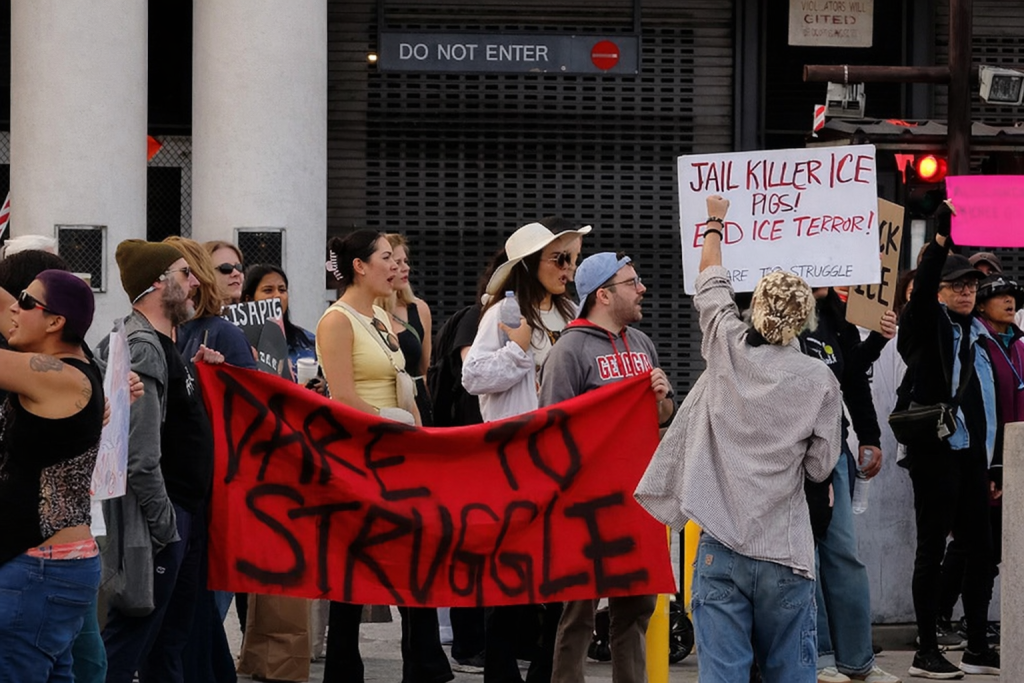
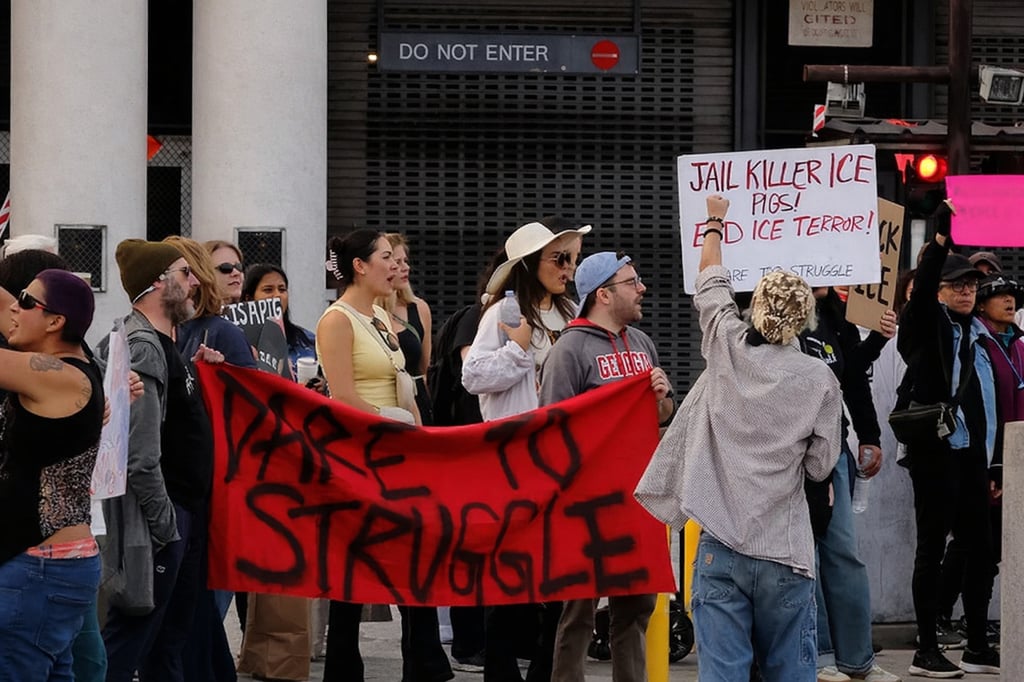
The protest itself had been brewing for hours before CNN went live. Demonstrators gathered outside a federal building in downtown L.A. to condemn recent ICE operations, which they claim have unfairly targeted immigrant communities. Protesters carried signs reading “End ICE Terror,” “No Human is Illegal,” and “Abolish ICE,” while chanting slogans condemning federal enforcement tactics.
At first, the atmosphere was heated but relatively controlled. Then, as night fell, tensions flared.
Police began forming barricades. Protest leaders urged calm, but pockets of the crowd grew increasingly confrontational. Some demonstrators pushed closer to restricted areas. Officers responded with warnings over loudspeakers, demanding that the crowd disperse.
That’s when things turned violent.
According to witnesses, what started as verbal clashes quickly escalated into physical standoffs. Objects were thrown. Police moved in. Tear gas canisters were launched into the crowd, sending protesters scrambling in all directions — including directly toward Miracle and her camera crew.
CNN’s control room reportedly went silent for several seconds as they watched their correspondent struggle through the ordeal. Anchors back in studio were visibly stunned, urging Miracle to prioritize her safety while she insisted on continuing her coverage.
Miracle later posted a brief statement on social media thanking her team and viewers for their concern, saying she was shaken but ultimately okay. She also criticized the “excessive use of force” by authorities, arguing that journalists should be able to report on public demonstrations without being treated as targets.
Her experience has reignited a broader debate about press safety in the U.S., particularly when covering protests involving federal agencies like ICE.
And this incident comes on the heels of another high-profile controversy involving CNN — this time centered around former anchor Don Lemon.
Just weeks earlier, Lemon had found himself in legal trouble after reporting from an ICE-related protest inside a Minnesota church. While Lemon insisted he was simply doing his job as a journalist, federal authorities saw things differently. He was arrested and later charged, with prosecutors alleging that he was not merely observing the protest but actively participating in it.
The government claims Lemon crossed the line between reporting and involvement, suggesting he acted more like a “co-conspirator” than a neutral journalist. Lemon has vehemently denied those accusations, calling the charges politically motivated and an attack on press freedom.
Unlike Miracle’s ordeal, Lemon was not tear-gassed or struck by projectiles. His arrest came after the fact — but it has sparked its own firestorm of debate about where the line lies between journalism and activism.
Critics argue that reporters embedded in protests must maintain clear boundaries, while supporters insist that journalists have the right to document events from within the movement itself, especially when covering issues of civil rights and government overreach.
Meanwhile, CNN finds itself caught in the middle of a growing conflict between the media and federal authorities.
On one side, reporters are being accused of overstepping their role. On the other, they are facing increasing physical danger while doing their jobs in hostile environments. Miracle’s tear-gassing is now being cited as a glaring example of how perilous frontline reporting has become.
Social media has exploded with reactions.
Some praise Miracle as a hero who refused to back down in the face of danger. Others argue she should have retreated sooner. Meanwhile, ICE critics are using the footage as evidence of what they describe as heavy-handed policing tactics, while law enforcement supporters claim the tear gas was necessary to control an unruly crowd.
CNN has yet to release a full official statement, but sources within the network say they are reviewing the incident closely and considering additional safety protocols for field reporters covering protests.
As for Miracle, she remains the face of the night’s chaos — a journalist literally coughing through history as the battle over immigration, policing, and press freedom continues to rage across America.
One thing is clear: the media isn’t just reporting the story anymore.
They’re becoming part of it.