
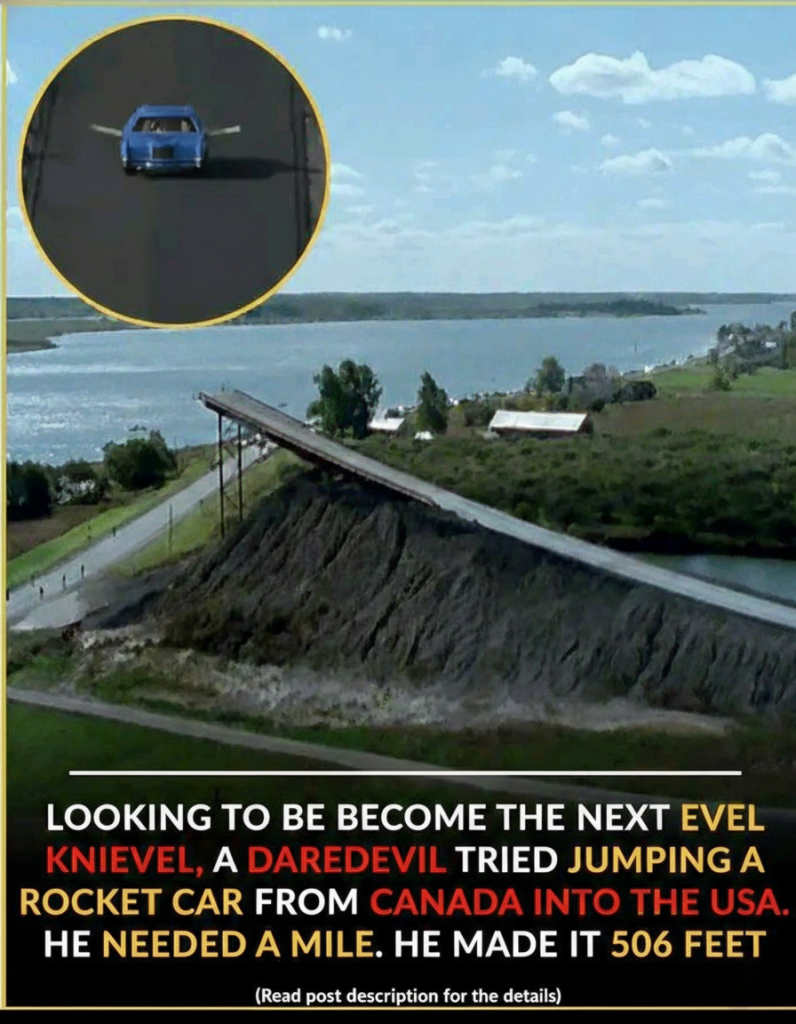
In the 1970s, stuntman Ken Carter set out to do what no daredevil had attempted before: jump a rocket-powered Lincoln Continental over the St. Lawrence River from Canada into the United States. The stunt was meant to cement his place in history, stepping out of the shadow of motorcycle legend Evel Knievel.
Carter convinced investors to fund the ambitious project, promising a spectacle “bigger than the moon landing.” His plan involved launching the car off a massive ramp, flying one mile over the river, and landing in a field of roses in New York.
However, the project quickly ran into challenges. The ramp was uneven, the rocket car frequently exploded during tests, and the supposed landing zone was actually a swamp. Despite repeated delays, Carter insisted that the jump would happen only when conditions were perfect. Investors grew frustrated as years passed with no successful attempt.
Eventually, the investors decided to act without him. While Carter was away on a business trip, they secretly hired a younger stuntman, Kenny Powers, to attempt the jump. On the day of the stunt, Powers strapped into the rocket car with minimal safety precautions. As the car hit 270 mph and launched off the ramp, it immediately flipped in the air. The parachutes deployed too early, and Powers crashed into the freezing river, breaking his back.
Although Kenny Powers survived, the car never crossed into the United States, and Ken Carter’s long-sought fame remained out of reach. The story serves as a dramatic example of ambition, risk, and the unpredictable nature of extreme stunts.
Professional Q&A Section