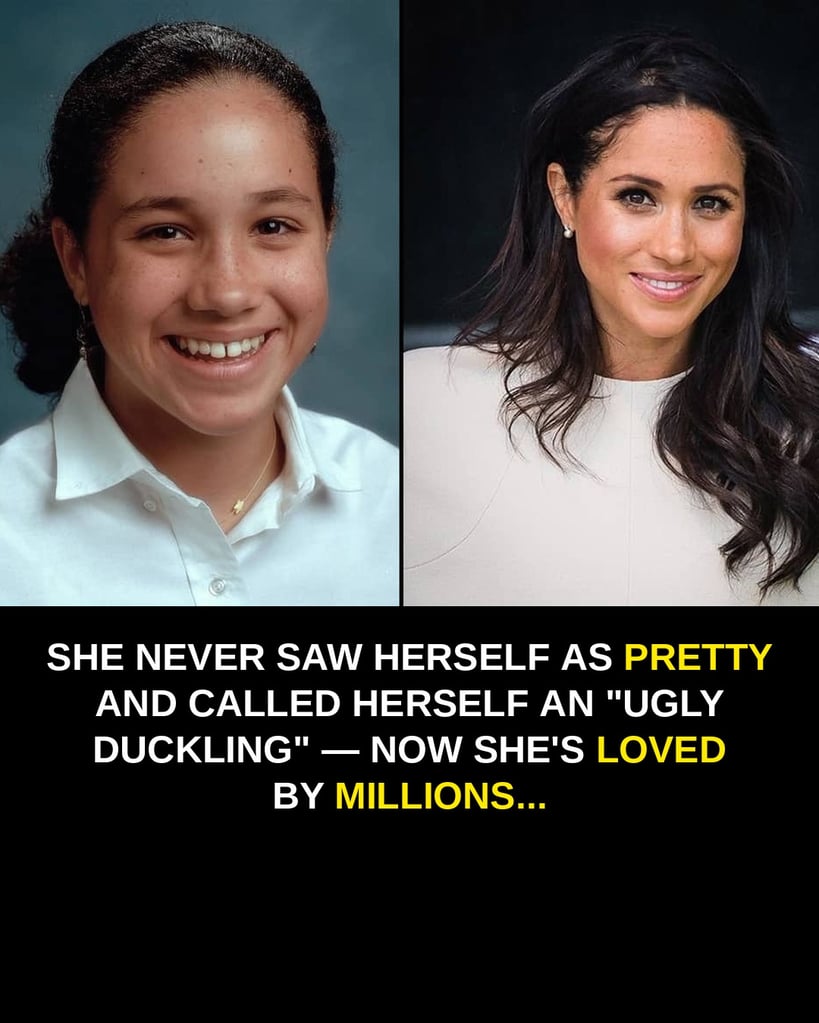
The school photo on the left is real, and so is what the girl in it believed about herself.
Long before the palace, the podcasts and the headlines, Meghan Markle described her younger self in words a lot of women will recognize instantly. On a 2022 episode of her podcast Archetypes, speaking with Mindy Kaling, she was asked whether she had been the pretty one growing up.
“No. Oh God, no,” she said. “Ugly duckling.”
She described “massive, frizzy, curly hair and a huge gap in my teeth,” and said she was “the smart one forever and ever” instead of the pretty one. She also said she was a loner at lunch — so shy, and so unsure where she fit in, that she became president of club after club mostly so she would have somewhere to be at lunchtime instead of sitting alone.
The box she refused to tick
That feeling of not fitting in a box followed her. In an essay she wrote for Elle in 2015, Meghan recalled a seventh-grade English class exercise that asked students to tick one box for their ethnicity. She was biracial — her mother, Doria Ragland, is Black and her father, Thomas Markle, is white — and neither box felt true.
“There I was (my curly hair, my freckled face, my pale skin, my mixed race) looking down at these boxes, not wanting to mess up, but not knowing what to do,” she wrote. She left her identity blank — “a question mark, an absolute incomplete — much like how I felt.”
When she told her father about it, he gave her the line she has repeated ever since: “If that happens again, you draw your own box.”
“Not Black enough, not white enough”
Hollywood gave her the adult version of the same problem. In the same essay she wrote that early in her acting career she “wasn’t Black enough for the Black roles and wasn’t white enough for the white ones,” leaving her, in her words, somewhere in the middle as an “ethnic chameleon” who struggled to book work.
What changed the story was not a makeover. It was persistence — years of auditions before landing Rachel Zane on Suits, then meeting Prince Harry in 2016 and marrying him in a globally watched royal wedding in 2018. The viral version of her story calls her a “millionaire’s wife.” The accurate version is bigger than that: the girl who left the box blank married a prince, became the Duchess of Sussex, and built her own platform that reaches millions.
Why this one lands on a natural hair page
Strip away the royalty and the core of the story is hair, identity and a mirror. A girl with big, frizzy, curly hair decided the hair — and the face that came with it — meant she was not the pretty one. Plenty of women who grew up straightening, hiding or apologizing for their natural texture have believed some version of the same thing.
Meghan’s story does not end with her learning to “fix” the curls. It ends with her drawing her own box. That is exactly the journey this page exists for.
Join the conversation
Were you the “smart one” instead of the “pretty one” growing up? When did you stop trying to fit the box — and start drawing your own? Share it below.
Source note: Meghan’s “ugly duckling” remarks are from her Archetypes podcast conversation with Mindy Kaling (September 2022), widely reported at the time. The census-box story and the “draw your own box” advice are from her own 2015 essay for Elle UK. The “almost died” wording used in some viral versions of this post is not part of her school story — she has separately spoken publicly about serious health and mental-health struggles as an adult, and this article does not fold those into the childhood story.