
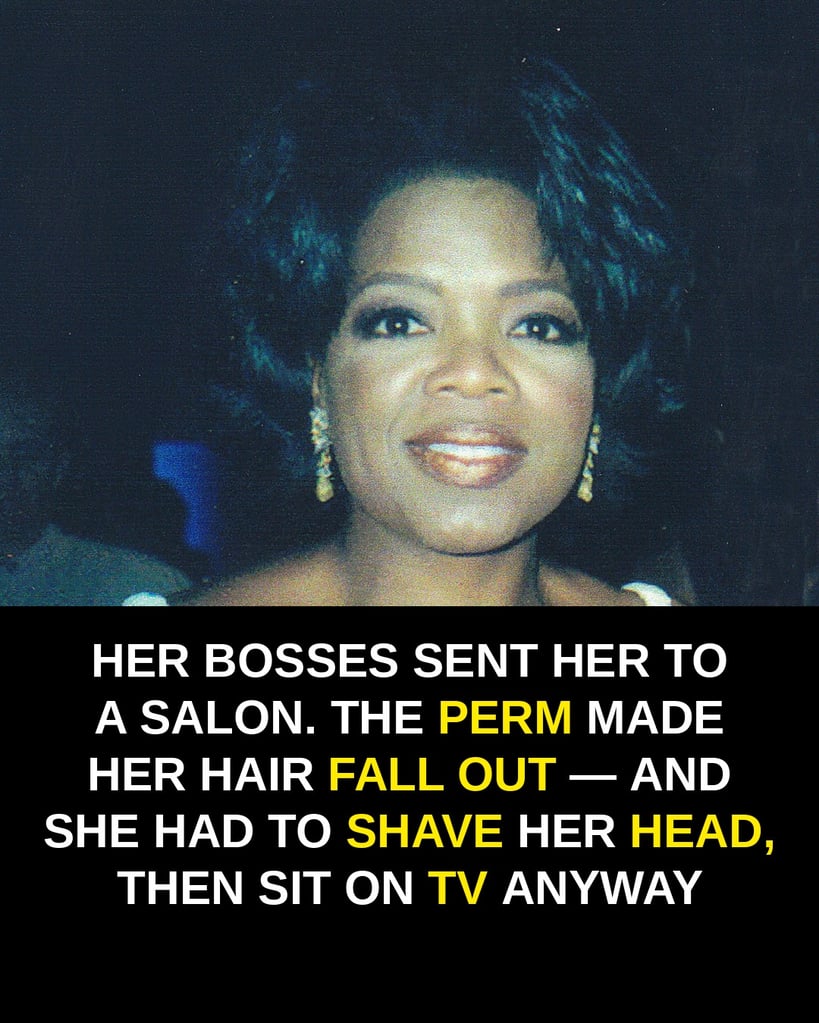
Before the book club, before the network, before the name became a verb — a young TV reporter in Baltimore was told her look wasn’t right. The fix they sent her for destroyed her hair in a matter of days.
Oprah Winfrey has told this story herself, in her own words, from one of the biggest stages in the world: her 2008 commencement address at Stanford University. And because this page checks before it posts, we’re telling it the way she dated it — because the viral versions get the decade wrong and hand the rescue to the wrong man.
1976, Baltimore — “they sent me to a salon”
This was not the Chicago era. It was 1976, early in her television career in Baltimore, and her bosses did not like how she looked. In her Stanford telling: “they sent me to a salon where they gave me a perm, and after a few days all my hair fell out and I had to shave my head.”
Then the line that lands like a headline all by itself: “now I am black and bald and sitting on TV.”
In later retellings she called it a French perm, said she was bald within a week, and said Lydia Lively took her to a barbershop to chop off whatever was left. Sit with that for a second. A young Black woman, at the very start of a career spent in front of cameras, loses all of her hair because the people in charge wanted her to look like somebody else — and then has to sit down in front of those cameras anyway.
She did. She kept the job, kept the face, kept going — bald head and all.
Where Andre Walker actually comes in
The viral version of this story usually ends with “and then Andre Walker saved her hair in the late 1980s.” That’s two true things welded into one wrong one.
Andre Walker is real, and his chapter is remarkable: he became her stylist in the mid-1980s and stayed for roughly 30 years, and he is credited with helping her keep her real hair healthy for decades. But he was not standing in that Baltimore barbershop in 1976. The perm disaster came nearly a decade before him.
There is a second bad-perm episode, and it’s the one that connects them. In her introduction to Walker’s book Andre Talks Hair, Oprah described a light perm that wasn’t rinsed out completely afterward — her hair came out in patches, and she shaved it down to a “teeny weeny Afro.” Her verdict on that stretch of her hair life was three words: “Until I met Andre.”
So the accurate story is better than the viral one. Not one rescue — a pattern. Chemicals forced on her by other people’s standards kept taking her hair; the man who finally protected it arrived later and stayed for thirty years.
Why this one lands on a natural hair page
Swap the TV station for an office, a school, a family photo, a job interview — the instruction sounds familiar to almost every woman reading this: your hair, as it grows, is a problem we need to fix. Oprah’s fix cost her every strand she had. Twice.
And the woman who got told her look was wrong in 1976 became the most famous head of hair on television — on her own terms, with her own stylist, keeping her own hair. The bosses got their broadcast. She got the last word, about thirty years of it.
Join the conversation
Has a job, a school, or a dress code ever sent YOU to “fix” your hair — and did the fix cost you more than the hair? And be honest: would you have sat down in front of those cameras bald, the way she did? Tell us below.
Source note: The 1976 Baltimore account — bosses disliking her look, the salon perm, hair falling out within days, the shaved head, and the line “now I am black and bald and sitting on TV” — is Oprah Winfrey’s own telling in her Stanford University commencement address, June 15, 2008. The “French perm,” bald-within-a-week detail and the barbershop trip with Lydia Lively come from her later retelling in a Glamour interview as reported by EURweb. Andre Walker’s role — her stylist from the mid-1980s for roughly 30 years, credited with helping her keep her real hair — is a separate later chapter; he did not rescue the 1976 perm. The second perm episode (incompletely rinsed, hair out in patches, “teeny weeny Afro,” “Until I met Andre”) is from her introduction to Andre Talks Hair (1997), as quoted in Walker’s biography. Claims dating the perm disaster to the late 1980s are incorrect.

