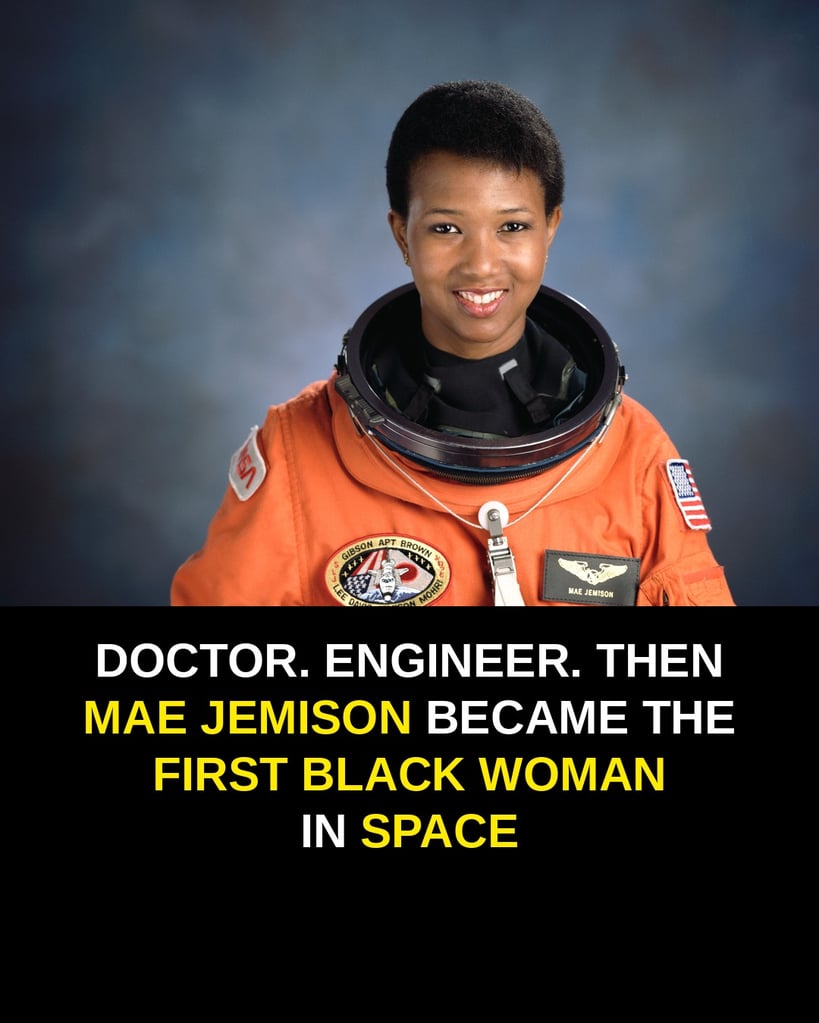
Most astronauts have one résumé. Mae Jemison had about four — and every single one of them had to be excellent before NASA ever let her near a launchpad.
On September 12, 1992, the space shuttle Endeavour lifted off on mission STS-47. Aboard was mission specialist Dr. Mae Jemison: physician, chemical engineer, former Peace Corps medical officer. When the shuttle reached orbit, she became the first Black woman in space. By the time Endeavour landed on September 20, she had logged 190 hours and 30 minutes beyond the Earth’s atmosphere.
Three careers before NASA
Jemison’s path did not start with a telescope. It started with degrees and work most people would call a finish line. She trained as a chemical engineer, then went on to become a medical doctor. She served as a Peace Corps medical officer from 1983 to 1985, carrying responsibility for the health of volunteers in Africa — real medicine, in real conditions, far from any spotlight.
Only then came NASA. She was selected as an astronaut candidate in 1987, joining a corps that had never flown a Black woman. Five years later, she flew.
Precision matters on this page, so here it is: Jemison was the first Black woman in space. The first Black American in space was Guion Bluford, who flew aboard Challenger on STS-8 in 1983. Both firsts are historic. Hers opened a door that had stayed shut for nearly a decade after his.
What 190 hours actually means
A week in orbit sounds brief until you picture the work. STS-47 was a science mission — experiments running around the clock, systems to monitor, a crew depending on every specialist doing exactly their job in an environment where a small mistake has no small consequences. Jemison wasn’t a passenger on a milestone flight. She was a working scientist on a working mission, who happened to also be making history simply by being assigned to it.
That combination — brilliance first, symbolism second — is exactly why her story keeps being told to little girls. She did not get to space by being an exception to the standard. She got there by clearing standards most people never attempt once, in field after field after field.
The door she left open
Every Black girl who has ever been handed a telescope, a microscope, or a “girls can’t do that” now has a name to answer with. Doctor. Engineer. Peace Corps officer. Astronaut. Jemison stacked the credentials so high that when the door finally opened, nobody could argue about whether she belonged on the other side of it.
She didn’t just go to space. She made “first Black woman in space” a sentence with her name permanently inside it.
Join the conversation
Were you watching in 1992 — or did you learn Mae Jemison’s name later? And which part of her résumé stuns you most: the medicine, the engineering, or the orbit? Tell us below.
Source note: Mae Jemison’s flight as mission specialist on STS-47 aboard Endeavour (September 12–20, 1992), her 190 hours 30 minutes in space, and her status as the first Black woman in space are from the NASA mission record as reported by Space.com and museum profiles (Intrepid Museum; Liberty Science Center). Her background as a physician and chemical engineer, Peace Corps medical service (1983–85), and 1987 NASA selection are from the same profiles. Guion Bluford’s 1983 STS-8 flight as the first Black American in space is noted to keep the two distinct firsts separate.