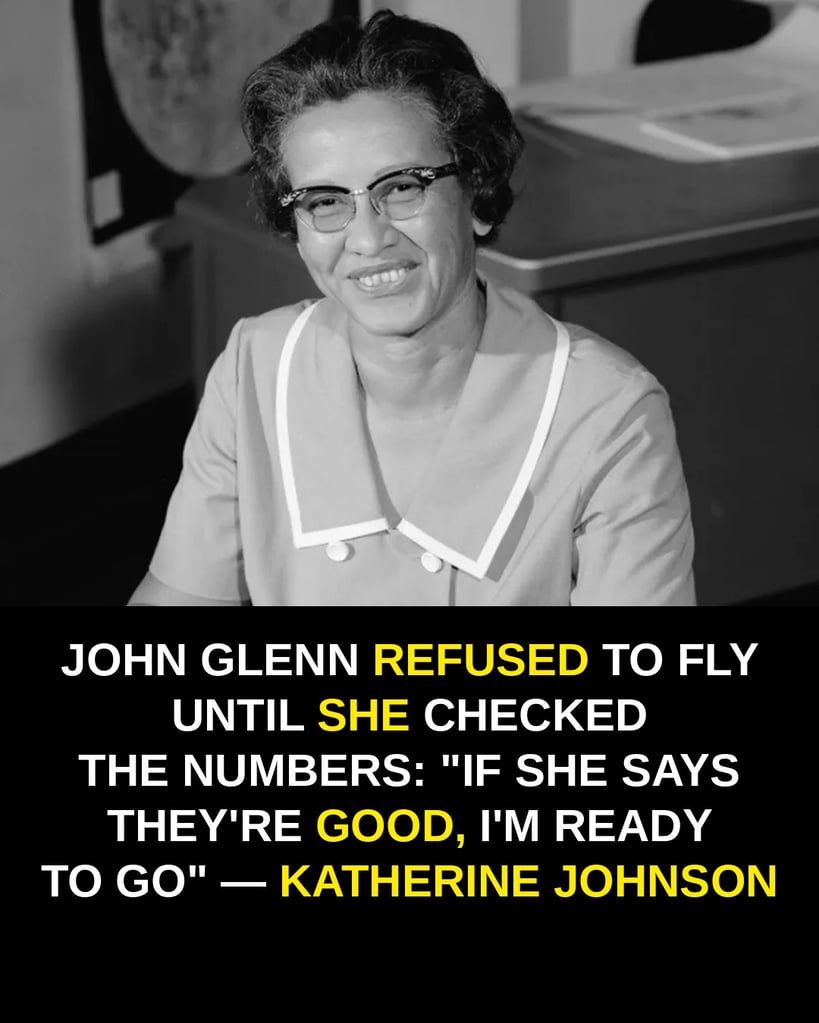
The computers had already done the math. The most famous astronaut in America still wouldn’t get in the capsule — not until a Black woman from the segregated computing pool checked the numbers by hand and said they were good.
The mission was Friendship 7, February 20, 1962: John Glenn’s flight to become the first American to orbit the Earth. NASA had programmed the orbital equations into its new IBM computers — a leap forward, and exactly the problem. The astronauts deeply distrusted the machines, which were, as NASA’s own biography puts it, “prone to hiccups and blackouts.” Glenn wanted a human being he trusted between him and the math his life depended on.
So, as part of the preflight checklist, Glenn asked the engineers to “get the girl.”
The girl was Katherine Johnson
“The girl” was Katherine Johnson — a mathematician who had started her NASA career at Langley in the segregated West Area Computing unit, where Black women computers did the agency’s calculations under Jim Crow rules, in a separate room, with separate bathrooms. Johnson had already built a reputation: she had co-authored trajectory work and run the numbers for Alan Shepard’s first American spaceflight in 1961.
For Glenn’s flight, she sat down with her desktop mechanical calculating machine and ran the same orbital equations the IBM had produced — by hand, number by number. As Johnson herself recalled Glenn’s instruction: “If she says they’re good, then I’m ready to go.”
Her numbers matched the computer’s. Glenn flew. Friendship 7 circled the Earth three times, and the man who wouldn’t fly on a machine’s word came home safely on Katherine Johnson’s.
Thirty-three years, one medal, and a name restored
Johnson retired in 1986 after 33 years at NASA — decades in which her calculations underwrote mission after mission while history mostly spelled other people’s names. The restoration, when it came, was official: in 2015, President Obama awarded her the Presidential Medal of Freedom, the nation’s highest civilian honor.
There is a reason this page keeps her story in rotation. Katherine Johnson’s genius was never hidden because it was small. It was hidden because of which room she’d been assigned to work in. John Glenn, to his eternal credit, knew exactly which room the real numbers lived in — and on the most important morning of his life, he asked for her by the only name the era allowed him to use for her, and staked his life on her answer.
Join the conversation
Be honest — before Hidden Figures, did you know the computers had a backup, and her name was Katherine Johnson? And whose hand-checked work does YOUR life quietly depend on every day? Tell us below.
Source note: John Glenn’s request to “get the girl,” Katherine Johnson’s hand-running of the Friendship 7 orbital equations on her desktop mechanical calculating machine, and Glenn’s recalled words — “If she says they’re good, then I’m ready to go” — are from NASA’s official Katherine Johnson biography by Margot Lee Shetterly (nasa.gov), including the astronauts’ distrust of computers “prone to hiccups and blackouts.” Johnson’s start in Langley’s segregated West Area Computing unit, her 1986 retirement after 33 years, and her 2015 Presidential Medal of Freedom are likewise from the NASA biography, corroborated by the Computer History Museum profile. Glenn’s Friendship 7 flight took place on February 20, 1962.