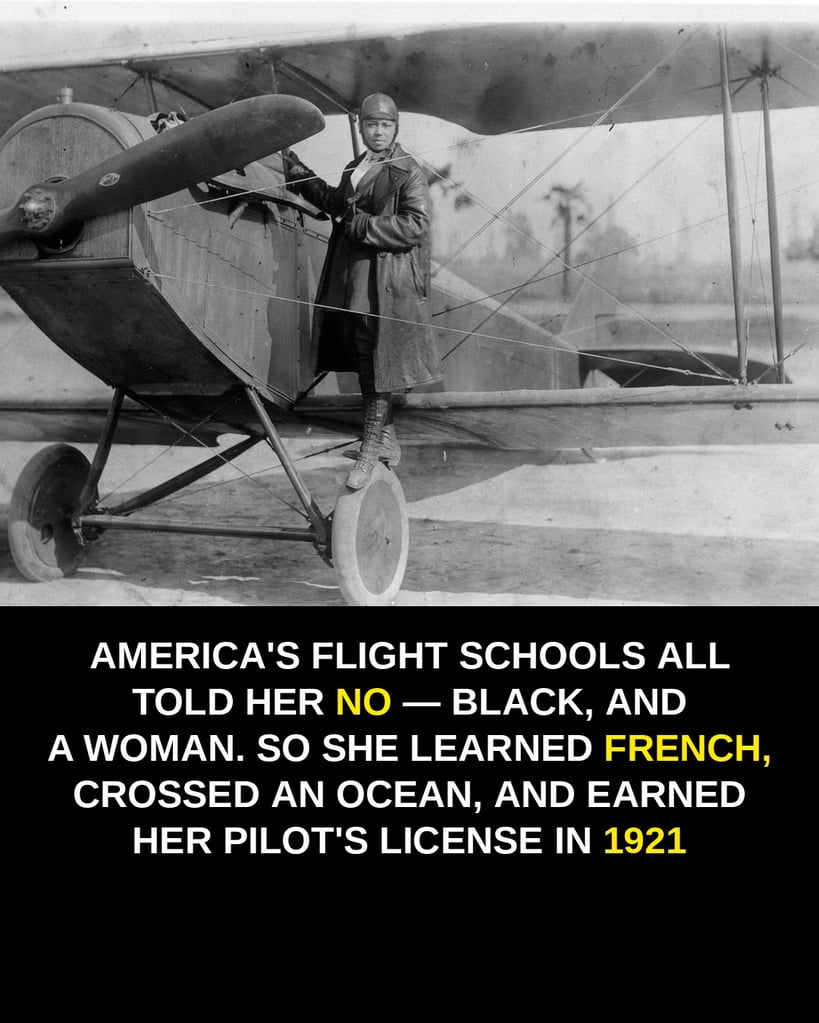
Every flight school in America had the same answer for her: no. They said it because she was Black, and they said it because she was a woman — so Bessie Coleman did something more audacious than arguing. She learned a new language and left the country that refused her, to come back with what it wouldn’t give her.
Bessie Coleman was born January 26, 1892. By the time she set her mind on flying, aviation was barely older than she was — and its American gatekeepers were certain about who belonged in a cockpit. Flight schools in the United States would not train her. Not one she could secure. The doors weren’t locked with a single key; they were locked with two — her race and her gender — and no amount of talent presented at the window changed either answer.
Most people stop at a wall like that. Coleman treated it as a routing problem.
Step one: learn French. Step two: France.
On the advice she took from Robert Abbott, the influential Black newspaper publisher, Coleman studied French at night — a working woman adding a foreign language to her life for one purpose: France trained pilots without the American refusals, and she intended to be one of them.
She crossed the Atlantic and trained at the Caudron Brothers School in Le Crotoy, France. On June 15, 1921, the Fédération Aéronautique Internationale issued her a pilot’s license — making her the first African American woman to earn one, and, as the Smithsonian notes, the first woman of Native American descent to hold one as well.
France gave her the paper America wouldn’t. Then America had to watch her use it.
September 1921: she came home a barnstormer with a mission

Coleman returned to the United States in September 1921 as a licensed pilot in a country that had produced zero schools willing to teach her. She became a barnstormer — one of the daredevil exhibition pilots who performed loops and feats at airshows, the era’s way of building fame in the sky.
But the license was never just for her. Coleman’s stated ambition ran past her own cockpit: she was working toward opening a flying school for African Americans — building, with her own hands, the exact door that had been slammed in her face. She died on April 30, 1926, at just 34, still working in that direction.
The plan outlived the pilot. Every Black aviator who trained in America after her — every Tuskegee Airman, every captain, every astronaut — trained downstream of the woman who had to learn French to get her wings.
Why this one lives on a natural hair page
Because the Coleman method is this page’s philosophy in an airplane: when the standard says your kind doesn’t belong here, you do not shrink to fit the standard. You expand — a language, an ocean, a whole other country’s sky — and come back credentialed beyond argument.
Join the conversation
Be honest: which part of her story stops you coldest — that America made her leave, or that she bothered to come back and open the door for others? And what’s the “learn French” move in YOUR life — the extra thing you did when the first door said no? Below. 👇
Source note: Bessie Coleman’s dates (January 26, 1892 – April 30, 1926), her inability to secure flight training in the United States because of race and gender, her move to France and training at the Caudron Brothers School in Le Crotoy, and her June 15, 1921 Fédération Aéronautique Internationale license — the first issued to an African American woman, and the first to a woman of Native American descent — are from the Smithsonian Institution / National Air and Space Museum and Smithsonian Magazine (January 21, 2022). Her September 1921 return as a barnstormer and her goal of opening a flying school for African Americans are from the Smithsonian and the National Women’s History Museum biography; her night French classes on Robert Abbott’s advice are from the National Women’s History Museum biography via AOPA centennial coverage.
Tell us in the comments below - we read every single one, and the best takes get featured.