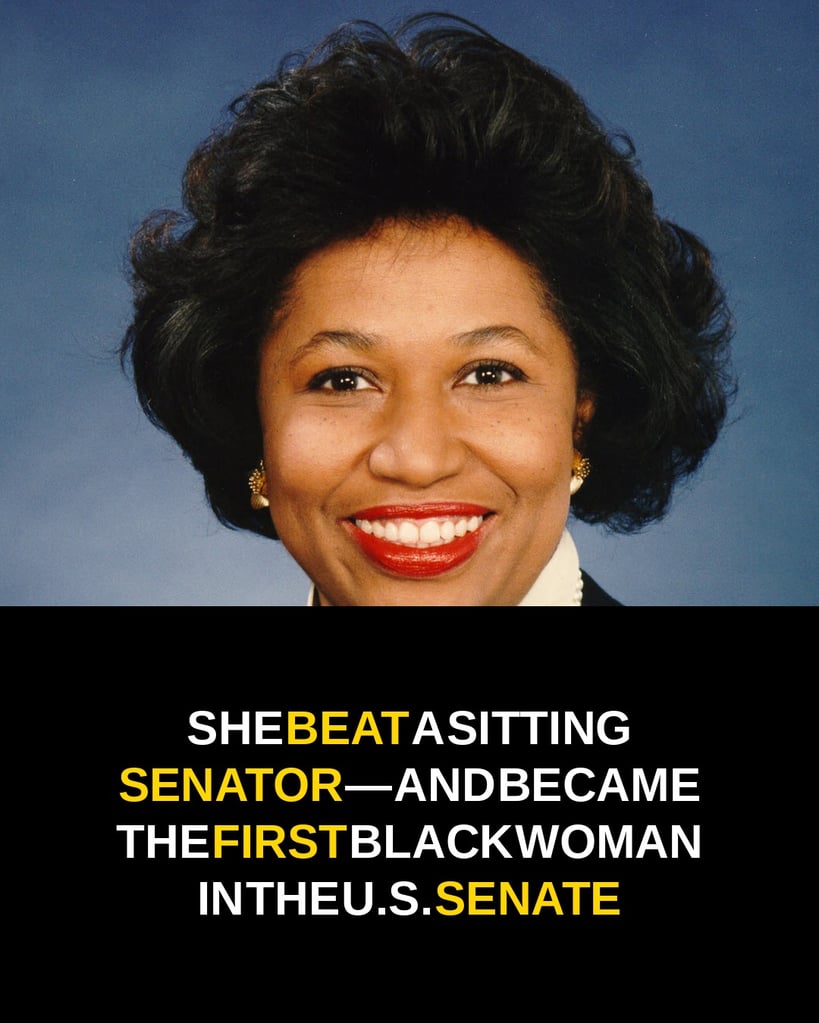
To make history, she first had to beat somebody who was already holding the seat. On November 3, 1992, Carol Moseley Braun was elected to the United States Senate from Illinois — the first Black woman ever elected to the Senate in American history. And she didn’t inherit the seat. She took it, primary first.
Understand what the triple first means, because each part of it is its own wall. She was the first Black woman ever elected to the U.S. Senate. She was the first woman senator from Illinois. And she was the first Black Democrat in the Senate. Three different doors, each closed for the entire life of the institution, all opened by one election.
And the road there ran through an incumbent. Braun first defeated sitting Senator Alan Dixon in the Democratic primary — beating a man who already held the job, from inside his own party — before winning the seat in November. Firsts that arrive by appointment or by accident can be argued with. Hers arrived the hardest way there is: she out-campaigned the sitting senator, then won the general.
The fight she picked in 1993
Once seated, she showed the country what she was there for. In 1993, Moseley Braun led the floor fight that defeated renewal of the federal design patent for the United Daughters of the Confederacy insignia — taking on, on the Senate floor, a piece of the Confederacy’s official symbolism that the government had been quietly renewing, and beating it.
That fight tells you the shape of the whole career. Getting elected as a first is about breaking a barrier. What you do in the room afterward is the point of breaking it. On the floor of the Senate, in her first year, the first Black woman senator stood up and argued that the United States government should stop renewing a Confederate organization’s design patent — and she won.

The service that followed
Her career didn’t end at the Senate door she opened. She later served as U.S. Ambassador to New Zealand and Samoa, from 1999 to 2001 — representing the country abroad, a generation’s distance from the institution that had never seated anyone like her.
Every Black woman who has served in the Senate since walks through the opening dated November 3, 1992. Somebody had to be first, and first had to beat an incumbent to do it. It was Carol Moseley Braun.
Join the conversation
Did YOU know the first Black woman senator had to beat a sitting senator in a primary to get there? And which of her three firsts do you think mattered most — the Senate first, the Illinois first, or the fight she picked once she was in the room? Tell us below.
Source note: Carol Moseley Braun’s record — elected to the U.S. Senate from Illinois on November 3, 1992 as the first Black woman ever elected to the Senate, the first woman senator from Illinois, and the first Black Democrat in the Senate, after defeating incumbent Senator Alan Dixon in the Democratic primary; her 1993 floor fight defeating renewal of the federal design patent for the United Daughters of the Confederacy insignia; and her later service as U.S. Ambassador to New Zealand and Samoa (1999–2001) — is from the U.S. Senate historical record, via NPR/WCMU memoir coverage and BlackPast/Encyclopedia references.
Tell us in the comments below - we read every single one, and the best takes get featured.