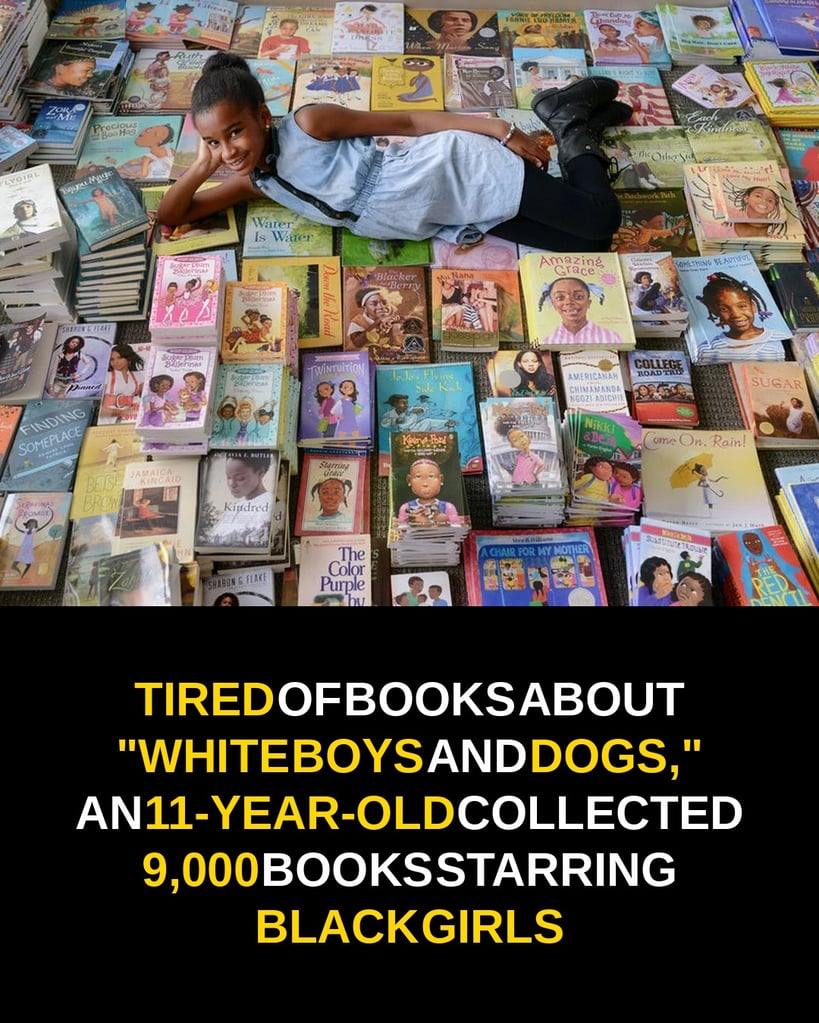
She did the math on her own bookshelf and didn’t like the answer. In November 2015, Marley Dias, 11, of West Orange, New Jersey, complained to her mother that all her assigned school reading was the same story over and over — in her words, books about white boys and their dogs. There was no freedom, she said, to read about someone like her. So she decided to collect the books herself. A thousand of them.
The campaign was called #1000BlackGirlBooks, and it had a precise definition: collect 1,000 books in which Black girls are the main characters — not the sidekick, not the lesson, the main character — and donate them to other schools, so other girls could find themselves on the page too.
She was in sixth grade.
The goal fell in weeks
She passed the goal within weeks. Within a few months, she had collected more than 9,000 books. Nine times the target, from a sixth grader’s complaint at the kitchen table — because the complaint turned out to be shared by thousands of people who had been waiting for somebody to organize it. Teachers, parents, librarians, strangers: the books poured in once an 11-year-old gave the frustration a name and a number.
Read the mechanism, because it’s the same one in every story on this page. She didn’t write an essay about the problem and stop. She set a countable goal, aimed it at other children’s shelves, and let the country’s quiet agreement do the heavy lifting.
What came after the books
The collecting was the beginning, not the whole story. Dias went on to edit Marley Mag for Elle.com — interviewing Misty Copeland, Ava DuVernay and Hillary Clinton, an eleven-turned-teen editor questioning some of the most powerful women in the country. She won Smithsonian Magazine’s 2017 American Ingenuity Award in the Youth category. And in 2018 she published her own book, Marley Dias Gets It Done — the girl who couldn’t find books about Black girls, on the shelf, as an author, about getting it done.

Somewhere in a school library tonight there is a book with a Black girl on the cover that arrived because an 11-year-old counted what was missing and refused to accept the count. That’s not a book drive. That’s a library corrected.
Her definition did quiet, important work, too. “Books in which Black girls are the main characters” is a standard anyone can apply — a donor can check it in a bookstore, a librarian can shelve by it, a parent can ask for it by name. That’s a large part of why the campaign scaled the way it did: an 11-year-old didn’t just voice a complaint, she wrote a specification the whole country could fulfill, one verified book at a time. Frustration is common. A countable, checkable goal is leadership.
Join the conversation
Be honest: when YOU were in school, how many books were you assigned with a Black girl as the main character? And what would you hand an 11-year-old today who counts what’s missing the way Marley did? Tell us below.
Source note: Marley Dias’s account — her November 2015 complaint to her mother, at 11 in West Orange, New Jersey, that her assigned school reading was, in her words, books about white boys and their dogs, with no freedom to read about someone like her; launching #1000BlackGirlBooks in sixth grade to collect 1,000 books with Black girls as main characters, to donate to other schools; passing the goal within weeks and collecting more than 9,000 books within a few months; editing Marley Mag for Elle.com, interviewing Misty Copeland, Ava DuVernay and Hillary Clinton; winning Smithsonian Magazine’s 2017 American Ingenuity Award in the Youth category; and publishing Marley Dias Gets It Done in 2018 — is from NPR’s original reporting (January 2016), Smithsonian Magazine, and Elle. Later lifetime collection counts run higher; this article prints the early reporting’s “more than 9,000 within a few months.”
Tell us in the comments below - we read every single one, and the best takes get featured.