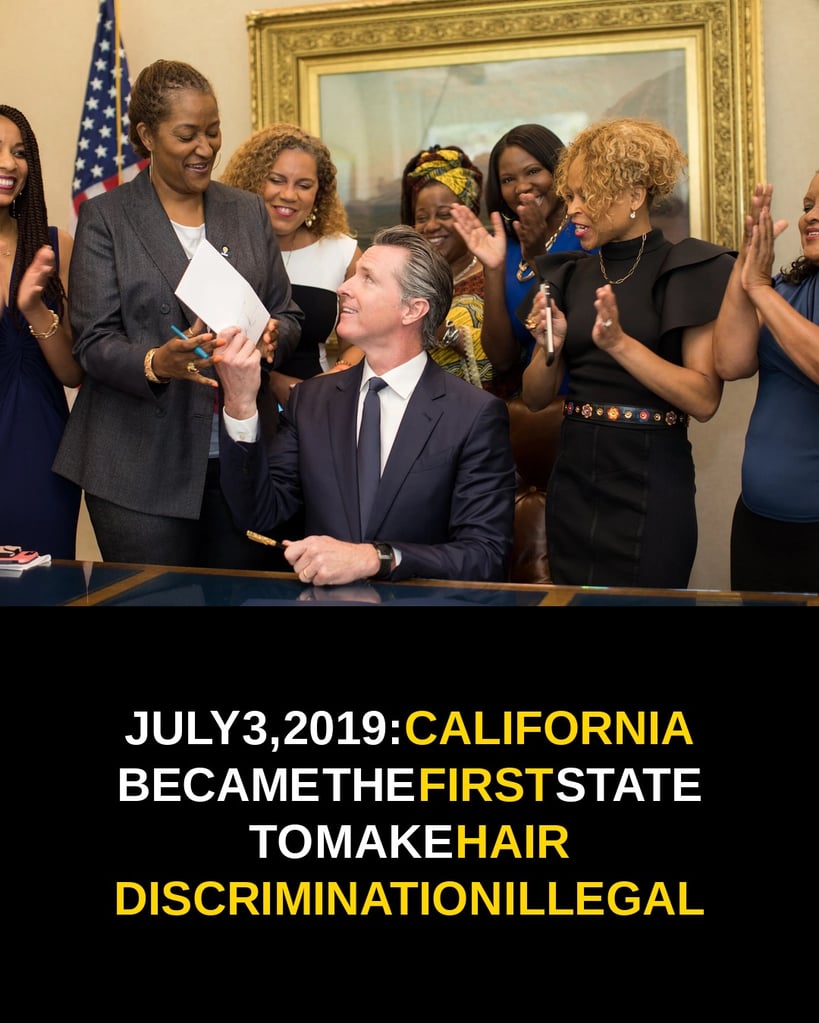
Write the date down, because this page exists partly because of it: July 3, 2019. On that day, California became the first state in America to make hair discrimination illegal — writing into law that race includes hair texture and the protective styles our people have worn for centuries. The bill passed both chambers of the Legislature without a single vote against it.
The law is the CROWN Act — Creating a Respectful and Open Workplace for Natural Hair. Senate Bill 188, authored by State Senator Holly Mitchell of Los Angeles, was signed by Governor Gavin Newsom on July 3, 2019, and took effect on January 1, 2020.
What the words on the page actually do
Laws live in their definitions, and this one’s definition is the whole victory. The CROWN Act amended California’s Fair Employment and Housing Act and its Education Code to state that race includes traits historically associated with race — naming hair texture and protective hairstyles such as braids, twists and locks.
Understand why that sentence matters. Every hair fight on this page — every student sent home, every employee told her braids or locs were “unprofessional,” every policy written to land on one kind of head — survived on a legal shrug: it’s not about race, it’s about hair. SB 188 closed that shrug in California law. Hair texture and protective styles are, by statute, part of what race means. An employer or a school that polices them is policing race, and the law now says so in writing.
Mitchell framed the law as being about “inclusion, pride and choice” — three words that could be stitched over every salon door in the state.

The wave it started
California was first, but it was not last, and the speed of what followed tells you how ready the country was. New York followed nine days later. Since then, more than two dozen states have enacted CROWN Act laws of their own. The federal CROWN Act has passed the U.S. House — it has not passed the Senate, and this page prints that plainly, because the job isn’t finished and pretending otherwise helps nobody.
But look at the shape of the thing. One state senator wrote a definition. One governor signed it on July 3, 2019. Unanimously passed, state after state since — the map is still filling in. Every child who walks into a California school with braids, twists or locs today does so behind a line of statutory text that did not exist before that date. That’s what a law is for.
Join the conversation
Does YOUR state have a CROWN Act yet — and be honest, have you or your kids ever been told your braids, twists or locs weren’t “professional” or “appropriate”? Should the federal law have passed by now? Tell us below.
Source note: The California CROWN Act account — the CROWN Act (Creating a Respectful and Open Workplace for Natural Hair), Senate Bill 188 authored by State Senator Holly Mitchell of Los Angeles, signed by Governor Gavin Newsom on July 3, 2019 and effective January 1, 2020; its amendment of the Fair Employment and Housing Act and Education Code to state that race includes traits historically associated with race, including hair texture and protective hairstyles such as braids, twists and locks, making California the first state to ban hair discrimination in workplaces and schools; its unanimous passage in both chambers; New York following nine days later; more than two dozen states having since enacted CROWN Act laws; the federal CROWN Act having passed the U.S. House but not the Senate; and Mitchell’s framing of the law as about “inclusion, pride and choice” — is from the California SB 188 text and signing coverage (July 3, 2019) and CROWN Coalition state tracking. The state count is stated as “more than two dozen” per the Coalition’s tracking.
Tell us in the comments below - we read every single one, and the best takes get featured.