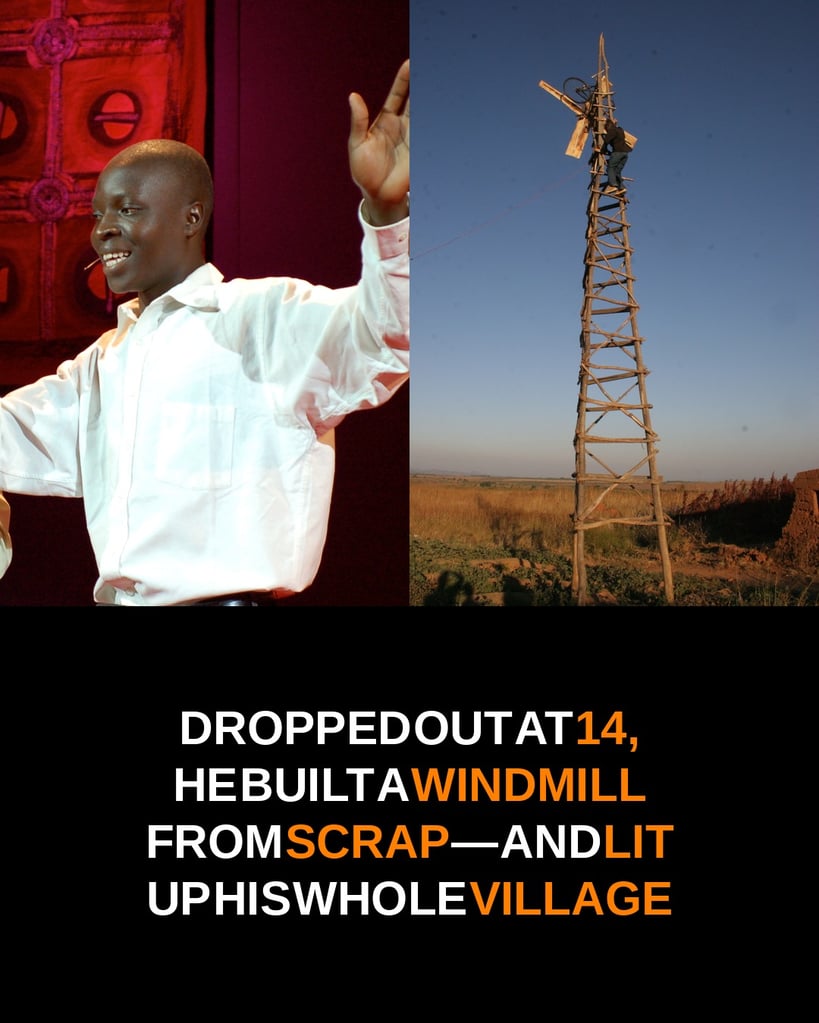
The school fees were about $80. His family didn’t have them — famine had seen to that — so at 14, William Kamkwamba of Wimbe, Malawi was out of school, watching his education end over a sum smaller than a grocery run. What he did next started in a library, with a borrowed textbook and a boy who refused to accept that learning was over.
Malawi’s famine of 2001–02 hit farming families like the Kamkwambas with everything at once: hunger, empty pockets, and choices no family should have to make. William’s was school. He left the classroom — but he kept walking to the library, where a textbook called Using Energy showed him pictures of windmills: machines that could pump water and generate power out of wind and scrap.
So he scavenged. Blue gum tree poles for the tower. A bicycle frame. A tractor fan for the blades. In 2002, the village watched a school dropout raise a windmill out of junk — and switch on four light bulbs and two radios in the family home, powered by nothing but wind and a 14-year-old’s refusal.
The boy who harnessed the wind
A later, larger windmill pumped water for irrigation — the difference, in a farming village, between watching crops fail and watering them yourself. And the story began to travel the way true stories do. William told it at TEDGlobal in 2007, standing on a global stage as the famine dropout who built a power station from a scrapyard.
He co-wrote the memoir The Boy Who Harnessed the Wind in 2009 — the title this page borrows with respect — which later became a Netflix film. And the education that $80 once ended? He finished it on his own terms, graduating from Dartmouth College in 2014.

Hold the pieces together and the shape of it is almost unfair: the boy priced out of school at $80 became an author, a filmmaker’s subject, a TED speaker and an Ivy League graduate. Nothing about his ability changed in 2002. Only the door did — so he built his own door, out of a bicycle frame and a tractor fan, and climbed a blue gum tower to hang it.
There is a discipline in this story that deserves its own paragraph, because it is the part a young reader can actually copy. William didn’t wait for a sponsor, a program or permission. He used the one institution still open to him — the library — and a textbook meant for somebody else’s classroom, and he treated scrap the way engineers treat inventory: a bicycle frame is a structure, a tractor fan is a blade set, a blue gum pole is a tower. The windmill that resulted powered four bulbs and two radios, and the bigger one behind it pumped irrigation water. Every piece of it was already lying around his village. The only missing ingredient had been a boy who believed the pieces were his to assemble.
Join the conversation
Eighty dollars ended his schooling — a borrowed library book restarted it. What could the young people in YOUR family build if we put tools and books in their hands instead of limits? And had you heard William Kamkwamba’s name before the film? Tell us below.
Source note: William Kamkwamba’s account — forced out of secondary school at 14 in Wimbe, Malawi, when the 2001–02 famine left his farming family unable to pay roughly $80 in school fees; teaching himself from the borrowed library textbook Using Energy; building a windmill in 2002 from scrap (blue gum tree poles, a bicycle frame, a tractor fan) that powered four light bulbs and two radios in the family home, with a later, larger windmill pumping water for irrigation; telling his story at TEDGlobal 2007; co-writing the memoir The Boy Who Harnessed the Wind (2009), later a Netflix film; and graduating from Dartmouth College in 2014 — is from TED, HarperCollins (the memoir), Dartmouth, and multiple agreeing profile sources.
Tell us in the comments below - we read every single one, and the best takes get featured.