
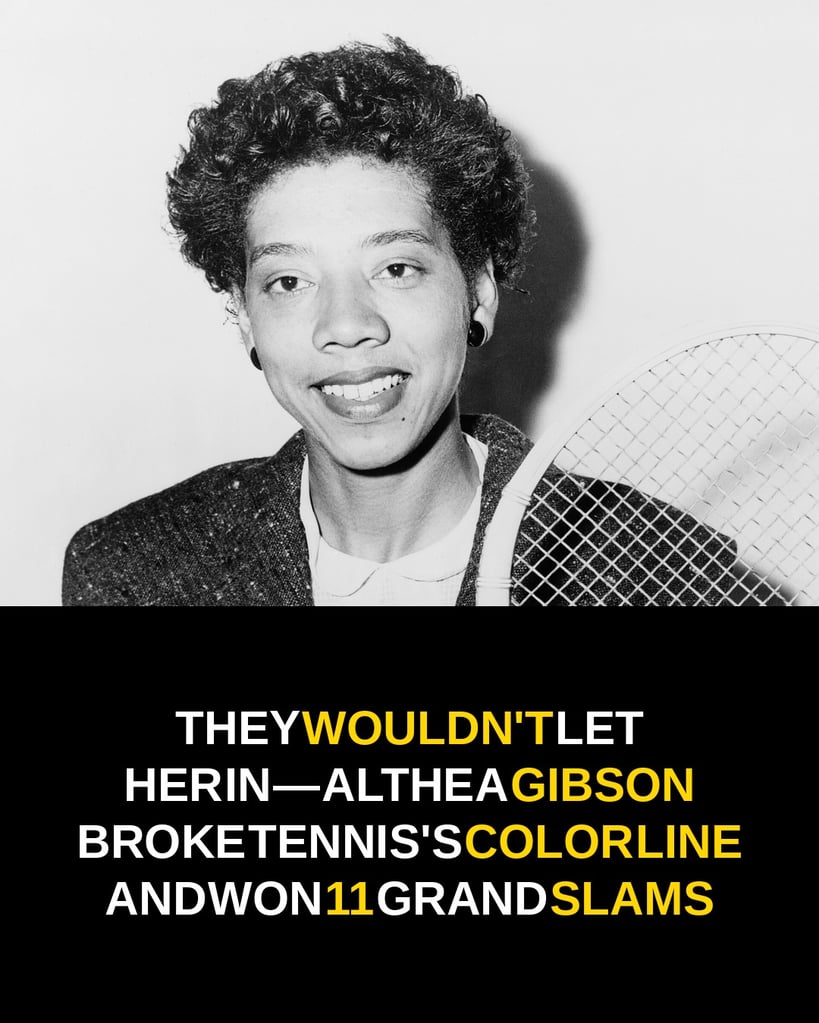
Before there was a door, there was a wall. Althea Gibson didn’t wait for tennis to open either one — she became the first Black player to compete at the U.S. Nationals in 1950, the first at Wimbledon in 1951, and then she started collecting the trophies the wall was built to keep from her: 11 Grand Slam titles before she was done.
Understand what “first to compete” really cost. The U.S. Nationals and Wimbledon were not tournaments that had forgotten to invite her; they were the guarded rooms of a whites-only sport. Gibson walked into both of them first — at Forest Hills in 1950 and at the All England Club in 1951 — carrying the particular loneliness of the pioneer, whose every match is also a referendum.
Then came the winning. In 1956 she won the French Championships singles title — the first Grand Slam title ever won by a Black player. In 1957 she won both Wimbledon and the U.S. Nationals singles titles. In 1958, she did it again — both of them, back to back, a reign. Her final count: 11 Grand Slam titles in all — 5 singles, 5 doubles, 1 mixed doubles.
Number one in the world, twice honored
She was the world No. 1 in 1957. And the Associated Press named her Female Athlete of the Year in 1957 and again in 1958 — the first Black woman ever so honored. Back-to-back, from the same press establishment, for the same woman the sport had kept out half a decade earlier. The wall didn’t just crack. The woman it excluded stood on top of the rankings looking down at it.
And because one barrier was apparently not enough for one lifetime, Gibson later broke another: she went on to play professional golf on the LPGA tour — a second whites-guarded sport, entered by the same woman who had already paid the pioneer’s price once and decided it was worth paying twice.
Every Black champion who has ever lifted a tennis trophy walked through the opening Althea Gibson cut in 1950 and widened in 1956, 1957 and 1958. She didn’t just win titles. She repossessed them — 11 of them — from a sport that had sworn she didn’t belong in the building.
The doubles record deserves its sentence too, because it reveals the completeness of the player the color line tried to keep out. Gibson’s 11 Grand Slam titles were not a singles streak padded by fame — they were 5 singles, 5 doubles and 1 mixed doubles, a champion in every format the sport offers, across the French Championships, Wimbledon and the U.S. Nationals. She was winning at the net and from the baseline, alone and in partnership, on clay and on grass. The establishment that barred her had claimed, in effect, that she didn’t belong at the highest level of the game. Her answer was to win at the highest level of the game in every way it can be won.
Join the conversation
Eleven Grand Slam titles. World No. 1. Athlete of the Year, twice — after being told she couldn’t even enter. Does Althea Gibson get her full measure of fame next to the champions who came after her? Tell us below.
Source note: Althea Gibson’s account — the first Black player to compete at the U.S. Nationals (1950) and at Wimbledon (1951); her 1956 French Championships singles title, the first Grand Slam title won by a Black player; her winning both the Wimbledon and U.S. Nationals singles titles in 1957 and again in 1958; her total of 11 Grand Slam titles (5 singles, 5 doubles, 1 mixed doubles); her world No. 1 ranking in 1957; her Associated Press Female Athlete of the Year honors in 1957 and 1958, the first Black woman so honored; and her later career as a professional golfer on the LPGA tour — is from the Library of Congress and International Tennis Hall of Fame coverage, the UCLA Arthur Ashe Legacy, and Tennis.com.

