
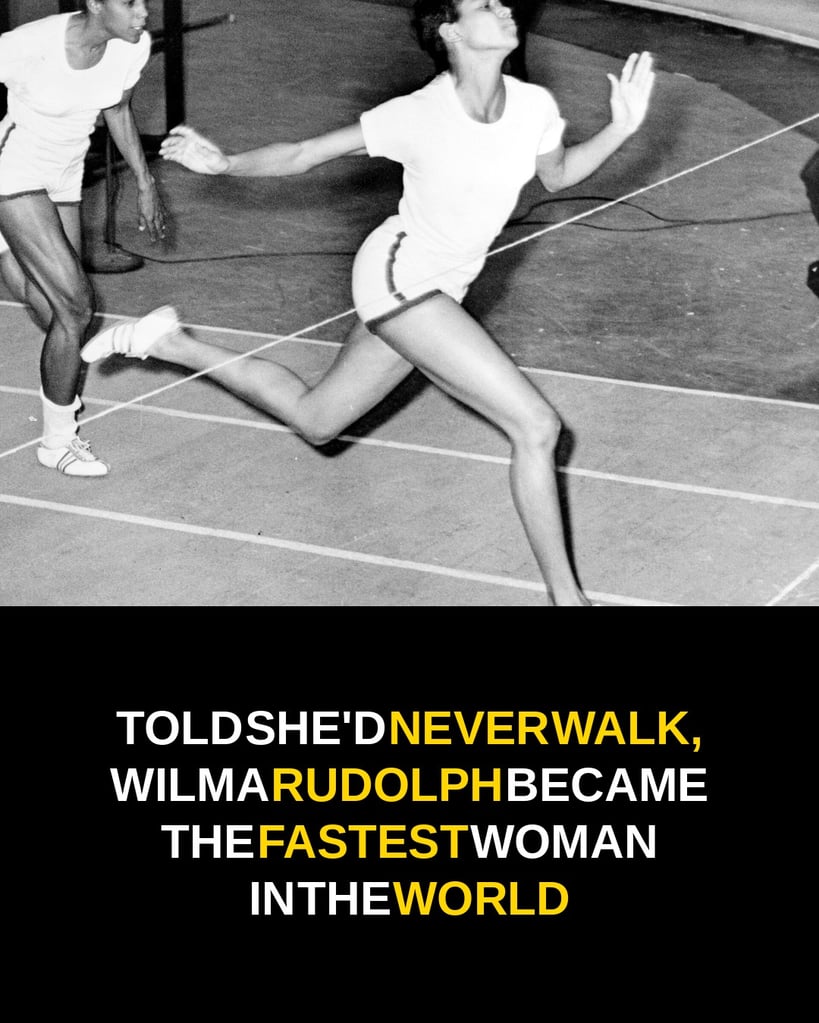
The sentence that raised her deserves to be printed exactly, in her own words: “My doctor told me I would never walk again. My mother told me I would. I believed my mother.” Wilma Rudolph — born premature at 4½ pounds in Tennessee in 1940, the 20th of 22 children — went from a metal leg brace to the title of fastest woman in the world. The doctor had the diagnosis. Her mother had the girl.
Pneumonia and scarlet fever came first, and then polio, which left Rudolph’s left leg weak. For years she wore a metal brace while her family waged the long campaign most history books skip: her mother drove her 50 miles each way to Nashville for treatment, and at home her siblings took turns massaging her leg. Twenty-two children in that house, and the family’s schedule bent around the little sister who couldn’t walk — because her mother had issued a ruling the whole family enforced: she would.
She walked without the brace by about age 12. By 16, she was at the 1956 Olympics, winning relay bronze — a girl who’d spent her childhood in a brace, standing on an Olympic podium before she could vote. And then came Rome.
Rome 1960: three golds
At the 1960 Rome Olympics, Wilma Rudolph won the 100 meters. She won the 200 meters. Then she anchored the 4×100-meter relay — recovering even a fumbled baton exchange — and won that too. Three gold medals at a single Games: the first American woman ever to win three track-and-field golds at one Olympics. The world crowned her the fastest woman alive, and the Italian press gave her the name that stuck to her grace: “La Gazzella Nera” — the Black Gazelle.
Hold the two pictures side by side, because they are the same girl. A child in a metal brace, being massaged by her brothers and sisters, 50 miles from the doctors who doubted her. And a woman in Rome with three gold medals, the planet’s fastest, while stadiums chanted. Between those pictures stands one decision, made by a mother in Tennessee, to believe her own report over the doctor’s — and a daughter who believed her mother.
Every family has a verdict it’s been handed about a child. Rudolph’s life is what happens when the family respectfully declines to accept it.
The relay gold is the one to study, because it contains her whole biography in ten seconds. Rudolph anchored the 4×100 in Rome — the last runner, the one who takes the baton with the race on her shoulders — and the exchange to her was fumbled. A runner with less nerve loses the medal in that stumble. Rudolph recovered the baton and won anyway, completing the first three-gold performance by an American woman at a single Games. A fumbled handoff, recovered at full speed, by a woman whose childhood had been one long lesson in recovering what her body dropped: it is hard to design a more fitting final scene for the girl from the brace.
Join the conversation
“My doctor told me I would never walk again. My mother told me I would. I believed my mother.” Whose word did YOU decide to believe about your own life — and who is the mother, grandmother or auntie still issuing rulings like that in your family? Tell us below.
Source note: Wilma Rudolph’s account — born prematurely (4½ pounds) in Tennessee in 1940, the 20th of 22 children; pneumonia, scarlet fever and then polio leaving her left leg weak; years in a metal brace while her mother drove her 50 miles each way to Nashville for treatment and her siblings took turns massaging her leg; her own words, “My doctor told me I would never walk again. My mother told me I would. I believed my mother”; walking without the brace by about age 12 (sources vary between 9 and 12, so “about 12” is printed); relay bronze at the 1956 Olympics at 16; and at Rome 1960 winning the 100m, 200m and 4×100m relay (anchoring it and recovering a fumbled baton exchange) as the first American woman to win three track-and-field golds at a single Games, crowned the fastest woman in the world and called “La Gazzella Nera” by the Italian press — is from NBC Sports/Olympics, the U.S. Olympic & Paralympic Museum, and the Smithsonian National Postal Museum.

