
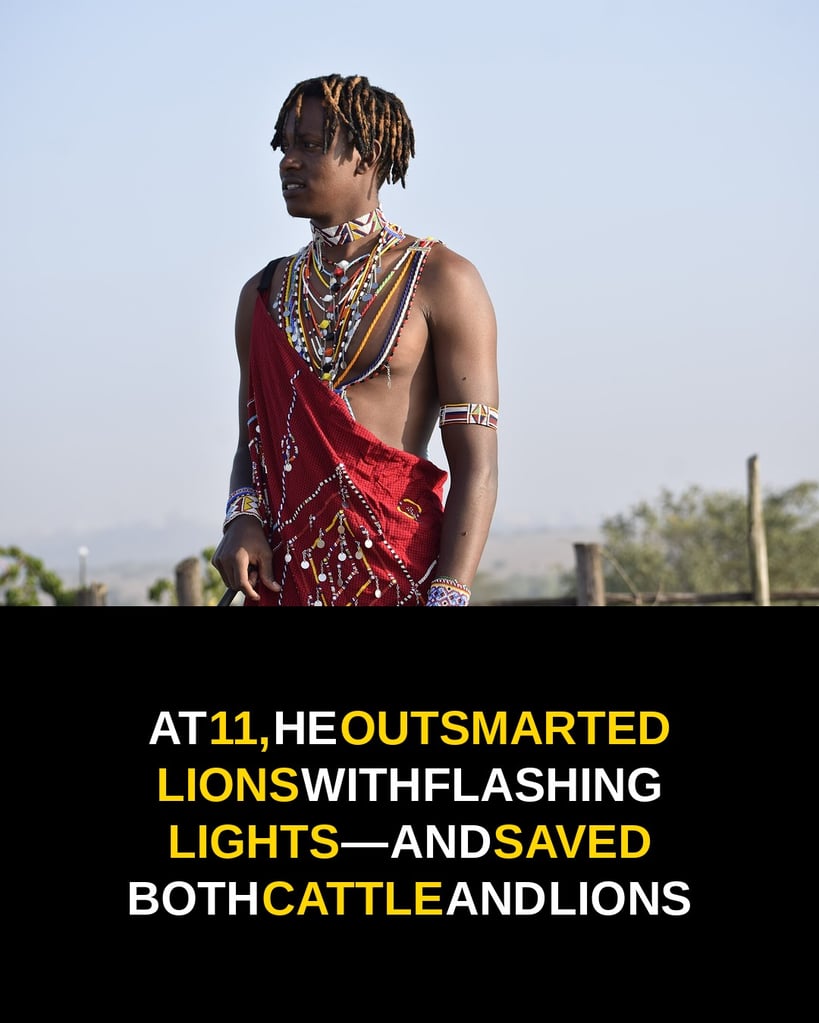
The lions came at night, and the boy in charge of the cattle was nine years old. Richard Turere, a Maasai boy in Kitengela, Kenya, on the edge of Nairobi National Park, kept losing his father’s animals in the dark — and every loss meant herders hunting lions in revenge. Fire didn’t work. Scarecrows didn’t work. Then, walking the enclosure one night with a flashlight, he noticed something: when he moved with the light, the lions stayed away. At 11, he turned that observation into an invention.
The problem had a rhythm every herder knew. Lions hunt cattle in the dark, when the kraal — the enclosure — is still. A stationary light is just scenery to a lion. But a moving light means a herder is awake, walking, watching. Turere’s insight was that the lions weren’t afraid of light. They were afraid of what the light announced.
So he built Lion Lights: LED bulbs on poles around the kraal, wired through a flasher unit to an old car battery charged by a solar panel, blinking in a sequence that reads, to a lion’s eyes, like a herder walking the fence line with a torch. The whole system cost under $10 to build.
No cattle lost — and no lions killed
After installation, his family lost no cattle. And here is the beat that makes this invention bigger than a clever gadget: it protected the lions too. Fewer cattle killed meant fewer lions speared in revenge. Conservation groups and neighboring herders took notice, and the system spread — to about 750 homesteads by around 2018, a boy’s fence-line idea standing guard across the region.
At 13, Turere told the story on the TED2013 stage — a Maasai schoolboy explaining predator psychology and solar wiring to the world’s technology elite. He won a scholarship to Brookhouse International School. And in 2023, he won the Young Inventors Prize at the European Inventor Award, a grown man still being honored for the lights he wired at 11.
Plenty of inventions solve the inventor’s problem. Turere’s solved his family’s problem, his neighbors’ problem, and the lions’ problem in the same circuit — for under ten dollars, out of a car battery and a boy’s attention to the dark. He didn’t outmuscle the lions. He out-observed them.
The elegance of the system is worth one more look, because it is why the invention spread. Lion Lights asked almost nothing of the families who adopted it: poles, LED bulbs, a flasher unit, an old car battery and a small solar panel — under $10 in parts, assembled from things a cattle-keeping community already has or can cheaply get. No grid, no subscription, no specialist. And the psychology it exploits is precise: lions don’t fear brightness, they fear the implication of brightness — a herder awake and moving. Turere learned that by walking his own kraal with a flashlight at 11 years old, watching the dark react. The TED2013 stage, the Brookhouse scholarship, the 2023 Young Inventors Prize at the European Inventor Award — all of it is decoration on a single act of attention by a child doing an adult’s job in the dark.
Join the conversation
Eleven years old. A solar panel, an old car battery, and blinking LEDs that saved cattle AND lions. What problem around YOUR home is waiting for a kid to look at it fresh? And had you heard of Lion Lights before today? Tell us below.
Source note: Richard Turere’s account — a Maasai boy in Kitengela, Kenya, on the edge of Nairobi National Park, put in charge of his father’s cattle at age 9 and losing animals to lions at night, after which herders hunted lions in revenge; fire and scarecrows failing; his noticing that lions stayed away when he walked the enclosure with a moving flashlight; building Lion Lights at 11 — LED bulbs on poles around the kraal, wired through a flasher unit to an old car battery charged by a solar panel, blinking in sequence; his family losing no cattle after installation; the system costing under $10 and spreading to about 750 homesteads (BBC figure, ~2018); his TED2013 talk at 13 and scholarship to Brookhouse International School; and his winning the Young Inventors Prize at the European Inventor Award in 2023 — is from UN Africa Renewal, CNN (February 2013), the BBC via Face2Face Africa, and the European Patent Office.