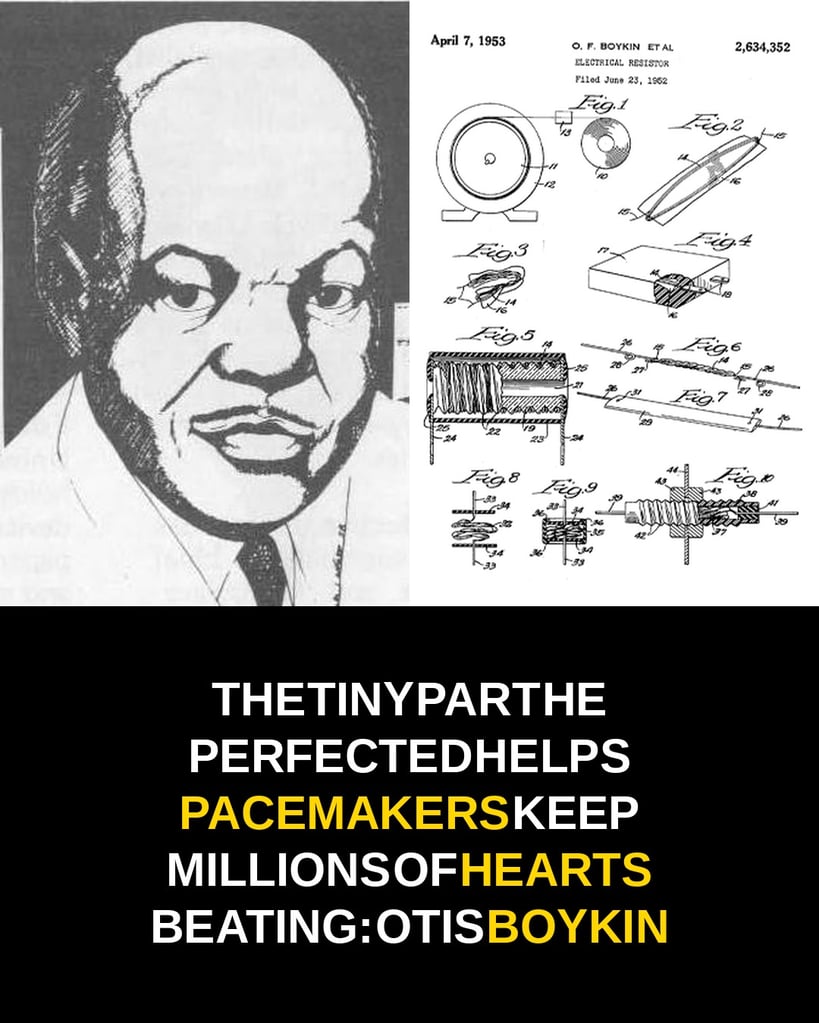
His invention was tiny, and that was the point. Otis Boykin built better resistors — the small components that control electric current — and, in the words this page will use carefully, his resistor technology helped make the pacemaker’s controls practical. That specific contribution — not a sole-inventor claim about the whole device — is what this story prints. What he did was real enough, and it is documented in his patents.
Otis Boykin was born on August 29, 1920, in Dallas, Texas. He was valedictorian of Booker T. Washington High School’s class of 1938, and he went on to Fisk University — but he had to leave college for work. That interrupted education is part of the record, not a footnote to hide. The patents that followed were earned by a man whose formal schooling had been cut short by necessity.
The patents tell the story
Boykin received his first patent on June 16, 1959 — a wire precision resistor, U.S. Patent 2,891,227. An improved resistor patent followed in 1961, U.S. Patent 2,972,726. Those numbers are not decoration. They are the paper trail: dated, filed, and in his own name.
What is a resistor for? In plain terms, it controls the flow of electric current inside a device. Make that control more precise and more reliable, and the devices built around it can become more precise and more reliable too. That is the honest bridge between Boykin’s work and medicine — not a slogan, a function.
Patent totals for Boykin conflict across sources, so here is this page’s rule: according to the National Inventors Hall of Fame, he held more than 25 patents. That figure is printed attributed, from that source, and no other total is printed here.
The pacemaker connection — stated exactly
The National Inventors Hall of Fame credits Boykin with developing a control unit for pacemakers in 1964. Stated precisely: his resistor technology helped make the implantable pacemaker’s control functions practical and reliable.
That sentence matters, because the viral version of this story often goes further and gives him sole credit for the whole device itself. This page will not print that version. A control unit is not the whole device, and helping make its controls practical is a serious, specific contribution that does not need inflating. Inflated claims are the ones that collapse under one hard question. The precise claim stands.
Think about what was at stake in that precision. A control function inside a medical device has to work the same way, reliably, again and again. Boykin’s life’s work was exactly that kind of reliability — current, controlled, measured, and dependable — first patented in 1959 and improved in 1961.
Recognition that came late
Boykin died in Chicago in March 1982. In 2014, he was inducted into the National Inventors Hall of Fame — recognition that arrived decades after his first patent and long after his death.
So the record, kept clean, is this: a valedictorian from Dallas who had to leave college for work, a first patent in 1959, an improved resistor in 1961, a pacemaker control unit credited in 1964, more than 25 patents according to the National Inventors Hall of Fame, and a Hall of Fame induction in 2014. No sole-inventor claim. No shortcuts. Just the work, in his name.
Join the conversation
Had you heard Otis Boykin’s name before today — and does the precise version, resistor and control unit, impress you more than the inflated one? Tell us below.
Source note: Otis Boykin’s story — Otis Boykin (August 29, 1920, Dallas, Texas – March 1982, Chicago), valedictorian of Booker T. Washington High School’s class of 1938 and a Fisk University student who had to leave college for work; his first patent on June 16, 1959, a wire precision resistor (U.S. Patent 2,891,227), followed by an improved resistor patent in 1961 (2,972,726); the National Inventors Hall of Fame crediting him with developing a control unit for pacemakers in 1964, with his resistor technology helping to make the implantable pacemaker’s control functions practical and reliable; the Hall’s figure of more than 25 patents, printed attributed because totals conflict across sources; his death in Chicago in March 1982, with no day printed because sources conflict; and his induction into the National Inventors Hall of Fame in 2014 — is from the National Inventors Hall of Fame, the Lemelson Center (MIT), APS News, and EBSCO. This piece prints only the locked framing: “his resistor technology helped make the pacemaker’s controls practical.”