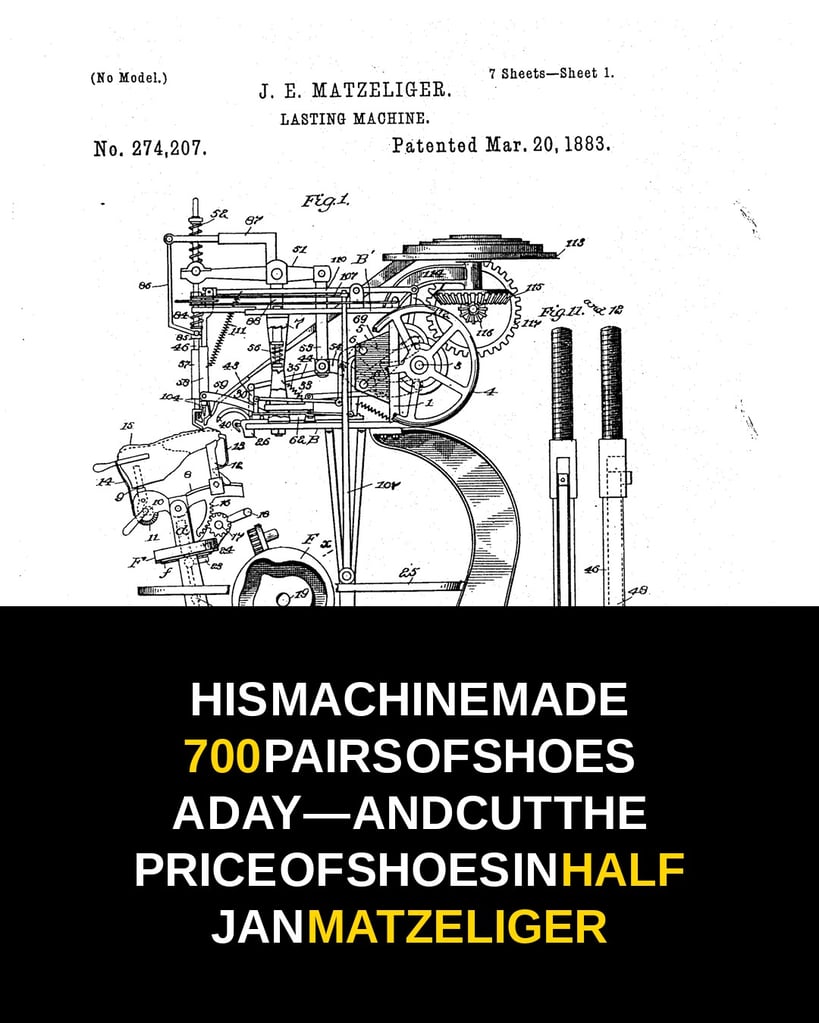
The best skilled hand workers could finish about 50 pairs of shoes a day. Jan Matzeliger’s machine could produce up to 700. He solved the one step of shoemaking everyone said could never be mechanized — and the price of a pair of shoes fell by roughly half.
Jan Ernst Matzeliger was born on September 15, 1852, in Paramaribo, Suriname. He immigrated to the United States and went to work in a shoe factory in Lynn, Massachusetts. He was not the owner, not an engineer with a laboratory — he was a factory worker, standing inside the process every day, watching exactly where it broke down. And he could see the bottleneck everyone else had accepted as permanent.
That bottleneck was called “lasting” — pulling the leather upper over the form and attaching it to the sole. It was the one step of shoemaking everyone said could never be mechanized. Skilled hand lasters did it by feel, by strength, by years of practice, and even the best of them could finish only about 50 pairs a day. The whole industry’s speed, and the whole industry’s price, hung on those men’s hands.
Fifty versus seven hundred
Matzeliger refused to accept “never.” He studied the hand lasters’ work — the pulls, the folds, the fastening — and built a machine that could do what their hands did. His lasting machine, U.S. Patent 274,207, was granted on March 20, 1883. It could produce up to 700 pairs of shoes a day.
Fifty versus 700. That is not an improvement; that is a transformation. And the transformation landed where ordinary people could feel it: shoe prices fell by roughly half, putting decent shoes within reach of ordinary families. Think about what a sturdy pair of shoes meant to a working family — work, school, winter, dignity. Matzeliger’s machine did not just make shoes faster. It made them affordable, for people who had always had to make do.
This is the pattern of so many great inventions: the breakthrough does not come from a boardroom. It comes from the person standing closest to the problem, watching it daily, deciding that “it can’t be done” is just a thing people say until somebody does it.
Gone at 36
The triumph cost him everything. Matzeliger spent his earnings and his health perfecting the machine. He died on August 24, 1889, in Lynn, Massachusetts, at just 36 — weeks before his 37th birthday. The man who put affordable shoes on a nation’s feet was gone before he turned 37, worn out by the work of perfecting the thing that changed the industry forever.
Recognition, as so often in these stories, arrived late. Matzeliger was inducted into the National Inventors Hall of Fame in 2006 — more than a century after his death, his name finally placed among the inventors who reshaped everyday life. Every affordable pair of shoes since 1883 walks in his footsteps. It is only right that we finally learned to say his name.
Join the conversation
50 pairs by hand, 700 by his machine, prices cut in half — and he was gone at 36. Had you ever heard Jan Matzeliger’s name before today, even though you’ve benefited from his work your whole life? Tell us below.
Source note: Jan Ernst Matzeliger’s story — born September 15, 1852, in Paramaribo, Suriname, and died August 24, 1889, in Lynn, Massachusetts, at 36; immigrating to the United States and working in a Lynn shoe factory; solving “lasting,” pulling the leather upper over the form and attaching it to the sole, the one step of shoemaking everyone said could never be mechanized; the best skilled hand lasters finishing about 50 pairs a day against his lasting machine (U.S. Patent 274,207, March 20, 1883) producing up to 700 pairs a day; shoe prices falling by roughly half, putting decent shoes within reach of ordinary families; his spending his earnings and health perfecting the machine and dying weeks before his 37th birthday; and his induction into the National Inventors Hall of Fame in 2006 — is from the National Inventors Hall of Fame, Wikipedia (patent-record sourced), and the Smithsonian National Postal Museum (stamp program).