
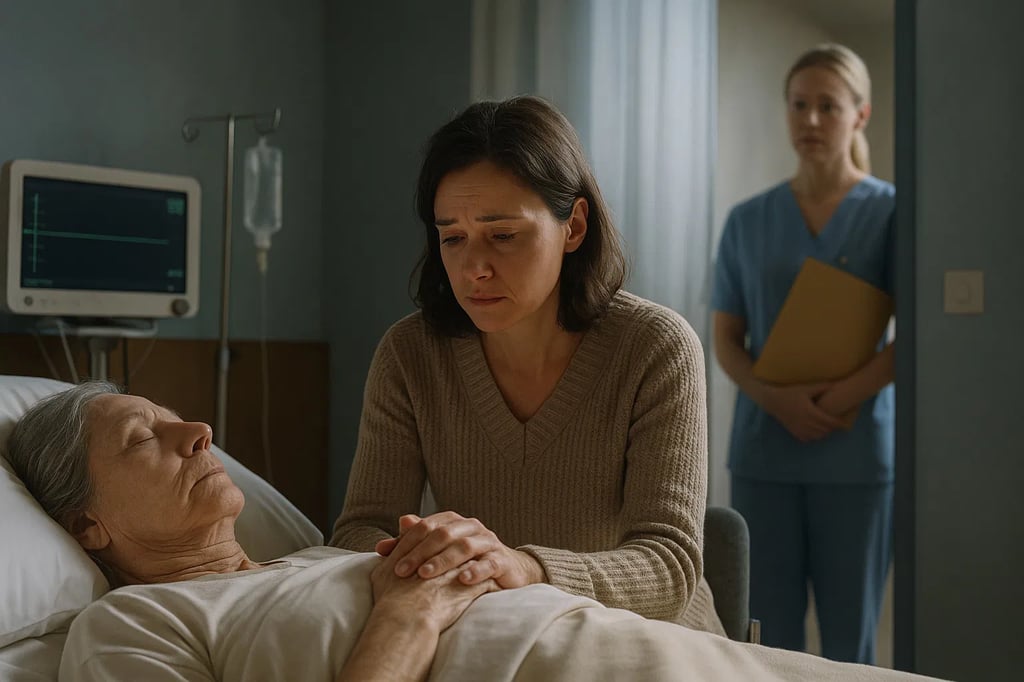
I was the only one there when Rachel Emerson took her last breath. There was no dramatic movie moment — just the monitor settling into a long, steady tone, my hands still wrapped around her cooling fingers, and silence.
A nurse asked if I was okay. I told her I had called them again — David, my husband, and his sister Karen. They had said they were coming. For three days I had left voicemails, sent messages, and looked up at every footstep in the hall. The nurse said some people cannot handle goodbyes. We both knew this was not about fear. It was about choice.
A Rusted Key and One Chilling Sentence
Before the doctor came to sign the papers, the nurse gave me an envelope Rachel had made her promise to hand over only after she passed. My name was on it in shaky handwriting.
Inside was a small, rusted key taped above an address I did not recognize — and one sentence saying, in essence, that they had never loved her, and now they would learn what it meant to be left behind.
Rachel’s belongings fit into one bag: a worn robe, glasses, an unfinished novel. I sat in my car for twenty minutes. Then my phone rang. It was David — asking, casually, whether I was almost home, because they were out of groceries.
I told him his mother had died that day, at 3:42. He paused, said he had had meetings, and added that she was never easy. I ended the call.
The Cottage Nobody Visited
At seven the next morning, key in my palm, I followed the address thirty miles out of the city, down winding country roads to a gravel driveway hidden behind tall shrubs. Roses climbed the walls of a weathered cottage. The key slid in easily.
Inside, dust hung in golden light. Books lined the shelves, photo albums sat on a table, and in the middle was another envelope — addressed to Charlotte Reed, Esq., to be opened upon Rachel’s death. This was Rachel’s real home, I realized, not the assisted living facility David had chosen for her. This was where her memories lived, and she had wanted me to see it.
I called the lawyer. Charlotte said she had been expecting me, and that Rachel had asked for all named beneficiaries to attend — including David and Karen.
“To My Son, I Leave My Forgiveness — Though It Was Never Earned”
At the downtown office, Karen complained she had taken off work for this. Two older women from Rachel’s church, Judith and Marie, sat nearby. Charlotte read the will, revised two months earlier.
To David, Rachel left her forgiveness, though it was never earned. To Karen, she left her wedding band, as a reminder that commitments are sacred. Judith and Marie received five thousand dollars each, for their kindness and loyalty.
And to me — her daughter-in-law, Lauren Emerson — she left the remainder of her estate: the home at 92 Maple Hollow, all her investments and her personal belongings. Karen stood up shouting that Rachel had barely even liked me. David called it a mistake and said I had tricked her. Charlotte stayed steady: Rachel had been of sound mind, with a medical report and a video confirmation to prove it. The house was worth around three hundred thousand dollars; the other assets totaled over four hundred thousand.
Once they had left, furious, Charlotte handed me one last envelope. Inside, Rachel had written the heart of it: forgive no one, let them beg, let them kneel — then walk away. Charlotte told me Rachel had left me more than property. She had left me her voice.
Rachel’s Refuge
In the cottage I found Rachel’s journals — her loneliness, her heartbreak, her disappointment written out in her own hand. One entry stayed with me: she had made a turkey, set four plates, and nobody came. Karen sent a text. David did not even call.
Karen filed a lawsuit. Charlotte had prepared for it. In court, the judge watched Rachel’s recorded statements — clear, direct and undeniable — and dismissed the case, ordering Karen to pay legal fees. David waited at home, saying his mother had turned on him from the grave. I told him no: she had given her truth, and I had simply listened. I told him I was leaving, and that we would speak through lawyers. Later he came begging for a small loan of five thousand dollars. I said no, and told him I was honoring what she left him: nothing.
By spring I had painted the cottage, planted flowers, and hung a sign above the door: Rachel’s Refuge. Working with Charlotte, I started a nonprofit there — a space for grief support and dignity, so no one would feel forgotten. On what would have been Rachel’s seventy-fifth birthday we unveiled a mural of her and her husband under an oak tree, and I later wrote a book, The Letter That Freed Me. Her gift had not really been money. It had been strength.
Source note: Original story via ViralStrange (https://viralstrange.com/my-dying-mils-final-letter-changed-everything-i-thought-i-knew/). Retold in our own words for Critical Content; story as originally narrated, not independently verified.

