

In a provocative finding that’s sparking heated discussions online, new data suggests that women working in healthcare—particularly nurses and female doctors—top the list when it comes to infidelity rates compared to other professions.
According to surveys from extramarital dating platforms, medical professionals stand out prominently. A widely cited 2018 survey by Ashley Madison, a dating site for married individuals seeking affairs, found that among female users, 23% worked in medicine, with doctors and nurses making up the largest share. More recent reports from the UK-based site Illicit Encounters in 2025 echoed this, noting that nurses represented the largest proportion of female users on their platform
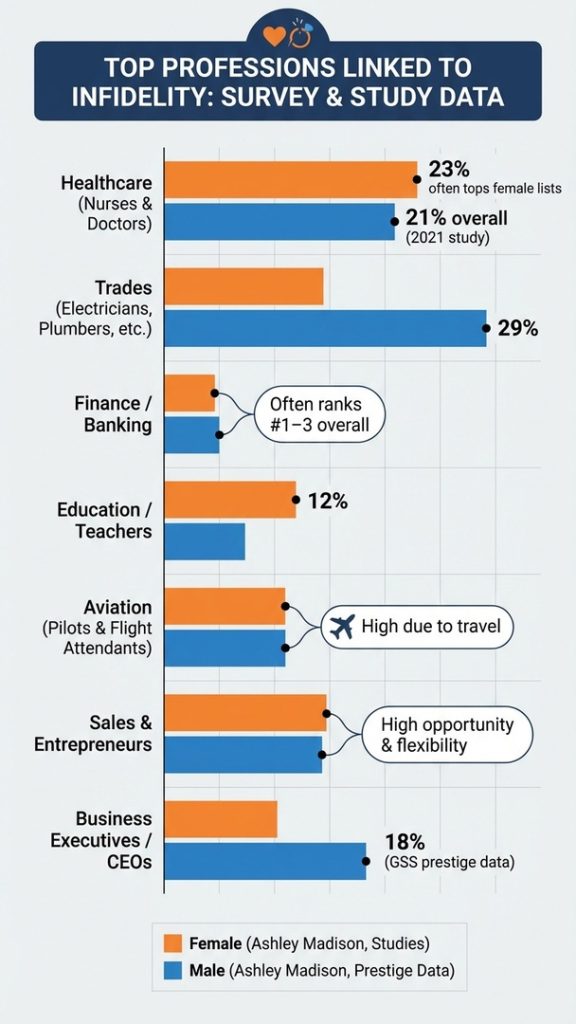
These numbers have fueled headlines claiming that nurses and female doctors are statistically the most likely to cheat among all professions. Similar sentiments appear across social media, with viral posts and discussions amplifying the idea that healthcare workers—especially women in these high-pressure roles—report higher rates of infidelity.
Why Might This Be the Case?
Experts and observers point to several factors common in nursing and medical environments:
- Irregular and Long Hours: Shift work, night shifts, and emergency schedules can strain relationships and create opportunities for connections outside the home. The 2021 study published in the International Journal of Environmental Research and Public Health found that healthcare workers on night emergency shifts had significantly higher rates of infidelity.
- High Stress and Emotional Exhaustion: Dealing with life-and-death situations, emotional patient interactions, and intense workloads can lead some individuals to seek comfort, validation, or escape elsewhere.
- Close Proximity and Team Dynamics: Hospitals foster intimate working relationships among colleagues who share high-stakes experiences, which can sometimes blur personal boundaries.
- Opportunity: Long hours away from partners combined with a workplace full of potential connections create an environment where affairs may be more feasible.
One informal analysis even suggested that healthcare roles consistently rank high in infidelity discussions, often ahead of professions like teaching, sales, or aviation.
A Nuanced Picture
While the headlines focus on female nurses and doctors, the data tells a more complex story. In the 2021 peer-reviewed study of over 360 doctors and nurses, 21% admitted to having been in an unfaithful relationship at some point. However, men were far more likely to cheat than women—nearly 4–5 times more, according to the findings. Male doctors made up the vast majority (over 80%) of those reporting infidelity in that sample.
Additionally, these surveys come with important caveats:
- Data from cheating-focused dating sites (like Ashley Madison or Illicit Encounters) reflect only people already seeking affairs, so they may not represent the general population.
- Self-reported behavior can be influenced by sampling bias—those using such sites are, by definition, more open to or engaged in infidelity.
- Broader general population studies on infidelity by profession are limited, and other fields (such as sales, teaching, or finance) also frequently appear near the top of various lists.
A psychologist commenting on the trend noted that while patterns exist, turning them into broad stereotypes about entire professions can be misleading and unfair. Stress affects people differently, and most healthcare workers maintain faithful relationships despite the demands of the job.
The Bottom Line
The claim that nurses and female doctors are among the most likely to cheat has gained traction thanks to consistent signals from infidelity-focused surveys. Long, unpredictable hours, high emotional demands, and close workplace interactions appear to play a role in elevating risks within healthcare.
That said, infidelity is a deeply personal issue influenced by individual circumstances far more than job titles alone. Correlation doesn’t always equal causation, and painting an entire profession with one brush overlooks the dedication and integrity shown by the vast majority of nurses and doctors every day.
What do you think—does the high-stress nature of healthcare make affairs more likely, or is this just another viral stereotype? The conversation continues.