
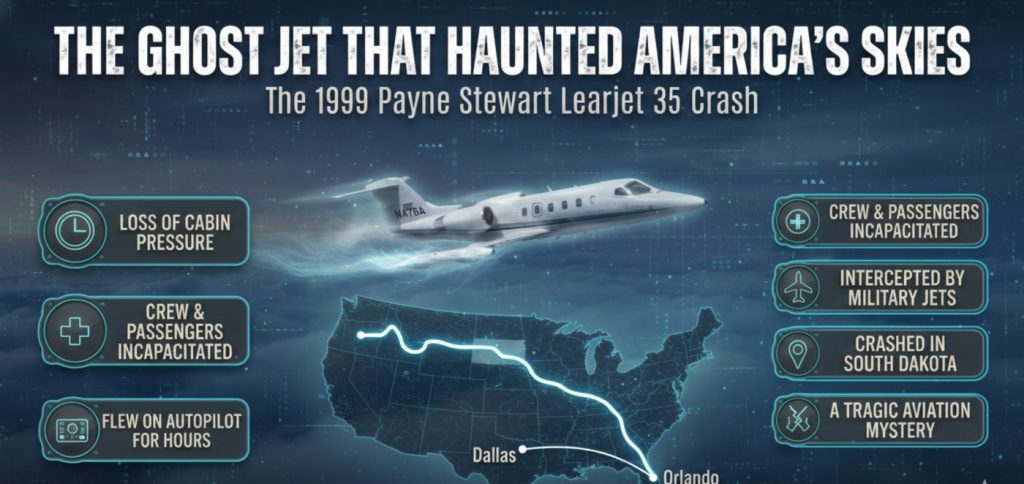
ORLANDO, Fla., October 25, 1999 Under a clear Florida sky, golf icon Payne Stewart stepped onto a Learjet 35 at Orlando International Airport, smiling beneath his trademark tam-o’-shanter cap. Just months removed from his dramatic U.S. Open victory, Stewart was traveling to Dallas for a short business meeting ahead of the PGA Tour Championship. Accompanying him were agents Robert Fraley and Van Ardan, golf course designer Bruce Borland, and pilots Michael Kling and Stephanie Bellegarrigue. What was expected to be a routine flight would soon become one of the most unsettling aviation mysteries in American history.
At 9:19 a.m. EDT, Learjet N47BA lifted off smoothly, climbing toward its cruising altitude of 39,000 feet. Eight minutes later, air traffic control received the final transmission from the cockpit an ordinary acknowledgment, nothing more. Then the radio went silent. No emergency call. No warning. Just an eerie absence of sound.
Controllers in Jacksonville attempted repeated contact. There was no response. By 9:33 a.m., the jet had exceeded its assigned altitude, climbing past 46,000 feet while maintaining a perfectly straight northwest course never turning toward Texas. Radar screens across multiple states began lighting up with concern. The aircraft was flying flawlessly, yet no one appeared to be in control.
Military aircraft were scrambled. At 9:54 a.m., an F-16 fighter jet intercepted the Learjet. What the pilot observed was chilling: the plane showed no visible damage, its engines running normally, navigation lights on but the cockpit windows were completely frosted over. There was no movement inside. Additional fighters from the Oklahoma and North Dakota Air National Guard confirmed the same haunting sight.
Experts quickly suspected hypoxia, a condition caused by oxygen deprivation at high altitude. In such conditions, pilots can lose consciousness within seconds, often without realizing anything is wrong. The jet, locked on autopilot, continued flying like a ghost across the American heartland.
For nearly four hours, the nation watched in suspense. Television networks tracked the aircraft as it crossed Missouri Stewart’s home state then pushed onward across the Midwest. Authorities debated whether the plane posed a national security risk. Former Canadian Prime Minister Jean Chrétien later revealed he had authorized the aircraft to be shot down if it entered Canadian airspace. That order was never executed.
At 12:10 p.m. CDT, fuel exhaustion finally took its toll. The cockpit voice recorder later captured the sound of the engines shutting down. Moments later, the Learjet plunged into a steep, uncontrolled dive. At 12:13 p.m., it slammed into a field near Mina, South Dakota, creating a massive crater. All six people on board were killed instantly.
Payne Stewart was 42 years old.
The loss stunned the sports world. Known for his colorful attire and emotional victories, Stewart had reinvented his career in the late 1990s. Tributes poured in from fellow athletes and fans. The PGA Tour honored him with a moment of silence and a lone bagpiper. He was later inducted into the World Golf Hall of Fame.
Yet questions remained.
The National Transportation Safety Board concluded that the probable cause was crew incapacitation due to loss of cabin pressurization, for reasons that could not be conclusively determined. Maintenance records from Sunjet Aviation revealed repeated pressurization complaints in the months before the crash. Lawsuits pointed to possible equipment failures, including oxygen system issues, but no single defect could be proven. In 2005, a jury cleared Learjet of responsibility.
The cockpit voice recorder offered no panic, no confusion—only silence. Whatever happened, it happened fast.
The tragedy led to industry-wide changes. Pilot training on hypoxia was intensified. Pressurization systems received increased scrutiny. Aviation safety improved. Still, the exact trigger that doomed Flight N47BA remains unresolved.
Residents near Mina remember the deafening impact. A small memorial now marks the site where the ghost jet finally fell. Stewart’s widow later expressed gratitude to the community that unknowingly became part of aviation history.
More than two decades later, the story still chills. A perfectly functioning aircraft. A silent cockpit. A plane that flew itself until it ran out of sky.
The legacy of Payne Stewart’s final flight is a sobering reminder: at 40,000 feet, one unnoticed failure can steal everything in seconds.
What do you believe caused the sudden depressurization—mechanical failure or human oversight? Share your thoughts as we continue exploring the darkest mysteries of the skies.
Inspired by findings from the NTSB investigation into Learjet N47BA.