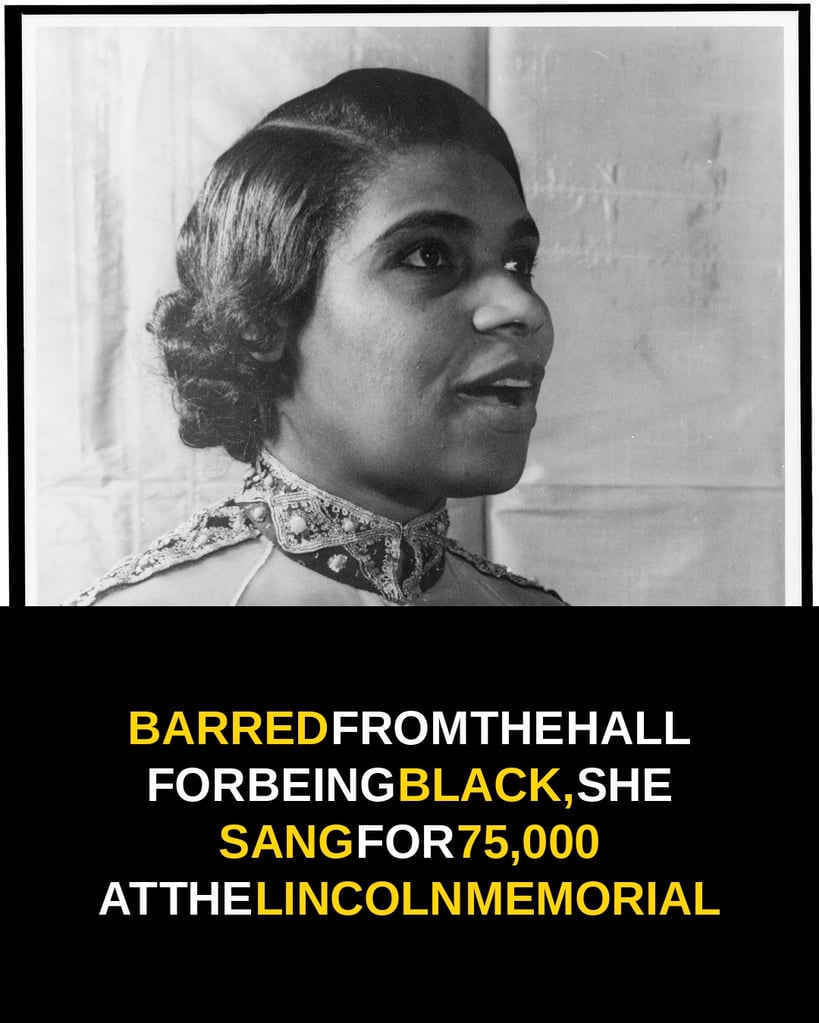
They controlled the hall. They did not control the steps of the Lincoln Memorial. In 1939, the Daughters of the American Revolution refused contralto Marian Anderson Constitution Hall — Washington’s only large venue — because its policy barred Black performers. On Easter Sunday, April 9, 1939, Anderson sang for 75,000 people instead, in the open air, at the feet of Lincoln.
Read the refusal plainly, because it was plain: the greatest American contralto of her generation could not book the capital’s only large concert hall, for one stated reason — the hall’s policy barred Black performers. The door was closed not on her talent, which nobody disputed, but on her race, which the policy named as the disqualification.
A First Lady resigns
First Lady Eleanor Roosevelt answered the refusal in the loudest way available to her: she resigned her DAR membership in protest. The First Lady of the United States publicly quit the organization over its treatment of a singer. That was not a small gesture in 1939, and it was not meant to be — it was a signal, sent deliberately, that the refusal had embarrassed the country.
Then the government itself made the counter-offer. Secretary of the Interior Harold Ickes arranged an open-air concert and introduced Anderson himself — “genius knows no color line.”
Easter Sunday on the steps
On April 9, 1939, Anderson stood on the steps of the Lincoln Memorial and opened with “My Country, ‘Tis of Thee” — before an integrated crowd of 75,000 people, with millions more listening on the radio. Integrated. In Washington. In 1939. The venue that was supposed to diminish her became the backdrop that made the moment immortal: the excluded singer, the emancipator’s memorial, and a crowd the hall could never have held.

And the epilogue belongs in the record too. In 1943, the DAR invited her back to Constitution Hall for a war-benefit concert. She agreed — on the condition that the audience be integrated. The woman barred from the hall returned to it only when the hall’s terms had to bend to hers.
The DAR kept its building. Anderson got the Lincoln Memorial, 75,000 people, a national radio audience, and a moment schoolchildren still learn about generations later. Exclusion has rarely backfired so completely.
One more fact sharpens the picture of that afternoon. Constitution Hall was Washington’s only large venue — meaning the DAR’s refusal wasn’t one lost booking among many. It was an attempt to make a singer of Anderson’s stature effectively unperformable at scale in the nation’s capital. The Lincoln Memorial answer defeated the arithmetic as completely as the insult: 75,000 people in person is a crowd the hall could never have held in the first place, and the radio audience multiplied it beyond any room in the city.
Join the conversation
Did you learn about the Lincoln Memorial concert in school — and be honest, whose move moves you more: Eleanor Roosevelt resigning, Ickes arranging the steps, or Anderson coming back in 1943 only if the audience was integrated? Tell us below.
Source note: The Marian Anderson account — the Daughters of the American Revolution’s 1939 refusal of Constitution Hall, Washington’s only large venue, under its policy barring Black performers; First Lady Eleanor Roosevelt’s resignation of her DAR membership in protest; Secretary of the Interior Harold Ickes arranging the open-air concert and introducing her (“genius knows no color line”); her Easter Sunday performance on April 9, 1939 from the steps of the Lincoln Memorial, opening with “My Country, ‘Tis of Thee,” before an integrated crowd of 75,000 with millions more on the radio; and the DAR’s 1943 invitation for a war-benefit concert, which she accepted on the condition the audience be integrated — is from the National Park Service’s “Marian Anderson and Constitution Hall” and the Eleanor Roosevelt Papers Project (GWU).
Tell us in the comments below - we read every single one, and the best takes get featured.