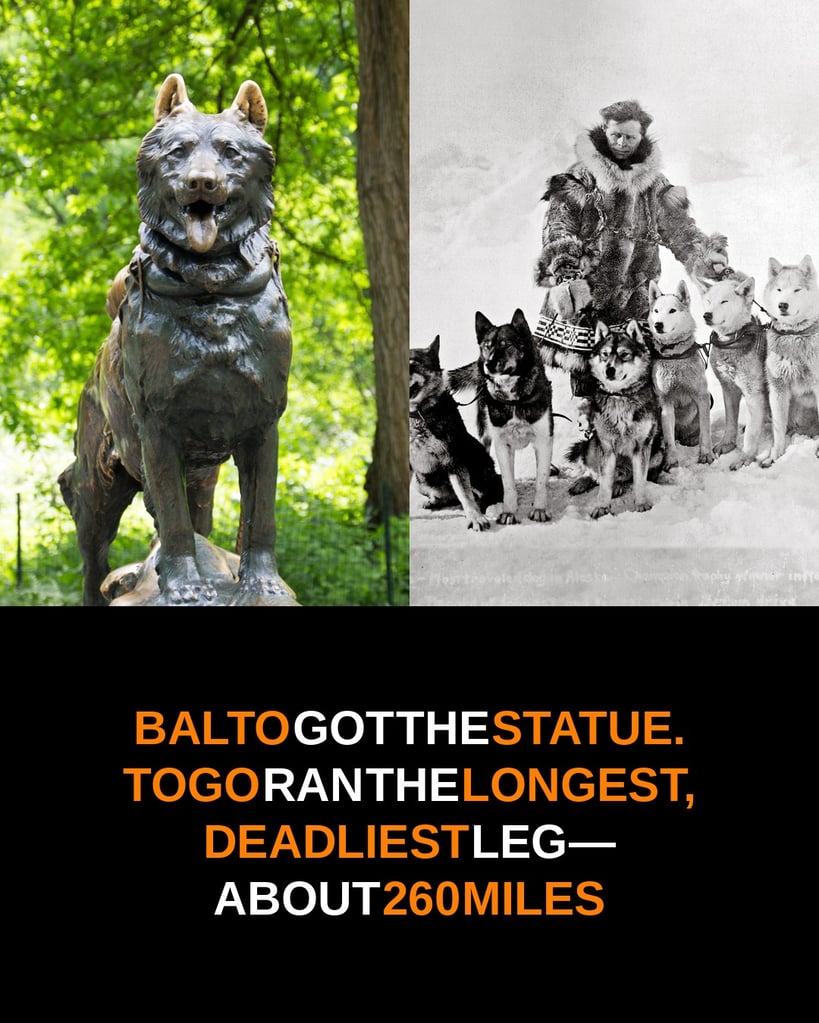
Everybody knows one name from the 1925 serum run, and the statue in Central Park is his. But the dog who ran the longest and most dangerous part of the trail — about 260 miles, including a 91-mile day across cracking sea ice — was somebody else. His name was Togo, and this is his half of the story.
In the winter of 1925, diphtheria threatened Nome, Alaska, and the antitoxin was 674 miles away in Nenana. The answer was a relay: about 20 mushers and more than 150 sled dogs, passing the serum hand to hand — paw to paw — across the Alaskan winter. A trip that normally took about 25 days was done in 5 days and 7 hours.
The famous final leg
Balto, leading Gunnar Kaasen’s team, ran the final leg into Nome, arriving at 5:30 a.m. on February 2, 1925. He became the name the country learned, and the statue followed — though it’s worth knowing the Central Park statue is dedicated to all the relay dogs, not to Balto alone. The last runner in a relay gets the photograph. That is how fame works, and Balto earned his leg honestly.
But fame’s arithmetic is not the trail’s arithmetic.
The dog history passed over
Leonhard Seppala’s lead dog Togo covered the longest and most dangerous stretch of the entire run — about 260 miles in total, including a 91-mile day across the Norton Sound ice, the kind of crossing where the surface itself can open under a team. Where Balto’s leg closed the story, Togo’s legs carried its hardest middle: the most miles, the worst ice, the thinnest margin.

And history largely passed him over — no statue with his name, no fame in his lifetime to match the work. The record is only fair when both halves are told: Balto, whose mounted remains are held by the Cleveland Museum of Natural History, and Togo, whose remains are at the Iditarod headquarters museum in Wasilla — the two lead dogs of the same relay, remembered very unequally for work that only succeeded because both of them did it.
The serum arrived. The children of Nome were saved by a chain of 150 dogs, and every link mattered. But if the chain had a strongest link, the mileage says it was the one whose name most people never learned.
Join the conversation
Be honest: had you EVER heard Togo’s name before today — and does it change the story for you that the famous dog ran the final leg while the hardest 260 miles belonged to another? Should Togo get a statue of his own? Tell us below.
Source note: The 1925 serum run account — diphtheria threatening Nome, Alaska; the relay of about 20 mushers and more than 150 sled dogs carrying antitoxin 674 miles from Nenana in 5 days and 7 hours, a trip that normally took about 25 days; Balto, leading Gunnar Kaasen’s team, running the final leg into Nome and arriving at 5:30 a.m. on February 2, 1925; the Central Park statue’s dedication to all the relay dogs; Leonhard Seppala’s lead dog Togo covering the longest and most dangerous stretch, about 260 miles in total including a 91-mile day across the Norton Sound ice; and the locations of the two dogs’ remains (Balto at the Cleveland Museum of Natural History, Togo at the Iditarod headquarters museum in Wasilla) — is from the Cleveland Museum of Natural History and Iditarod / serum-run histories. Note: sources split on the mileage of Balto’s final leg (53 vs 55 miles), so this article leaves it unnumbered and uses Togo’s total, on which sources agree.
Tell us in the comments below - we read every single one, and the best takes get featured.