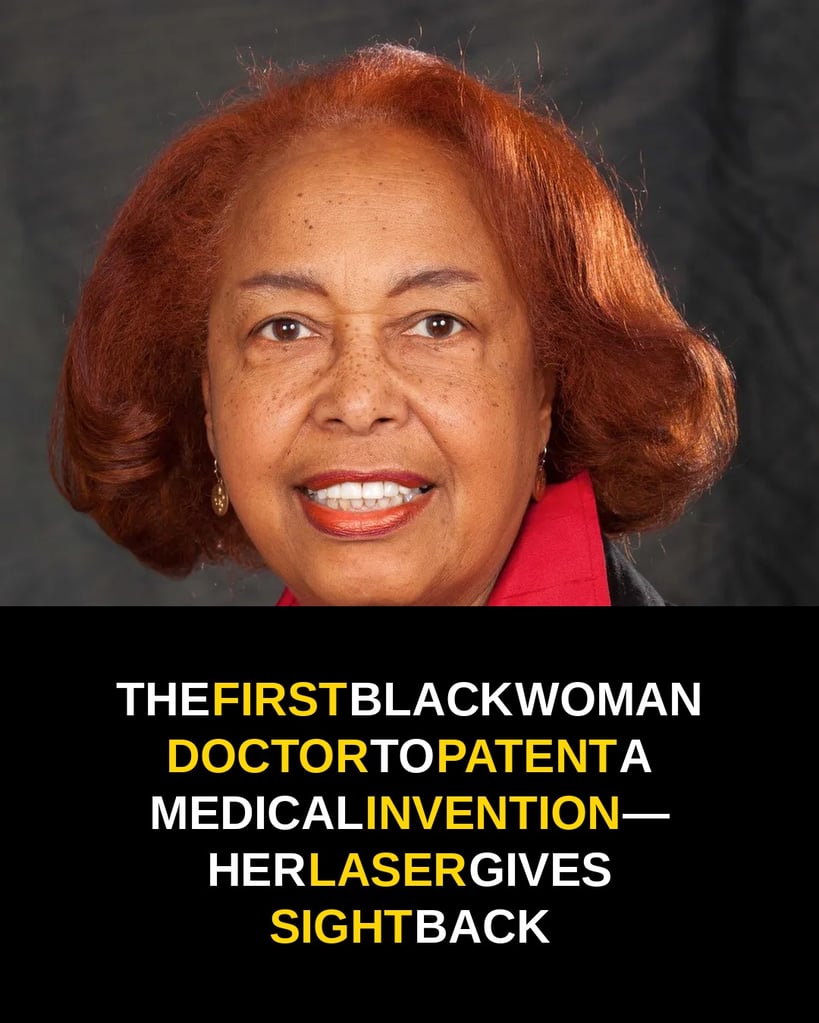
Cataracts steal sight slowly, and for most of history the surgery to fix them was rough work. An ophthalmologist named Patricia Bath looked at that problem and built a laser to solve it — and on May 17, 1988, she became the first African American female doctor in history to receive a patent for a medical purpose.
The invention was the Laserphaco Probe. Bath conceived it in 1981 and completed it in 1986: a laser device that dissolves cataracts so that sight can be restored. U.S. Patent 4,744,360 issued on May 17, 1988. It was not her only patent — she held five U.S. patents in total. But that first one put her in a record book that, until that day, no Black woman doctor had ever entered.
A career built out of firsts
The patent is the headline, but it sits on top of a career that was already a ladder of firsts. Bath was the first African American to complete an ophthalmology residency at NYU, finishing in 1973. She was the first woman to chair a U.S. ophthalmology residency program. And in 1976 she co-founded the American Institute for the Prevention of Blindness — because her work was never just about the patients who could reach a famous doctor. It was about preventable blindness, everywhere, including in the communities medicine had overlooked.
Read that pattern the way it deserves to be read. At every level of one of the most demanding specialties in medicine, she was either the first or among the first — and each time, she used the position to widen the door behind her: a residency program chaired, an institute founded, an invention that made restoring sight more precise for every surgeon who came after.
Why an eye surgeon belongs on this page
This page celebrates firsts and the women who carry them. Some firsts change what girls believe is possible in a salon or on a stage. Patricia Bath’s firsts changed what was possible in an operating room — for the doctors who would follow her, and for the patients whose sight her invention helps restore to this day.

She didn’t just practice medicine at the highest level. She added a tool to medicine itself, and signed her name to it in the patent record, where it cannot be argued with or forgotten.
Hold the shape of her contribution at its full weight. Some doctors change medicine one patient at a time. Bath also changed it one tool at a time: the Laserphaco Probe turned her insight into an instrument other surgeons could pick up and use, in rooms she would never enter, on patients she would never meet. That is why the patent record matters so much in her story. A paper can be shelved and a reputation can be argued with, but a patent is a receipt — dated May 17, 1988, numbered 4,744,360 — that the tool, and the name attached to it, belong to her.
Join the conversation
Did YOU know the laser device that helps dissolve cataracts came from a Black woman ophthalmologist in 1988? And which woman inventor do you think history class owes a much bigger chapter? Tell us below.
Source note: Dr. Patricia Bath’s record — conceiving the Laserphaco Probe in 1981 and completing it in 1986; U.S. Patent 4,744,360 issuing on May 17, 1988, making her the first African American female doctor to receive a patent for a medical purpose; five U.S. patents in total; the first African American to complete an ophthalmology residency at NYU (1973); the first woman to chair a U.S. ophthalmology residency program; and co-founding the American Institute for the Prevention of Blindness in 1976 — is from the National Library of Medicine’s “Changing the Face of Medicine” biography and the National Women’s History Museum.
Tell us in the comments below - we read every single one, and the best takes get featured.