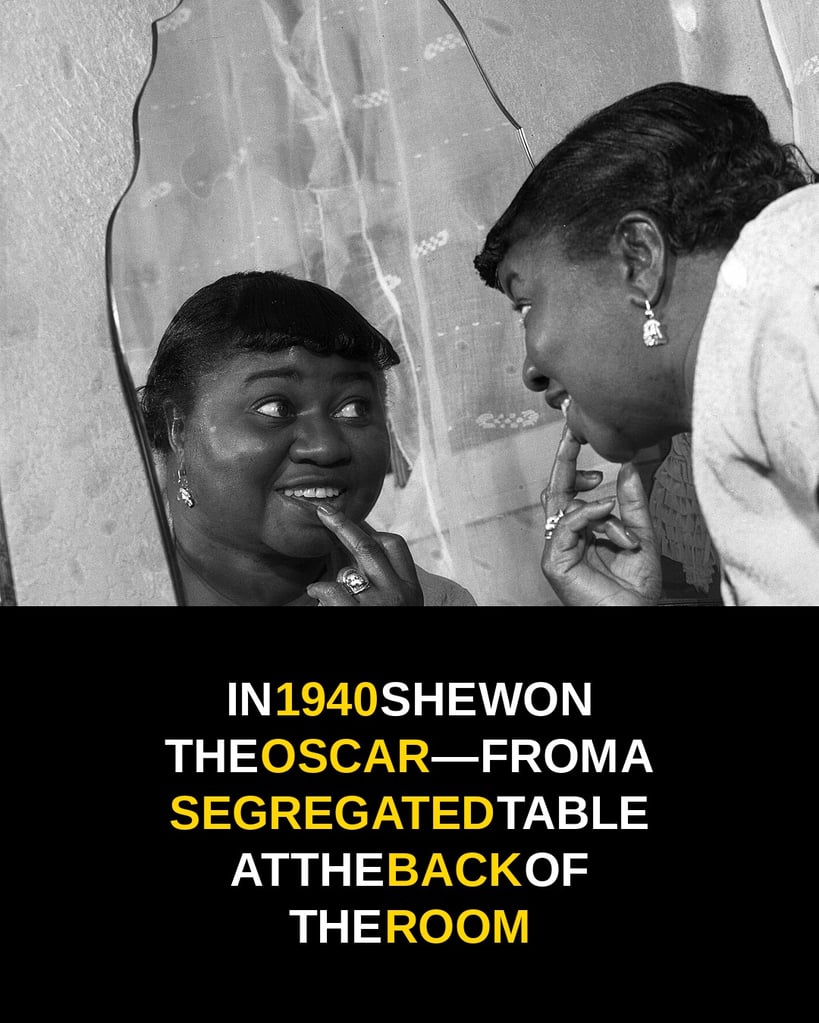
The hotel barred Black guests. She needed a special exception just to walk through its doors. Then she sat at a small table against the far wall — segregated, at the ceremony honoring her own performance — and won the Oscar anyway. On February 29, 1940, Hattie McDaniel became the first Black Oscar winner in history.
The setting was the 12th Academy Awards, in the Ambassador Hotel’s Cocoanut Grove in Los Angeles — a venue whose policy barred Black guests. Producer David O. Selznick had to arrange a special exception for McDaniel even to enter the building. Let that sink in properly: the woman nominated for one of the year’s most celebrated films could not legally be a guest in the room where the industry gathered to celebrate it.
She sat at a small segregated table against the far wall, gardenias in her hair, and when her name was called for Best Supporting Actress for Gone with the Wind, she became the first Black Oscar nominee — and the first Black Oscar winner — the Academy had ever had.
The premiere she couldn’t attend
The Oscar night was not even the first door closed to her by her own film. Months earlier, McDaniel had been barred from attending Gone with the Wind’s Atlanta premiere. The star of the picture, shut out of the picture’s celebration — then decorated for it weeks later from the back wall of a room she needed permission to enter.
Hold those two facts together and you have the whole era in one story: the industry wanted her talent on its screens and her presence nowhere near its rooms. She took the trophy home anyway. That is not a small kind of strength. That is strength with the receipts suppressed and the record books forced to include her name forever.

The plaque that vanished — and the one that replaced it
There is a coda this page reports because it happened: McDaniel’s winner’s plaque — in that era, supporting winners received plaques — later went missing from Howard University, where it had been held. For decades, the physical token of the first Black Oscar win was simply lost.
In 2023, the Academy replaced it. Eighty-three years after the night at the back wall, the institution formally restored the award of the woman it once made enter by exception. Some debts take most of a century to be acknowledged. The name in the record book, at least, was never missing — she put it there herself, from the far wall, with gardenias in her hair.
Join the conversation
She won the biggest honor in her industry in a room she needed special permission to enter. Does Hattie McDaniel get the credit she deserves in Oscar history — and what does her night tell us about how many other firsts were celebrated from the back wall? Tell us below.
Source note: Hattie McDaniel’s Oscar night — February 29, 1940, at the 12th Academy Awards in the Ambassador Hotel’s Cocoanut Grove, a venue that barred Black guests; producer David O. Selznick arranging a special exception for her to enter; her seat at a small segregated table against the far wall with gardenias in her hair; her Best Supporting Actress win for Gone with the Wind, making her the first Black Oscar nominee and winner; her having been barred months earlier from the film’s Atlanta premiere; and her winner’s plaque going missing from Howard University before the Academy replaced it in 2023 — is from Academy history as reported by EW and Mental Floss, with NNPA/AFRO and LA Sentinel coverage.
Tell us in the comments below - we read every single one, and the best takes get featured.