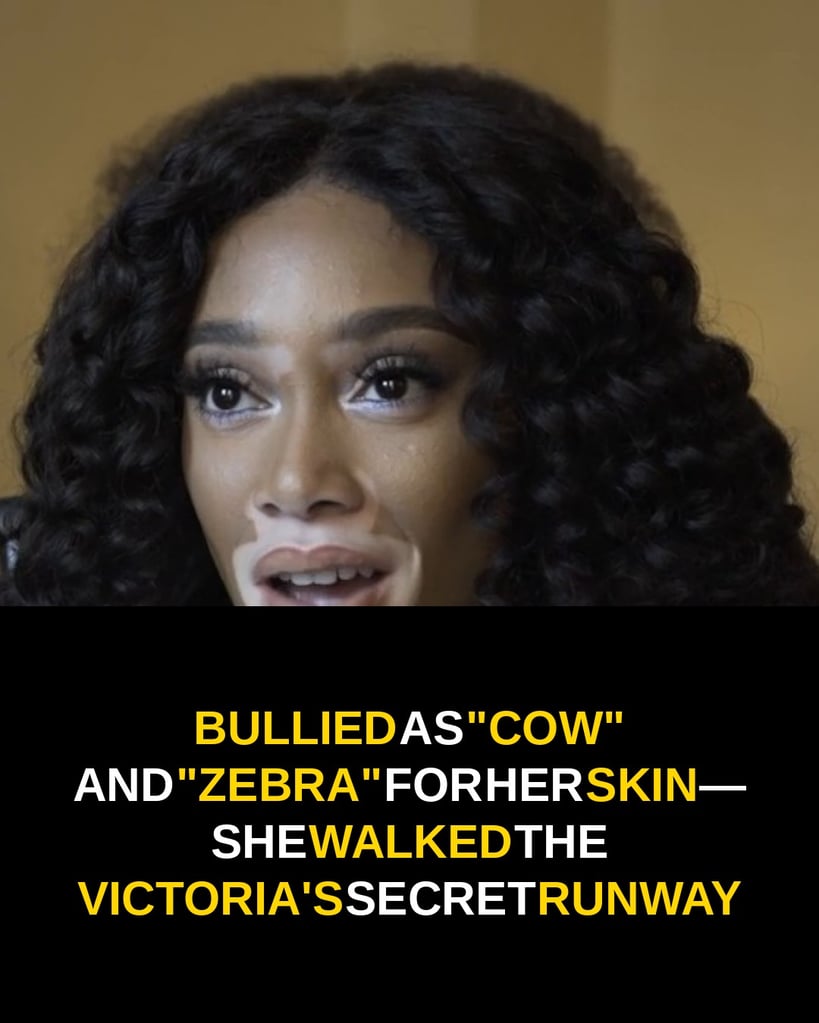
The names they called her were “cow” and “zebra” — children mocking the patches of her skin. Winnie Harlow was diagnosed with vitiligo around age 4, changed schools repeatedly, and carried a childhood of taunts into her teens. Then she picked up a camera, told her own story, and walked one of the most famous runways on earth.
Harlow was born Chantelle Brown-Young in Toronto, to a Jamaican family. The vitiligo that patterns her skin appeared when she was about four years old, and school turned cruel in the specific way children can be cruel about anything visible and different. “Cow.” “Zebra.” She changed schools repeatedly, eventually left high school, and has spoken about how dark that period in her life became. This page tells that part with care, because she has: the runway only means what it means if you know what it cost to get to it.
The video she made herself
In July 2011, before the industry found her, Harlow found her own audience. She posted her own video with a title that made her position plain: “Vitiligo: A Skin Condition, not a Life Changer.” And in it, she said the line that became her signature framing: “People have black skin, people have brown skin, and I have both.”
Read that framing carefully, because it is hers and it matters to get it right. She does not present herself as defined by her condition — she is a model and a spokesperson who happens to carry both colors of skin in one body, and she refused, from her very first public statement, to let the condition be the headline of her life. This article follows her framing, because it’s her story.
The runway
Tyra Banks discovered her on Instagram, and in 2014 she competed on America’s Next Top Model Cycle 21 — the show’s first Canadian — placing sixth. But the show was not the summit. She built the bigger career afterward: brand representative for Desigual, a TEDx talk, campaign after campaign.

Then, in 2018, she walked the Victoria’s Secret Fashion Show — the first model with vitiligo ever to do it. The runway that for decades defined one narrow picture of beauty put her skin, exactly as it is, under its brightest lights.
Her own summary of the whole road is the line to keep: “I learned to love who I am despite what anyone would say.” From “cow” and “zebra” in school corridors to that sentence, on that runway — that’s not a glow-up story. That’s a woman who authored herself.
Join the conversation
Be honest: if your child’s skin, hair, or body was the thing classmates mocked, what would you want them to hear first — and does Winnie Harlow’s line, “I have both,” say it the way you’d want it said? Tell us below.
Source note: Winnie Harlow’s account — born Chantelle Brown-Young in Toronto to a Jamaican family; diagnosed with vitiligo around age 4; taunted by classmates as “cow” and “zebra,” changing schools repeatedly and leaving high school, and having spoken about how dark that period became; her July 2011 self-posted video “Vitiligo: A Skin Condition, not a Life Changer” (“People have black skin, people have brown skin, and I have both”); her discovery by Tyra Banks on Instagram and competing on America’s Next Top Model Cycle 21 (2014) as the show’s first Canadian, placing sixth; her subsequent career including Desigual brand representative and a TEDx talk; becoming the first model with vitiligo to walk the Victoria’s Secret Fashion Show in 2018; and her summary, “I learned to love who I am despite what anyone would say” — is from her CNN interview (her words), ET Canada, Victoria’s Secret show coverage (November 8, 2018), and her TEDx talk. In line with Harlow’s own framing, she is presented as a model and spokesperson, never as “suffering from” her condition.
Tell us in the comments below - we read every single one, and the best takes get featured.