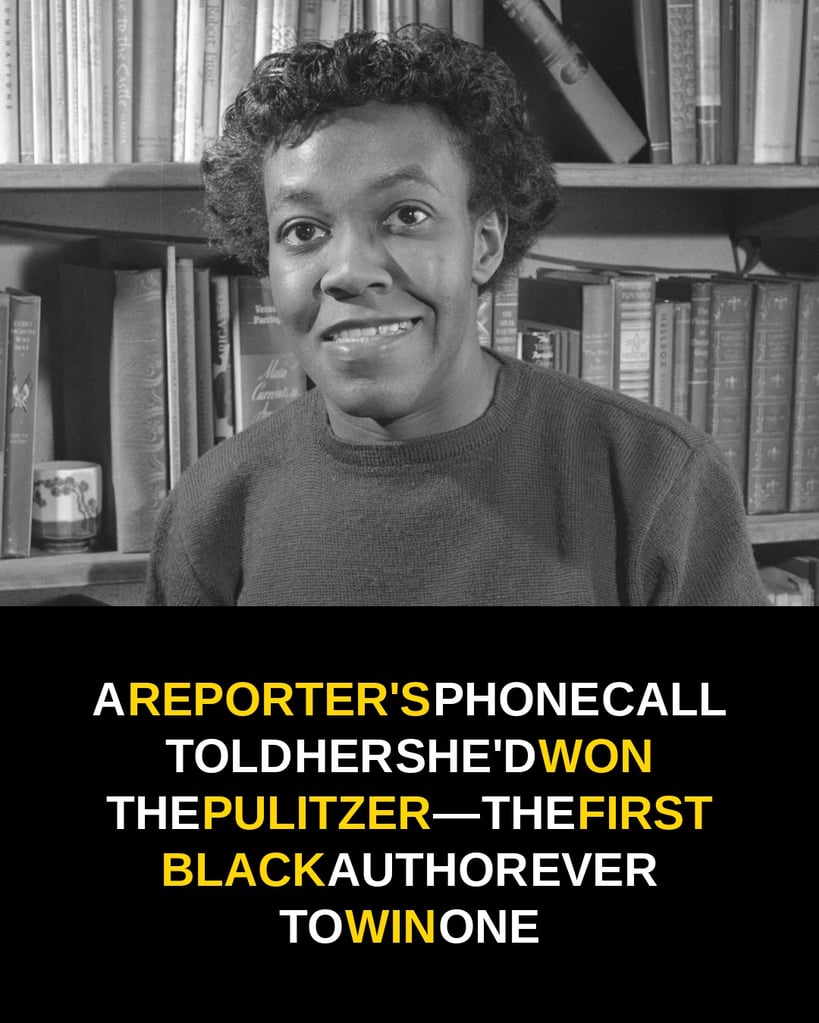
History didn’t send a letter. It rang the telephone. On May 1, 1950, Gwendolyn Brooks answered a call from a Chicago Sun-Times reporter and heard the news: her second book, Annie Allen, had won the Pulitzer Prize for Poetry. She was the first African American ever to win a Pulitzer Prize — in any category.
Annie Allen (1949) was a book of portraits: a young Black girl growing into womanhood in Bronzeville, Chicago’s great Black neighborhood, rendered in verse of extraordinary technical power. This was not a novelty win or a gesture. It was the highest honor in American letters, awarded to a book about a Black girl’s inner life, written by a Black woman from the South Side — in 1950.
Consider what the Pulitzers had been for the 33 years before that phone call: an institution that had simply never found a Black author to honor, in any category, in a country full of them. Brooks didn’t edge through a side door of that history. Her book took the prize in poetry outright, and the category list of “first Black winner” in American letters starts with her name and that date.
A lifetime of holding firsts
The Pulitzer turned out to be the first of a shelf of them. Brooks served as Poet Laureate of Illinois from 1968 until her death in 2000 — thirty-two years as her state’s poetic voice. She became the first Black woman inducted into the American Academy of Arts and Letters, in 1976. And she was the first Black woman appointed Consultant in Poetry to the Library of Congress, in 1985–86 — the position now known as U.S. Poet Laureate.
Lay those out in a row. First African American to win a Pulitzer, any category. First Black woman in the American Academy of Arts and Letters. First Black woman to hold the nation’s poetry consultancy. Illinois’s laureate for three decades. That is not a career with a famous year in it. That is a half-century spent, again and again, being the first person through a door — and writing like somebody the door should never have excluded.

The girl from Bronzeville at the center of it
And notice what the winning book was about. Not a bid for respectability in somebody else’s subjects — a young Black girl, growing up in Bronzeville, her girlhood and womanhood treated as material worthy of the most demanding craft in American poetry. The phone call in 1950 said the institution finally agreed.
Every Black girl who has seen her own life treated as literature’s center since stands somewhere downstream of May 1, 1950, and a poet who answered the phone.
Join the conversation
Did you learn Gwendolyn Brooks’s name in school — and be honest, were you taught that the first Black Pulitzer winner was a poet writing about a Black girl in Bronzeville? Which of her firsts should be on a plaque? Tell us below.
Source note: Gwendolyn Brooks’s record — learning by telephone from a Chicago Sun-Times reporter on May 1, 1950 that her second book, Annie Allen (1949), portraits of a young Black girl growing into womanhood in Bronzeville, had won the Pulitzer Prize for Poetry, making her the first African American to win a Pulitzer Prize in any category; her service as Poet Laureate of Illinois from 1968 until her death in 2000; her induction as the first Black woman into the American Academy of Arts and Letters (1976); and her appointment as the first Black woman Consultant in Poetry to the Library of Congress (1985–86), the role now called U.S. Poet Laureate — is from the Poetry Foundation, the Illinois Center for the Book / Illinois State Library, and Pulitzer records.
Tell us in the comments below - we read every single one, and the best takes get featured.