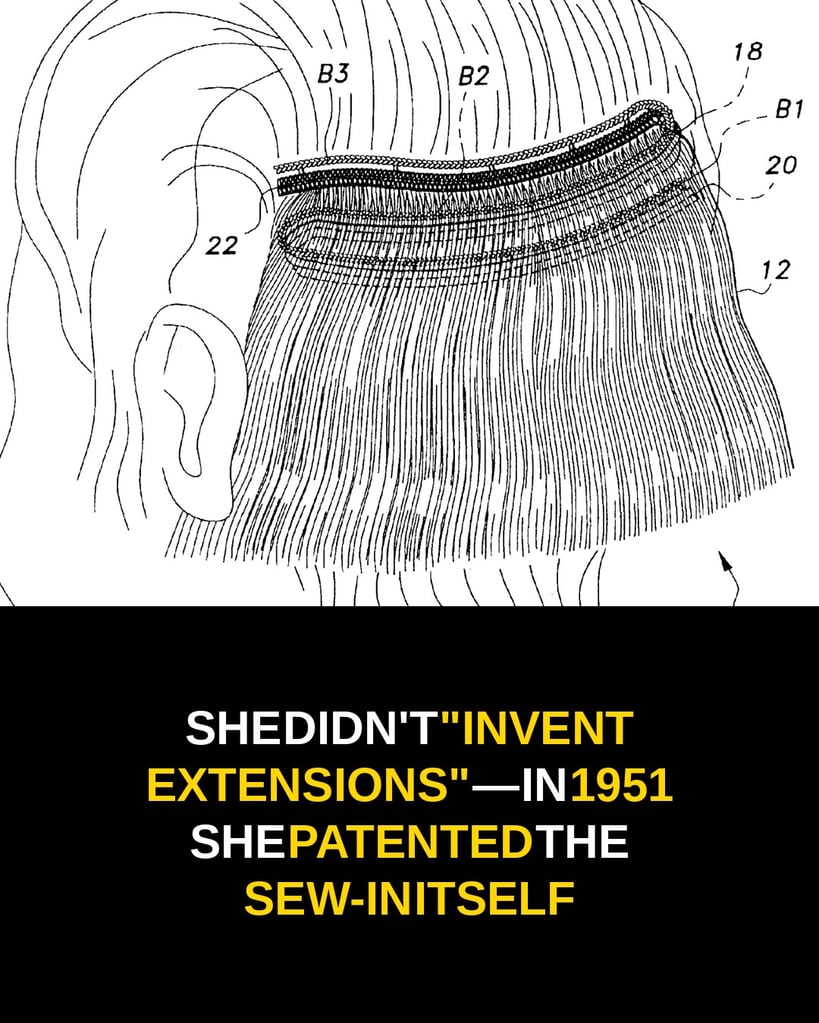
You’ve seen this one: “Christina Jenkins invented hair extensions and patented them in 1951.” It is wrong twice — and the true story underneath it is bigger anyway. She didn’t invent extensions. In 1951 she filed the patent on the modern sew-in method itself, the technique half the world’s stylists still use. Because this page checks before it posts, here is the record, exact.
The claim vs. the truth
The claim: Christina Jenkins invented hair extensions, patented in 1951.
The truth, first half: Extensions are ancient. Sewn-in weaves appear in ancient Egypt — thousands of years before any patent office existed. Nobody in 1951 “invented” them, and claiming so erases millennia of Black and African hair practice that Jenkins herself stood on.
The truth, second half: The patent wasn’t granted in 1951 — it was filed then. Jenkins filed U.S. Patent 2,621,663, “Permanently Attaching Commercial Hair to Live Hair,” on May 4, 1951. It was granted in 1952. Filed 1951, granted 1952 — print it exactly that way, and the story loses nothing.
What she actually built
Christina M. Jenkins was a science graduate — Leland College, 1943 — who worked for a Chicago wig manufacturer from 1949. What she developed was a method: attaching commercial hair permanently to a client’s own hair by interweaving strands of live hair and commercial hair with cord, sewn onto braids. That is the foundation of today’s sew-in. She called the technique the Hair-Weev.

Then she built an empire on it that the viral posts skip entirely. From Ohio, she ran Christina’s Academy of Hair-Weev and the Hair-Weev Penthouse Salon in Shaker Heights until 1993. She founded the National Hair-Weev Association in 1960. She trained and licensed stylists across the United States and Europe. This wasn’t a lone inventor with a certificate — it was an institution-builder who taught her method on two continents for four decades.
The honest ending
And here is the ending the feel-good versions leave out. Salons used her technique widely without paying her for it. The patent was overturned in litigation in 1965. The industry got the invention; Jenkins never got rich from it.
That ending doesn’t shrink her — it places her in a line this page knows well, with inventors like Marjorie Joyner, whose work enriched everyone except its creator. The sew-in you can book in any salon in America descends from a method a science graduate from Leland College worked out in Chicago, patented properly, taught for forty years, and was never properly paid for. The least the record can do is get her dates right.
Join the conversation
Be honest: had you heard “she invented extensions, patented 1951” before today? And tell us — did you know the modern sew-in has a named inventor at all? Tell us below.
Source note: Christina M. Jenkins’s record — a science graduate of Leland College (1943) working for a Chicago wig manufacturer from 1949; her method of permanently attaching commercial hair to live hair by interweaving strands of live hair and commercial hair with cord, sewn onto braids, as the foundation of today’s sew-in, which she called the Hair-Weev; filing U.S. Patent 2,621,663, “Permanently Attaching Commercial Hair to Live Hair,” on May 4, 1951, granted in 1952; running Christina’s Academy of Hair-Weev and the Hair-Weev Penthouse Salon in Shaker Heights, Ohio until 1993; founding the National Hair-Weev Association (1960) and training and licensing stylists across the U.S. and Europe; and the patent’s overturning in litigation in 1965, with salons using the technique widely without paying her — is from the patent record as analyzed in The Journal of Cutaneous Medicine (May 2020) and Stylist’s “Forgotten Women” profile. Corrections: hair extensions themselves are ancient (sewn-in weaves appear in ancient Egypt), so Jenkins did not invent them; and “patented in 1951” conflates the filing (May 4, 1951) with the grant (1952).
Tell us in the comments below - we read every single one, and the best takes get featured.