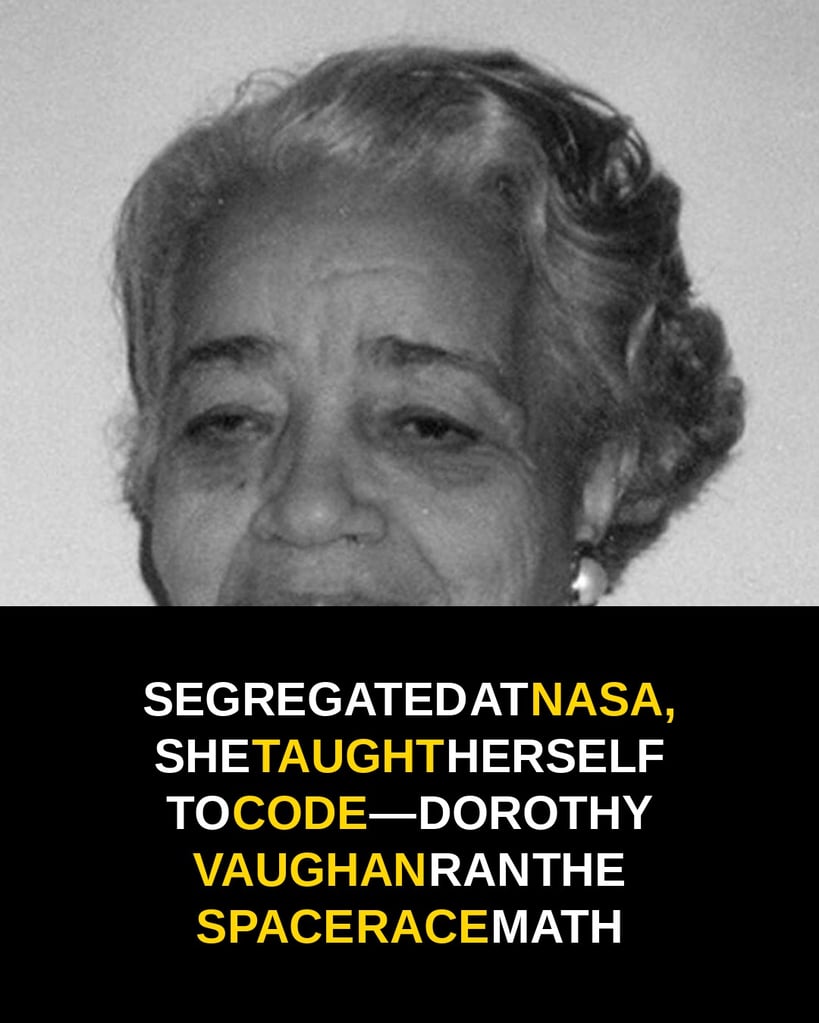
The women who calculated America’s path to space did their math in a segregated room. Dorothy Vaughan didn’t just work in that room — she ran it, and when machines arrived to take the work away, she mastered the machines before they could master her people. Her story is the supervisor’s story: the leader who saw the future coming and marched her whole team into it.
Vaughan was hired in December 1943 into the West Area Computing unit at Langley — then part of NACA, the agency that became NASA. The unit was segregated: Black women mathematicians, doing the calculations flight research ran on, in their own building, under their own roof, apart. In 1949, Vaughan became acting supervisor of the West Computers — the first Black supervisor in NACA history, and one of its very few women supervisors. The role was later made permanent, and she led the unit until 1958.
Leading a segregated unit inside a segregated agency meant doing two jobs at once: the mathematics, and the fight for her women’s assignments, pay and respect. She did both for fifteen years.
She saw the computers coming — and got there first
Then the future knocked. Electronic computers were arriving, and everyone could do the arithmetic on what that meant for a room full of human “computers”: the machines would do the math, and the women would be done. Vaughan’s answer is why her name belongs at the front of the space age. She taught herself FORTRAN — the programming language of the new machines — and then she taught her staff too, turning the women the future was supposed to discard into the people who would run it.
She became an expert programmer and went on to head a programming section of the Analysis and Computation Division, including work supporting the Scout launch vehicle program. The human computers didn’t get replaced. Led by Vaughan, they became the programmers.

A 28-year career, honored at last
Vaughan’s career ran 28 years, until her retirement in 1971. In 2019 she received the Congressional Gold Medal posthumously, as part of the honors for the Hidden Figures group of women whose work the country had taken decades to see. This page has told Katherine Johnson’s story; Vaughan’s is its own and different — not the lone genius at the blackboard, but the woman in charge who refused to let progress be something that happened to her team.
Every era has a Vaughan moment coming: a new machine, a new method, a quiet announcement that the old skills are finished. Her answer, from inside a segregated room in 1950s Virginia, was to learn it first and teach everybody behind her.
Join the conversation
She taught herself to code so her whole team would survive the future. Is Dorothy Vaughan the Hidden Figure your family knows least — and who is the Vaughan in your life, the leader who drags everybody forward with her? Tell us below.
Source note: Dorothy Vaughan’s account — hired in December 1943 into the segregated West Area Computing unit at Langley (then NACA); becoming acting supervisor of the West Computers in 1949, the first Black supervisor in NACA history and one of its few women supervisors, later made permanent and leading the unit until 1958; teaching herself FORTRAN and teaching her staff when electronic computers arrived, becoming an expert programmer and heading a programming section of the Analysis and Computation Division, including work supporting the Scout launch vehicle program; her 28-year career ending with retirement in 1971; and her posthumous Congressional Gold Medal in 2019 among the Hidden Figures group honors — is from the NASA Langley official biography and the Science Museum (London) profile.
Tell us in the comments below - we read every single one, and the best takes get featured.