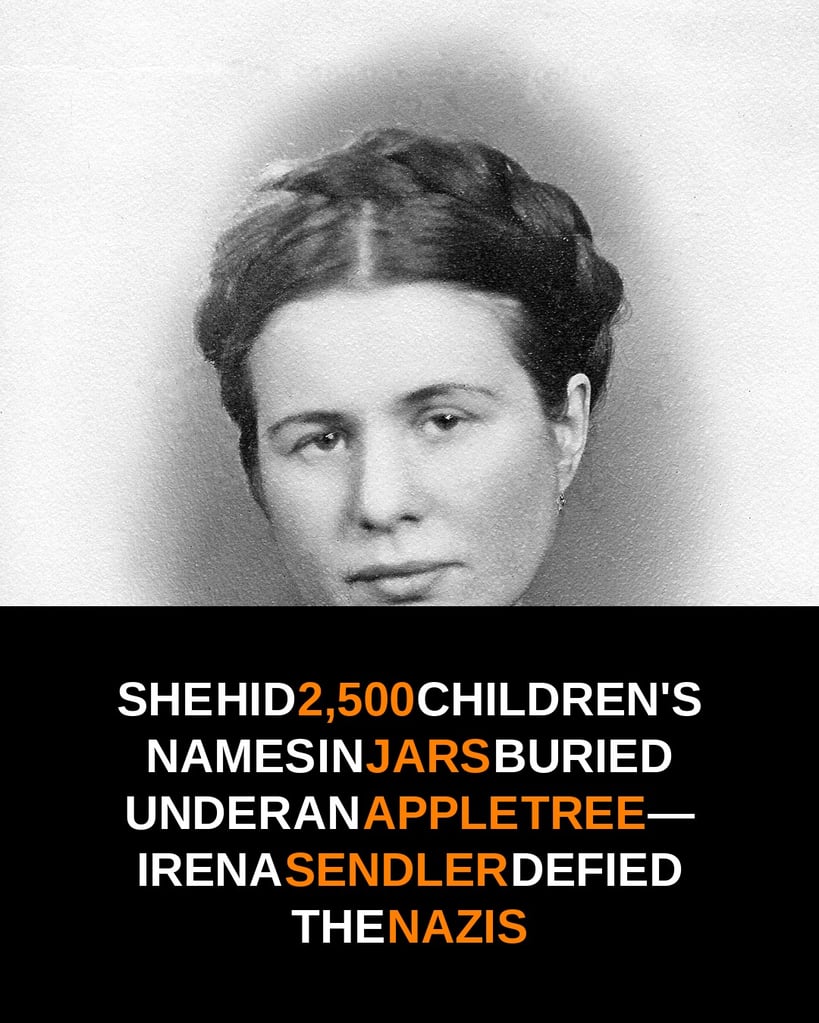
Under an apple tree in Warsaw, jars were buried in the dirt. Inside them, on scraps of paper, were the true names of 2,500 Jewish children — smuggled out of a ghetto, hidden with strangers, and renamed for their own survival. Irena Sendler buried those names so that one day, when the nightmare ended, somebody could give the children their identities back.
Sendler was a Polish social worker in Warsaw. From 1943 she headed the children’s section of Żegota, the Council to Aid Jews — a network that smuggled Jewish children out of the Warsaw Ghetto to safety with Polish families, convents and orphanages. Getting a child out was only half the rescue. A hidden child needed a new name, a new story, a new life — and everything true about them had to be recorded somewhere the Nazis could never find, or the child would be lost forever even if they lived.
So Sendler’s network wrote the names down and buried them in jars. Say the number accurately, because this page always does: the 2,500 figure is the number of children’s names her network recorded and saved. Sendler herself personally carried out several hundred children. The jars were the network’s memory — and her promise that rescue would not mean erasure.
Arrested, tortured — and silent
On October 20, 1943, the Gestapo arrested her. She was tortured — her feet and legs were broken — and she was sentenced to death. She gave them nothing. Not a name, not a jar, not a family hiding a child. Żegota bribed an execution escort, and Sendler walked out of her own death sentence on broken legs, straight back to the work.
Think about what she was protecting from that cell. Not weapons. Not troop movements. Names. The right of 2,500 children to one day learn who they had been before the world tried to unmake them. Tyranny doesn’t only kill people; it tries to delete them. A woman with jars and an apple tree refused to let it.

The honor that took twenty years
In 1965, Yad Vashem named Irena Sendler Righteous Among the Nations. She died in 2008 at 98 — a social worker from Warsaw whose weapon against an empire of murder was paperwork, buried in the ground, kept for children she might never see again.
Some heroes carry people out of burning buildings. Sendler carried them out in her arms, a few hundred at a time — and carried all 2,500 of their names in jars, so the saving would still mean something when the war was over.
Join the conversation
She was tortured and sentenced to death — and protected a list of names instead of herself. Had you ever heard Irena Sendler’s name before today, and does she belong in every history book beside the famous rescuers? Tell us below.
Source note: Irena Sendler’s account — a Polish social worker in Warsaw who from 1943 headed the children’s section of Żegota (the Council to Aid Jews); her network smuggling Jewish children out of the Warsaw Ghetto to Polish families, convents and orphanages; the lists of the children’s true names buried in jars under an apple tree so they could one day be reunited with their families, with 2,500 being the number of names her network recorded and saved while Sendler personally carried out several hundred children; her arrest by the Gestapo on October 20, 1943, her torture (her feet and legs were broken), her death sentence and her release when Żegota bribed an execution escort; her naming as Righteous Among the Nations by Yad Vashem in 1965; and her death in 2008 at 98 — is from the U.S. Holocaust Memorial Museum oral history, Yad Vashem and the Jewish Virtual Library, and the Holocaust Memorial Day Trust.
Tell us in the comments below - we read every single one, and the best takes get featured.