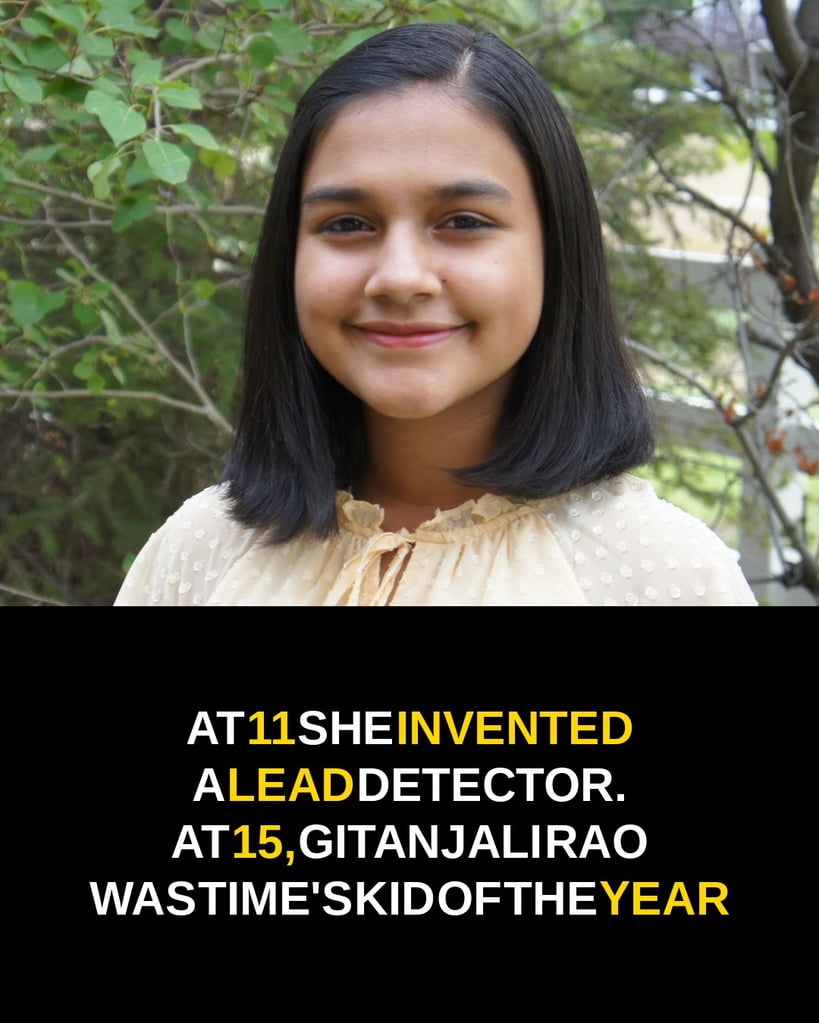
She was 10 years old when she heard about Flint, Michigan — a city where the water itself had become poison, and where testing for lead was slow, expensive and hard for ordinary families to get. Gitanjali Rao of Lone Tree, Colorado didn’t write an essay about it. She built a better test. At 11, her invention won her the title of America’s Top Young Scientist. At 15, TIME named her its first-ever Kid of the Year.
Her device is called Tethys. Working with a 3M research-scientist mentor, Rao built it on carbon-nanotube sensors that detect lead in water and send the results to a phone by Bluetooth — fast answers, from a device a community could actually use, instead of samples mailed away to a lab and results that arrive after the children have kept drinking.
In 2017, Tethys won the Discovery Education 3M Young Scientist Challenge and its $25,000 prize, making the 11-year-old America’s Top Young Scientist. Most adults respond to a water crisis with outrage. She responded with a prototype — and the prototype worked.
One invention was just the beginning
Rao kept building, and the pattern in her choices is the story. She developed Epione, aimed at early detection of opioid addiction risk. She built Kindly, an AI tool against cyberbullying. Lead in water, addiction before it takes hold, cruelty in the comments — every one of her projects is a net thrown over a problem adults complain about and children actually live inside.
In December 2020, TIME named the 15-year-old its first-ever “Kid of the Year,” chosen from about 5,000 nominees. The magazine had honored a Person of the Year for generations; it created the kid version, and the first name on it is a girl from Colorado who heard about poisoned water at 10 and reached for a sensor instead of a slogan.

The update writes itself forward: as of 2025, Gitanjali Rao studies biological engineering at MIT — the 11-year-old with the Bluetooth lead test, training at the highest level to build the next ones. Flint’s children deserved faster answers than the system gave them. One of the fastest arrived from somebody who was nearly their age.
Look at the range of what she chose to build, because the pattern is a worldview. Tethys put a laboratory test in the hands of families drinking questionable water. Epione aimed at detecting opioid addiction risk early, before it could entrench. Kindly took on cyberbullying — the cruelty children inflict in the digital spaces where they now live. Water, addiction, cruelty: each is a problem whose victims are usually told to wait for adults to fix it, and each found a teenager building instead of waiting. TIME’s selection of her as its first Kid of the Year, from about 5,000 nominees in December 2020, was the culture catching up to what the 3M judges had already seen in 2017: this is what a scientist looks like when she starts at 11.
Join the conversation
At 11 she built a working lead detector for a city she’d never lived in. What problem in YOUR neighborhood would you hand to the young people — and do the kids around you know their ideas could be prototypes, not just school projects? Tell us below.
Source note: Gitanjali Rao’s account — of Lone Tree, Colorado, hearing about the Flint, Michigan water crisis at 10 and setting out to build a faster lead test; her device Tethys, built on carbon-nanotube sensors sending results to a phone by Bluetooth and developed with a 3M research-scientist mentor, winning the Discovery Education 3M Young Scientist Challenge in 2017 at age 11 with its $25,000 prize, making her America’s Top Young Scientist; her later projects Epione (early detection of opioid addiction risk) and Kindly (an AI tool against cyberbullying); TIME naming her, at 15 in December 2020, its first-ever “Kid of the Year,” chosen from about 5,000 nominees; and her studying biological engineering at MIT as of 2025 — is from TIME (December 2020), WaterWorld/WQP, and 3M/Discovery Education records.
Tell us in the comments below - we read every single one, and the best takes get featured.