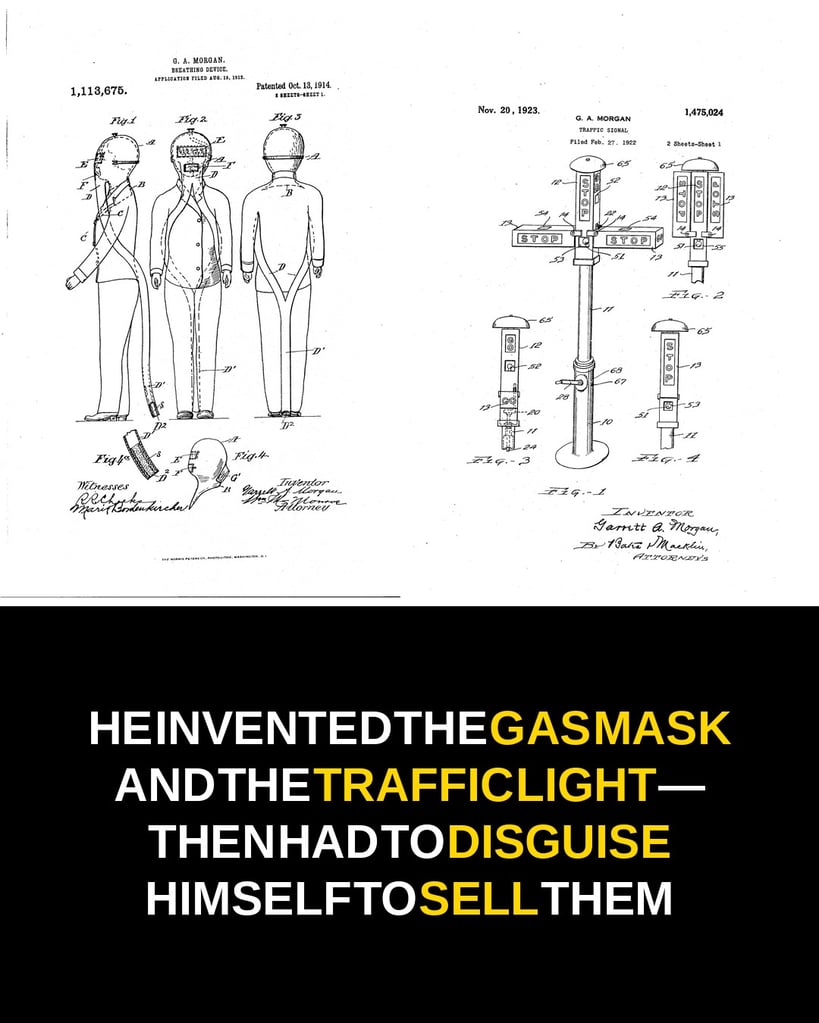
His invention could pull a man out of poisoned air alive. But once buyers found out the inventor was a Black man, they stopped buying — so Garrett Morgan took to demonstrating his own safety hood disguised as a Native American assistant named “Big Chief Mason,” while a white stand-in played the inventor. America bought the device. It just couldn’t be told whose mind it came from.
Morgan, a Black inventor from Kentucky who built his life in Ohio, patented his safety hood — an early gas mask — in 1914. In July 1916, the invention got its trial by fire: an explosion trapped workers in a tunnel under Lake Erie in Cleveland. Morgan and his brother pulled on the hoods and went down into the smoke and gas, pulling survivors out. The rescue made national news, and the hood’s worth was proven in the only court that matters — a tunnel full of men who lived.
And still, the disguise. When orders came in from the South and buyers learned the inventor was Black, sales stalled; Morgan sometimes demonstrated the hood posing as “Big Chief Mason,” the supposed assistant, while another man fronted as the inventor. The device worked. The man had to hide. Both things were true in the same room, at the same demonstration.
The traffic light in every intersection
In 1923, Morgan patented the three-position traffic signal — the forerunner of the yellow light, the pause between stop and go that gives every driver a warning instead of a collision. He sold the rights to General Electric for $40,000. Every intersection you have ever braked through on amber is running on his idea: not just stop, not just go, but a signal in between, because human beings need a breath to be safe.
And because this is a hair page, here is the beat the history books leave in the footnotes: Morgan also founded the G.A. Morgan Hair Refining Company, selling hair products including a hair-straightening cream — one of Cleveland’s early Black hair businesses. The man who made breathing safer and driving safer also built part of our industry, out of the same mind, in the same city.

Hold his three careers side by side and a pattern emerges that this page finds almost unbearably American. The safety hood: a device so effective it survived its inventor having to hide behind a costume to sell it. The traffic signal: an idea so universal that every driver alive obeys it daily without knowing a name attaches to it. The hair company: a Black business built in Cleveland’s Black community, serving Black customers the mainstream industry ignored. Morgan worked every register — life safety, public infrastructure, and his own people’s beauty culture — with the same inventor’s mind, and history kept the inventions while misplacing the man. This page is in the business of putting the man back.
Join the conversation
He had to PRETEND to be his own assistant to sell a mask that saved lives. Did you know the traffic light’s yellow pause and the gas mask trace back to Garrett Morgan — and which of his inventions touches your life every single day? Tell us below.
Source note: Garrett Morgan’s account — a Black inventor from Kentucky/Ohio (1877–1963) who patented his safety hood (an early gas mask) in 1914; the July 1916 explosion in a tunnel under Lake Erie in Cleveland, where Morgan and his brother put on the hoods and pulled survivors out, making national news; the stall in sales once buyers learned the inventor was Black, and Morgan’s demonstrating the hood disguised as a Native American assistant, “Big Chief Mason”; his 1923 patent on the three-position traffic signal, the forerunner of the yellow light, and the sale of the rights to General Electric for $40,000; and his founding of the G.A. Morgan Hair Refining Company, selling hair products including a hair-straightening cream — is from the National Inventors Hall of Fame, the University of Houston’s Engines of Our Ingenuity, and Mental Floss’s coverage of the Cleveland rescue. Sources split on the rescue count, so none is printed.
Tell us in the comments below - we read every single one, and the best takes get featured.