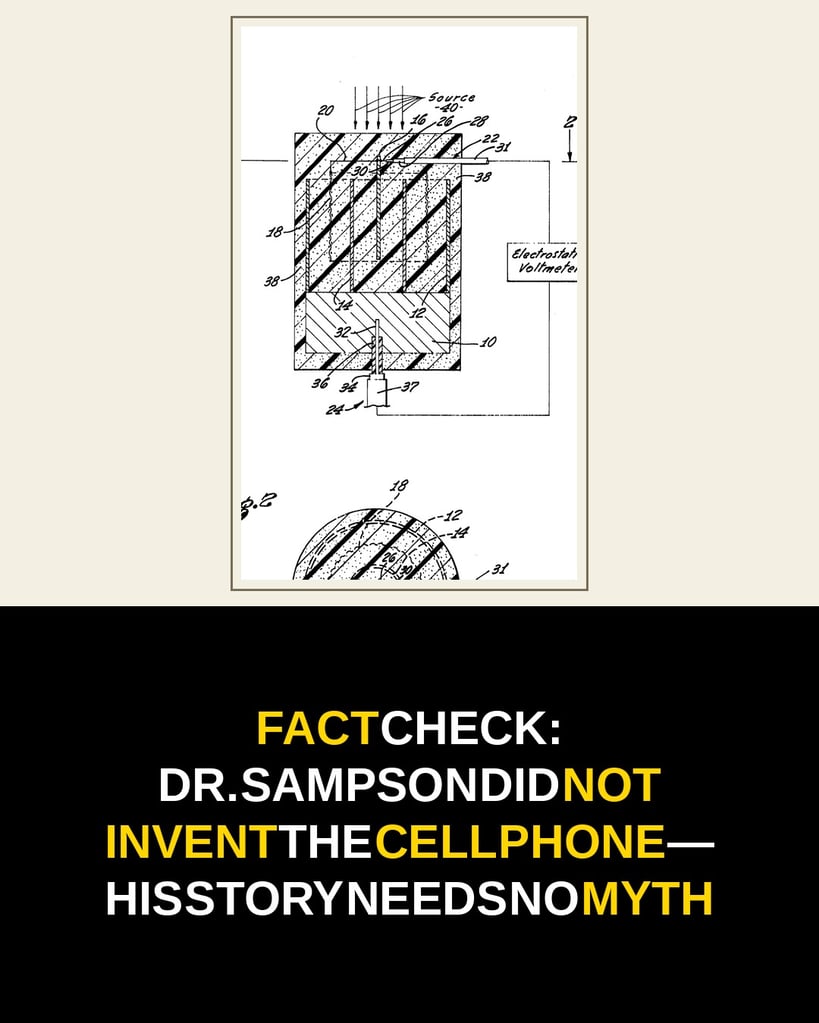
You’ve seen this one, usually with a photo and a flourish: “Dr. Henry Sampson invented the cell phone.” The patent in the post is real — U.S. Patent 3,591,860, granted July 6, 1971. But open the patent and the story falls apart, because what Henry Sampson actually invented has nothing to do with telephones. This page corrects the record the respectful way: his real story needs no myth.
The claim vs. the truth
The claim: Dr. Henry T. Sampson Jr. invented the cell phone, based on his July 6, 1971 patent.
The truth: The patent, granted to Sampson and George H. Miley, covers a gamma-electric cell — a device that converts gamma radiation into electricity, designed to draw auxiliary power from a nuclear reactor’s shielding. It is nuclear engineering, not telephony. The confusion seems to grow out of two ordinary words sitting side by side: “electric” and “cell.” A gamma-electric cell is a power cell — a battery-like device — not a cellular phone. The first handheld mobile phone, for the record, was demonstrated by Martin Cooper of Motorola in 1973.
The real story the myth buries
Here is what the viral version steals from Dr. Sampson: his actual record, which is extraordinary enough to stand in any room. In 1967, Henry Sampson became the first African American in the United States to earn a PhD in nuclear engineering, from the University of Illinois, after an engineering degree from Purdue. He spent his career at the Aerospace Corporation, working on satellites and space power systems — the power engineering behind things that actually do fly over our heads.
And he had a second life the myth never mentions: Sampson was a respected film historian who wrote landmark books documenting Black performers in early cinema and radio — preserving a cultural record the industry itself had neglected, with the same precision he brought to a reactor.

He died on June 4, 2015. Honor him accurately: not as the inventor of a phone he never built, but as the first Black American nuclear engineering PhD, a space-power specialist, and a historian who spent his life making sure real achievements — his own people’s — were written down correctly. Getting his facts right isn’t a downgrade. It’s the assignment he himself took up.
Consider what he actually spent his life doing, because each piece of it is a “first” or a foundation the myth pushes aside. A Purdue engineering degree when few Black men were admitted to the field at all. Then, in 1967, the first PhD in nuclear engineering earned by an African American in the United States, from the University of Illinois. Then a career at the Aerospace Corporation on satellites and space power systems — the unglamorous, exacting engineering that keeps spacecraft alive. And in parallel, the film histories: landmark books documenting Black performers in early cinema and radio, rescuing names the industry had let fall out of the record. The cell phone myth doesn’t just credit him wrongly; it replaces a documented pioneer with a fairy tale, when the documentation was the man’s whole second profession.
Join the conversation
Be honest: had you shared the cell phone version before today? And which Dr. Sampson impresses you more — the nuclear engineer and satellite man, or the myth? We’d argue the real one wins by a mile. Tell us below.
Source note: The Dr. Henry Sampson correction — the viral claim naming Henry T. Sampson Jr. “inventor of the cell phone” on the basis of U.S. Patent 3,591,860, granted July 6, 1971 to Sampson and George H. Miley; the patent in fact covering a gamma-electric cell, a device converting gamma radiation into electricity designed to draw auxiliary power from a nuclear reactor’s shielding, unrelated to telephony, with the confusion apparently arising from the words “electric” and “cell”; the first handheld mobile phone being demonstrated by Martin Cooper of Motorola in 1973; Sampson becoming in 1967 the first African American in the U.S. to earn a PhD in nuclear engineering (University of Illinois, after a Purdue engineering degree); his career at the Aerospace Corporation working on satellites and space power systems; his standing as a film historian who wrote landmark books on Black performers in early cinema and radio; and his death on June 4, 2015 — is from BlackPast.org, the Purdue University College of Engineering, and the patent record itself.
Tell us in the comments below - we read every single one, and the best takes get featured.