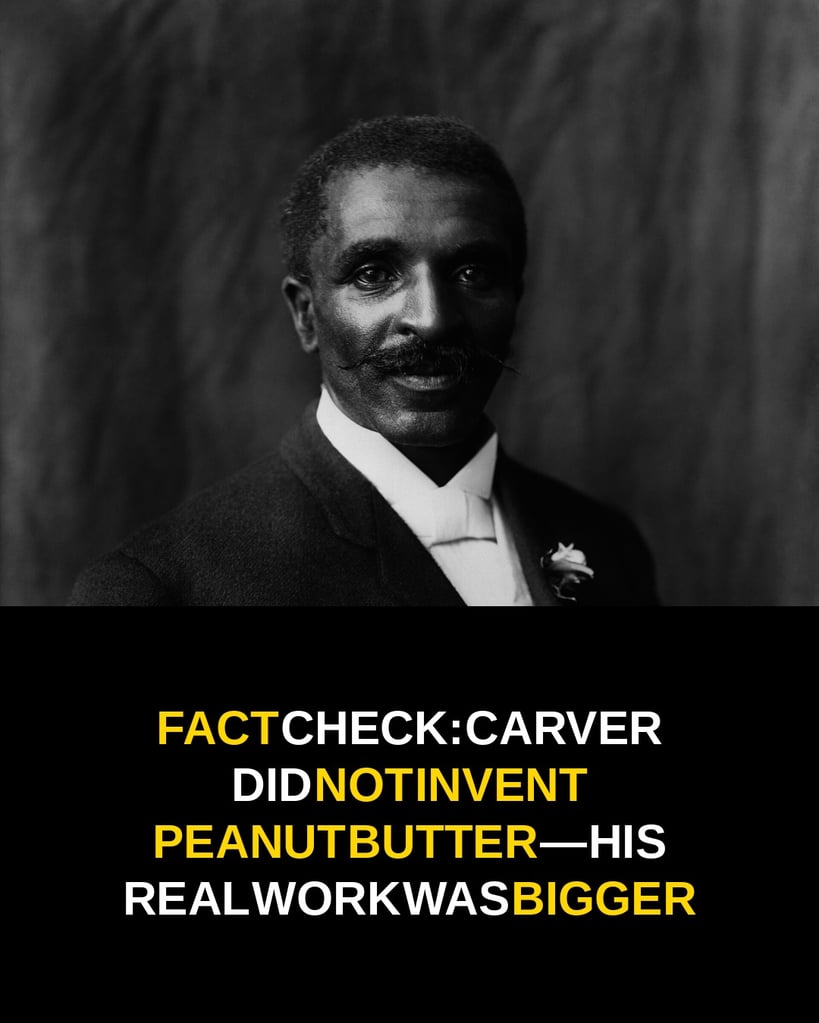
You’ve seen this one: “George Washington Carver invented peanut butter.” It’s shared with love, by people honoring a great man. It’s also false — and the man himself never claimed it. Because this page checks before it posts, here is the record: Carver didn’t invent peanut butter. What he actually did was bigger, harder, and aimed at something peanut butter never fed — the freedom of poor Black farmers.
The claim vs. the truth
The claim: George Washington Carver invented peanut butter (often with a bonus claim that he single-handedly invented hundreds of products).
The truth: Peanut pastes go back to the Aztec and Inca. In the modern patent record, Marcellus Gilmore Edson patented a peanut paste in 1884, and John Harvey Kellogg patented a peanut-butter process in 1895 — both before Carver’s peanut work at Tuskegee began. Carver never claimed the invention. It isn’t his, and saying so takes nothing from him, because his real record doesn’t need a borrowed condiment.
What he actually did at Tuskegee
Carver’s mission was soil and survival. Southern farms were trapped in cotton monoculture — one crop, planted until the land was exhausted, leaving Black farmers poorer every year. Peanuts and other rotation crops could restore the soil, but only if farmers had reasons to grow them and uses for what they grew.
So Carver became the peanut’s greatest publicist. His 1916 bulletin, How to Grow the Peanut and 105 Ways of Preparing It for Human Consumption, listed 105 peanut preparations. His published lists went on to publicize more than 300 uses for peanuts and other crops — dyes, paints, plastics, gasoline, cosmetics and more. Print the verb the way the record supports: he publicized and promoted those uses — Smithsonian notes many list items were compiled from existing publications, which Carver himself acknowledged, crediting more than 20 sources.

His whole patent count across a lifetime of genius? Three. He deliberately shared his knowledge freely instead of fencing it off for profit. The lists were never the point. The point was a poor farmer in Alabama with worn-out land, handed a crop, a market and a way out of cotton — by a scientist who could have gotten rich and chose to get farmers free instead.
Notice, too, the honesty built into Carver’s own method — the quality the myth accidentally erases. When his lists compiled uses from existing publications, he said so, crediting more than twenty sources rather than posing as the lone origin of every idea. That is the opposite of how legends usually behave, and it is exactly why the correction honors him: Carver practiced attribution while the internet version of him practices exaggeration. A scientist who shared credit, shared knowledge and held only three patents by choice does not need a borrowed invention to be great. He needs his readers to be as careful as he was.
Join the conversation
Be honest: were you taught that Carver “invented peanut butter”? And does the real story — a man who gave away 300+ ideas so poor farmers could escape dead soil — honor him more, or less, than the myth? Tell us below.
Source note: The George Washington Carver correction — peanut pastes dating to the Aztec and Inca; Marcellus Gilmore Edson’s 1884 peanut-paste patent and John Harvey Kellogg’s 1895 peanut-butter process patent, both predating Carver’s peanut work, which Carver never claimed as his invention; his 1916 Tuskegee bulletin How to Grow the Peanut and 105 Ways of Preparing It for Human Consumption listing 105 peanut preparations; his published lists publicizing 300+ uses for peanuts and other crops (dyes, paints, plastics, gasoline, cosmetics), with many items compiled from existing publications as Carver acknowledged in crediting 20+ sources; his holding only three patents in his life and deliberately sharing his knowledge freely; and his mission of crop rotation and practical help for poor Black farmers escaping cotton monoculture and worn-out soil — is from Smithsonian Magazine, the Tuskegee University archives, and National Park Service myth/fact coverage.
Tell us in the comments below - we read every single one, and the best takes get featured.