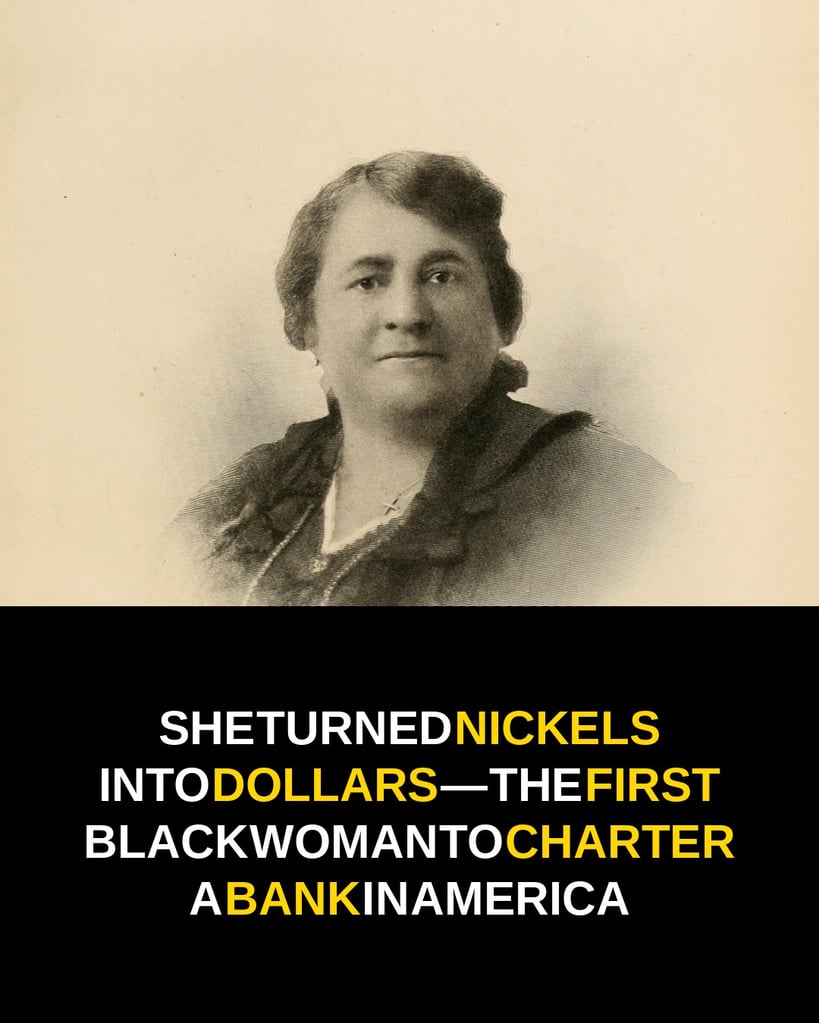
Her whole financial philosophy fit in four words: turn nickels into dollars. Maggie Lena Walker of Richmond, Virginia, took the small change of working Black families — money the big banks wouldn’t bother with — and built it into an empire of institutions. In 1903 she chartered the St. Luke Penny Savings Bank and served as its first president: the first African American woman to charter a bank in United States history.
Walker didn’t start with the bank. She started with the Independent Order of St. Luke, a fraternal organization she rebuilt from near-bankruptcy into a force of roughly 100,000 members in 24 states. On that foundation she stacked institutions the way her philosophy stacked coins: the St. Luke Herald newspaper in 1902, so her community had its own voice; the St. Luke Emporium department store, so its money could circulate at home; and then the bank, so its savings could become homes.
That last part is the heart of the whole story. By 1920, the St. Luke Penny Savings Bank had financed at least 600 Black families’ home purchases. Six hundred families — in Jim Crow Virginia — holding deeds because a woman in Richmond decided nickels were worth banking and Black borrowers were worth lending to, decades before the rest of American finance would say either thing out loud.
An institution that outlived the century
In 1930 the bank merged into Consolidated Bank and Trust — which remained the oldest continually Black-operated bank in America until 2009. Run that timeline slowly. A bank chartered in 1903 by a Black woman, when Black women could not yet vote in Virginia, was still standing as the nation’s oldest Black-operated bank more than a century later. Institutions built that well don’t just serve their customers. They testify.
Walker built all of it from Richmond’s Jackson Ward, on the membership dues and trust of ordinary people, with a motto any grandmother on this page would recognize: small money, faithfully gathered, is big money. She didn’t wait for Wall Street to discover her community’s worth. She chartered the proof herself, signed her name as president, and lent the nickels back as mortgages.
Walker’s order of operations teaches as much as her bank does. She did not begin by asking a legislature for a charter or a white bank for a loan. She began with membership — roughly 100,000 members in 24 states, organized through the Independent Order of St. Luke, rebuilt from near-bankruptcy on trust. Then came communication, the St. Luke Herald in 1902, so the organization had its own voice. Then commerce, the St. Luke Emporium, so dollars could circulate inside the community. Only then, on that foundation of people, voice and trade, did the bank arrive in 1903 — which is why it lasted. The St. Luke Penny Savings Bank wasn’t a building with money in it. It was the financial expression of an organization that already existed, and institutions built in that order are the ones still standing in 2009 as the oldest continually Black-operated bank in the country.
Join the conversation
A newspaper, a department store, 100,000 members — and a bank that financed 600 Black families into homes by 1920. Did you learn Maggie Lena Walker’s name in school? And who is the nickels-into-dollars builder in YOUR family’s story? Tell us below.
Source note: Maggie Lena Walker’s account — building the Independent Order of St. Luke from near-bankruptcy into a fraternal organization of roughly 100,000 members in 24 states; founding the St. Luke Herald newspaper (1902) and the St. Luke Emporium department store; chartering the St. Luke Penny Savings Bank in 1903 and serving as its first president, the first African American woman to charter a bank (and serve as a bank president) in U.S. history, in the National Park Service’s phrasing; her “nickels into dollars” philosophy; the bank having financed at least 600 Black families’ home purchases by 1920; and the bank’s 1930 merger into Consolidated Bank and Trust, which remained the oldest continually Black-operated bank in America until 2009 — is from the National Park Service (Maggie L. Walker National Historic Site), the Virginia Museum of History & Culture, and the Federal Reserve Bank of Richmond.