
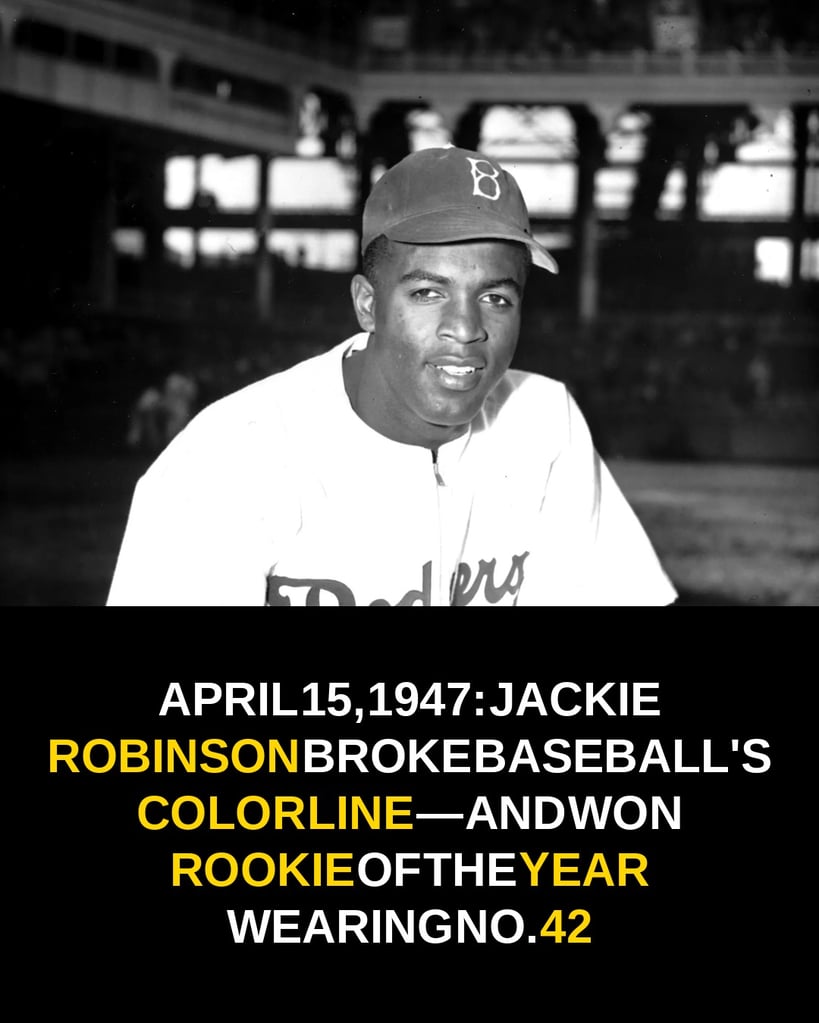
Some debuts are just a first game. April 15, 1947 was a door breaking. That day at Ebbets Field, Jackie Robinson started at first base for the Brooklyn Dodgers and broke Major League Baseball’s modern-era color barrier — and then, under pressure no rookie before or since has carried, he won the inaugural Rookie of the Year Award doing it.
Say the era precisely, the way this page prints it: the modern era color barrier. Fleet Walker had played in the majors back in 1884, before the line was drawn and hardened. Robinson broke the modern line — the one that had kept Black players out for decades — after a season with the Kansas City Monarchs in 1945 had shown exactly what the majors were excluding.
And make no mistake about what he did once the door was open. This was not a symbolic roster spot. In his rookie season Robinson hit .297, launched 12 home runs and led the league with 29 stolen bases — daring, disruptive baseball, played in the open, in front of everyone. The league named him its first Rookie of the Year. The barrier-breaker wasn’t a guest in the game. He was immediately one of its best players.
1949: the MVP, and a number nobody else can wear
Two years later he removed all doubt. In 1949 Robinson became the first Black player named National League MVP, winning the batting title at .342 with 37 stolen bases and 124 RBI. First Black MVP, two years after first modern-era game — that is the speed at which excellence answered every ugly argument made against his presence.
The full record still staggers: six straight All-Star selections from 1949 to 1954, a World Series title in 1955, a career .311 batting average across 10 seasons, and first-ballot election to the Hall of Fame in 1962. He died on October 24, 1972, far too young — but baseball had one more honor waiting that no player of any era can match.
In 1997, his No. 42 was retired by every Major League team — the number taken out of circulation across the entire sport, worn by all players together each April 15. Every other number belongs to a team. Forty-two belongs to the day the modern game finally opened, and to the man who opened it by being undeniable: Rookie of the Year the year he arrived, MVP two years after that, champion, Hall of Famer, and a standard of grace under fire that this page will keep naming as long as baseball is played.
Join the conversation
What do you think it took — in skill and in sheer nerve — to break that line AND perform at an MVP level at the same time? And every April 15, when every player wears 42, what does that number say to the young players in your family? Tell us below.
Source note: Jackie Robinson (1919–1972) — playing a season with the Kansas City Monarchs in 1945 before breaking Major League Baseball’s modern-era color barrier on April 15, 1947, starting at first base for the Brooklyn Dodgers at Ebbets Field, with “modern era” printed because Fleet Walker played in the majors in 1884; his rookie season of a .297 average, 12 home runs and a league-leading 29 stolen bases, winning the inaugural MLB Rookie of the Year Award; his 1949 season as the first Black player named National League MVP, winning the batting title at .342 with 37 steals and 124 RBI; six straight All-Star selections (1949–54), a World Series title in 1955, a career .311 average over 10 seasons and first-ballot election to the Hall of Fame in 1962; his No. 42 being retired by every MLB team in 1997 and worn by all players each April 15; and his death on Oct 24, 1972 — is from the National Baseball Hall of Fame, the Jackie Robinson Museum and UCLA.

