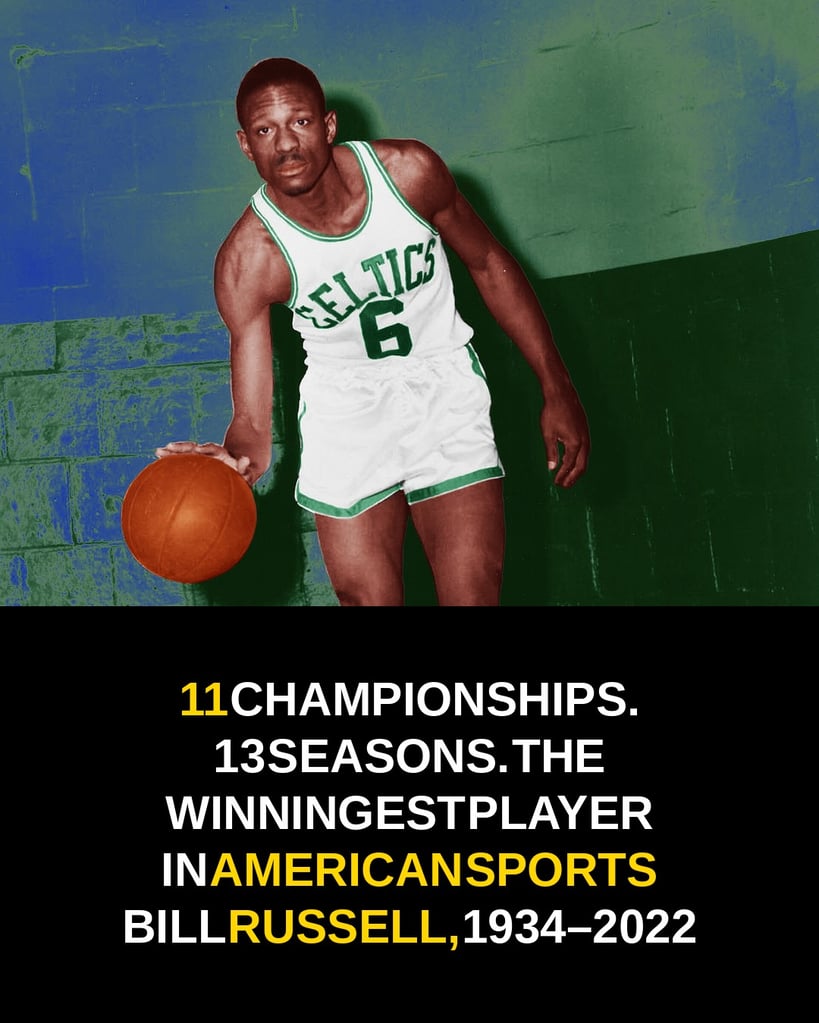
Eleven championships in thirteen years. No player in a major American team sport has matched that record, and it belonged to Bill Russell, who anchored the Boston Celtics from 1956 to 1969. He did not just win more than anyone else. In 1966, still playing, he became the first Black head coach in any major North American professional sports league — and won in that role, too. This is a tribute to the greatest winner in American team sports.
Bill Russell was born on February 12, 1934, in Monroe, Louisiana. Before Boston, he won two NCAA championships at the University of San Francisco and Olympic gold in 1956. Read that sequence again: champion in college, champion on the Olympic stage, and then he arrived in Boston and built the longest winning run his sport has ever seen.
Eleven in thirteen
With Russell anchoring the Celtics from 1956 to 1969, Boston won 11 NBA championships in 13 seasons. Inside that run were eight straight titles, from 1959 to 1966 — year after year after year, with every other team in the league aiming directly at them, and the result staying the same.
The individual honours matched the team record. Russell won five league MVP awards — in 1958, 1961, 1962, 1963 and 1965 — and he was selected as an All-Star 12 times. Five MVPs and 11 championships tell two sides of one story: he was recognised as the league’s most valuable player again and again, on teams that finished the job again and again.
Plenty of great players have won a championship. A few have won several. Eleven in thirteen seasons is a different category altogether — a record no player in a major American team sport has matched. That is not an opinion added to his story. It is the standing record his career left behind.
The first Black head coach
In 1966, Russell became the first Black head coach in any major North American professional sports league. He took the role as player-coach — leading the Celtics while still anchoring them on the court — and he won two more titles in that role.
Pause on what that meant. The barrier he broke was not only about one team or one sport. It was the head coaching position itself, in every major league, opened for the first time — by a man who was still playing, still winning championships, and now responsible for the whole team as well as his own game. He carried both jobs and closed both with titles.
The honours that followed
President Obama awarded Russell the Presidential Medal of Freedom in 2011. And since 2009, the NBA Finals MVP award has carried his name — so the player judged best in the Finals each year receives an award named for the man who won the Finals more times than anyone.
Bill Russell died on July 31, 2022, at 88. He left behind 11 championships in 13 seasons, eight straight titles, five MVP awards, 12 All-Star selections, two NCAA championships, Olympic gold, a barrier broken as a coach, a Medal of Freedom, and his name on the Finals MVP award. Winners are measured by what they won and what they opened. Russell’s measure, on both counts, is still unmatched.
Join the conversation
Eleven championships in thirteen years — do you think any player in a major American team sport will ever match it? And be honest: did you know Russell was also the first Black head coach? Tell us below.
Source note: Bill Russell’s story — Bill Russell (February 12, 1934, Monroe, Louisiana – July 31, 2022, age 88); anchoring the Boston Celtics from 1956 to 1969 to 11 NBA championships in 13 seasons, a record no player in a major American team sport has matched, including eight straight titles (1959–66), five league MVP awards (1958, 1961, 1962, 1963, 1965) and 12 All-Star selections; two NCAA championships at the University of San Francisco and Olympic gold in 1956 before Boston; becoming in 1966 the first Black head coach in any major North American professional sports league, as player-coach, and winning two more titles in that role; the Presidential Medal of Freedom awarded by President Obama in 2011; and the NBA Finals MVP award carrying his name since 2009 — is from Sports Illustrated / AP obituaries (July 31, 2022), BlackPast, and NBA records. This piece is a tribute, in past tense.