
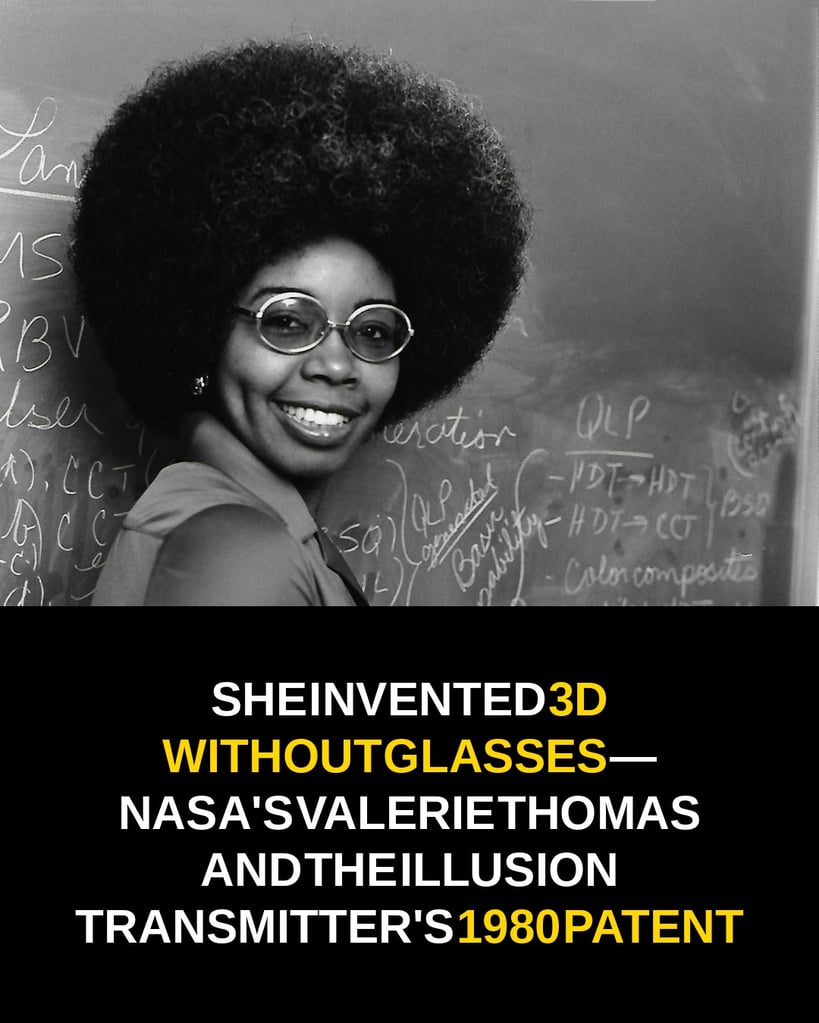
No glasses. No headset. Just a realistic 3D image, floating in front of you. Valerie Thomas patented that idea in 1980 — decades before 3D became a marketing word — and she did it at NASA, where she had already helped teach satellites to see the Earth. Her invention is called the illusion transmitter, and her name deserves to travel with it.
Valerie Thomas was born on February 8, 1943, in Maryland. She earned her physics degree from Morgan State as one of only two women in her class — sit with that for a moment — and in 1964 she joined NASA’s Goddard Space Flight Center as a data analyst. Two women in the class. One very long career at the frontier of what images could do.
At NASA, Thomas manages a résumé that would be a career highlight reel for anyone. She managed development of the image-processing systems for Landsat — the first satellite program to send multispectral images of Earth from space — and she led the Large Area Crop Inventory Experiment, an early proof that satellites could predict crops worldwide. Before most of the world had seen a single satellite picture, she was helping build the systems that made those pictures useful.
The floating lightbulb
Then came the moment inventors dream about. In 1976, Thomas saw a demonstration using concave mirrors that made a lightbulb seem to float in space. Most people would have called it a neat trick and walked on. She spent four years turning the principle into a device.
The result was the illusion transmitter, which projects realistic 3D images using parabolic mirrors — no glasses needed. U.S. Patent 4,229,761 was issued on October 21, 1980. The core idea she patented is still being explored today: descendants of her technology are explored for medical imaging and entertainment, fields still chasing the same dream she chased in 1976 — images with real depth, right in front of your eyes.
Her NASA story didn’t end at the patent office. Thomas later managed NASA’s SPAN network — an early computer network linking scientists — and she retired in 1995 as associate chief of the Space Science Data Operations Office. Analyst, Landsat systems lead, crop-experiment leader, inventor, network manager, associate chief: that is not a footnote career. That is a pillar career, built inside one of the most demanding scientific institutions on Earth.
Thomas is still with us, and her work lives in the long arc of imaging itself — from the first multispectral pictures of Earth beamed down from orbit, to a patented mirror system that puts a 3D image in the air in front of you. One of two women in her physics class. Remember what she did with the room she was given.
Join the conversation
Be honest — had you ever heard the words “illusion transmitter” before today, let alone the name of the Black woman at NASA who patented it in 1980? And where would YOU want glasses-free 3D most — a doctor’s office or your living room? Tell us below.
Source note: Valerie Thomas’s story — born February 8, 1943, in Maryland; her physics degree from Morgan State as one of only two women in her class; joining NASA’s Goddard Space Flight Center in 1964 as a data analyst; managing development of the image-processing systems for Landsat, the first satellite program to send multispectral images of Earth from space; leading the Large Area Crop Inventory Experiment; the 1976 concave-mirror demonstration that made a lightbulb seem to float in space; four years of work leading to the illusion transmitter, which projects realistic 3D images using parabolic mirrors with no glasses needed; U.S. Patent 4,229,761 issued October 21, 1980; later managing NASA’s SPAN network; retiring in 1995 as associate chief of the Space Science Data Operations Office; and her technology’s descendants being explored for medical imaging and entertainment — is from NASA, the Lemelson Center (Smithsonian), and Wikipedia (patent data).