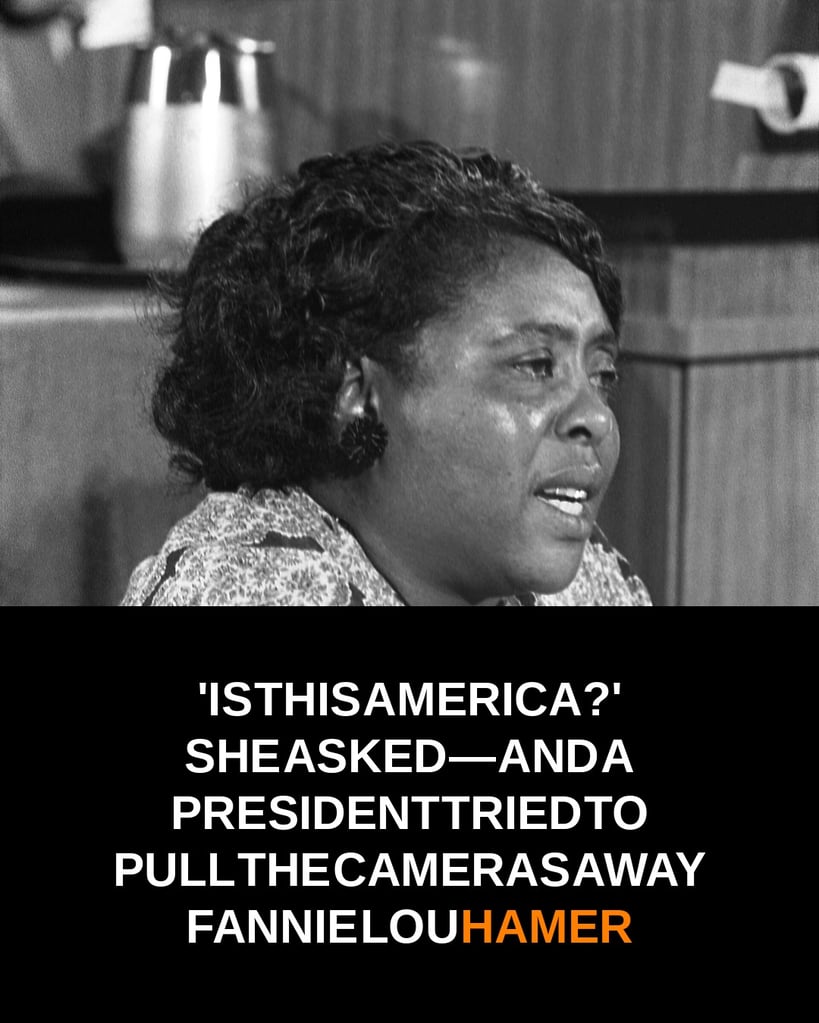
She was 44 years old before anyone told her she had the legal right to vote. Two years later, her testimony was so powerful that a President of the United States staged a press conference just to pull the television cameras away from her. Her name was Fannie Lou Hamer.
Fannie Lou Hamer was born on October 6, 1917, in Montgomery County, Mississippi — the youngest of 20 children, and a lifelong sharecropper. Her life was the life Mississippi had assigned her: work the land, keep your head down, expect nothing from the system. For 44 years, nobody told her the system owed her a voice.
Then, at a 1962 SNCC meeting, she learned that Black citizens had the legal right to register to vote. Forty-four years old. Sit with that number. It was not that she had been denied the right — it was that the right had been hidden from her, in plain sight, for her entire adult life. What Hamer did with that knowledge, in the short time that followed, is one of the great American stories.
Beaten in Winona — and unbroken
She became a field secretary and organizer, registering voters in the heart of Mississippi. The price came due fast. In June 1963, jailed in Winona, Mississippi, she was beaten so severely by officers and forced inmate attackers that she carried permanent kidney damage, a blood clot in her left eye and a limp for the rest of her life.
Read that again. Kidney damage for life. A blood clot in her eye. A limp she never lost. That was the cost of telling sharecroppers they could vote — and Hamer paid it, and then went back to organizing. The beating was meant to be a message. She turned it into testimony.
“Is this America?”
Hamer co-founded the Mississippi Freedom Democratic Party, and on August 22, 1964, she gave televised testimony before the Democratic convention’s Credentials Committee. She told the country what had been done to her, and she asked the question that still echoes: “Is this America, the land of the free and the home of the brave?”
Her testimony was so powerful that President Lyndon Johnson called an impromptu press conference specifically to pull the cameras away from her. Think about that. The most powerful man in the country rearranged his day to interrupt a sharecropper from Mississippi — because her truth, live on television, was more powerful than his office. It did not work. The networks aired her testimony in full that evening anyway, and America heard every word.
Fannie Lou Hamer died on March 14, 1977, at 59. She had only learned of her own right to vote at 44 — and in the years she had left, she made sure millions would never have to wait that long to learn of theirs.
Join the conversation
Age 44 before she knew. Beaten in Winona. A president trying to cut her off — and the networks airing her in full that night. Had you heard Fannie Lou Hamer’s full story before today? Tell us below.
Source note: Fannie Lou Hamer’s story — born October 6, 1917, in Montgomery County, Mississippi, the youngest of 20 children and a lifelong sharecropper, and died March 14, 1977, at 59; learning at 44, at a 1962 SNCC meeting, that Black citizens had the legal right to register to vote; her work as a field secretary and organizer; the June 1963 beating in a Winona, Mississippi jail by officers and forced inmate attackers, which left her with permanent kidney damage, a blood clot in her left eye and a limp for the rest of her life; her co-founding of the Mississippi Freedom Democratic Party; and her televised testimony on August 22, 1964, before the Democratic convention’s Credentials Committee — “Is this America, the land of the free and the home of the brave?” — after which President Lyndon Johnson called an impromptu press conference to pull the cameras away, while the networks aired her testimony in full that evening anyway — is from the Smithsonian National Museum of African American History and Culture and the SNCC Digital Gateway (via sourced profiles).