
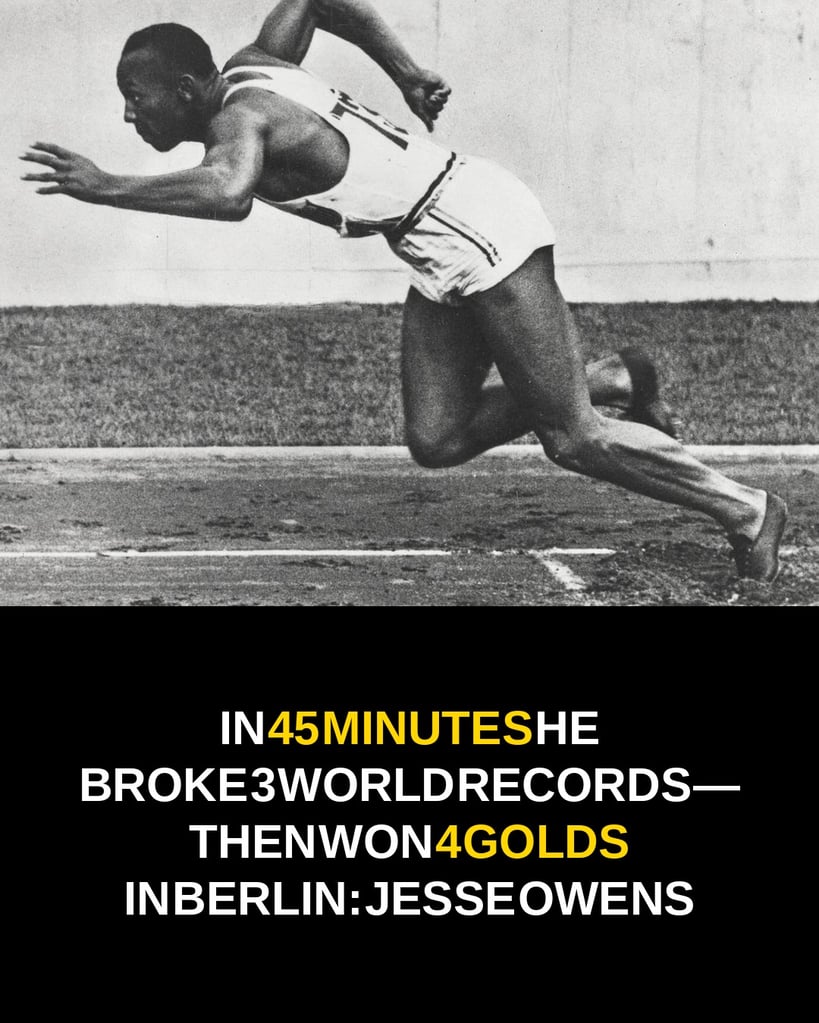
It is still called the greatest 45 minutes in sports — and the man who produced it then walked into the most hostile stadium on Earth and took home four gold medals. James Cleveland “Jesse” Owens, Ohio State’s “Buckeye Bullet,” did in one afternoon and one Olympics what most legends need a whole career to approach. And the coldest reception of his life was not waiting for him overseas. It was waiting for him at home.
Start with Ann Arbor. At the Big Ten meet on May 25, 1935, Owens set three world records and tied a fourth — in about 45 minutes. Forty-five minutes. Most athletes dream of one world record in a lifetime; Owens stacked three, plus a tie, inside a single afternoon, including a long jump world record of 8.13 m that stood for 25 years. A quarter of a century passed before anyone on Earth jumped farther than Jesse Owens did that day.
Then came Berlin, 1936 — an Olympics staged as Nazi propaganda, built to showcase a supposed master race to the world. Owens answered it the only way that could not be argued with: on the track, in front of everyone.
Four golds, one friendship, and the real snub
Owens won four gold medals in Berlin: the 100 m in 10.3, the long jump at 8.06 m — an Olympic record — the 200 m, and the 4×100 m relay, in a world record 39.8 that stood for 20 years. He was the first American track athlete to win four golds at one Games, a feat unmatched until Carl Lewis in 1984.
His long-jump duel came with German rival Luz Long — and here the true story is better than any myth. Long famously advised Owens on his run-up, helped his competitor in the middle of the competition, and was the first to congratulate him. That is what the record actually shows, and it is worth more than the viral version, because it is two athletes honoring the sport while the propaganda machine ground on around them.
Now for the homecoming beat this page will print honestly. Owens returned to a segregated America — and received no White House invitation from President Roosevelt. Owens himself said Hitler waved at him; the documented snub was at home, from his own country’s president, who never invited the four-time gold medalist to the White House. A man could shatter the master-race stage in Berlin and still come home to a country that would not set him a place at its own table. He carried that with the same grace he carried everything else, and he kept running in the memory of the world long after. Owens died March 31, 1980 — and that 45 minutes, and those four golds, have never been topped for sheer concentrated greatness.
Join the conversation
Which hits YOU harder — the 45 minutes in Ann Arbor, the four golds in Berlin, or the empty mailbox from the White House when he came home? And should Luz Long’s name be taught right alongside Owens’s? Tell us below.
Source note: James Cleveland “Jesse” Owens (1913–1980), Ohio State’s “Buckeye Bullet,” set three world records and tied a fourth in about 45 minutes at the Big Ten meet in Ann Arbor on May 25, 1935, including a long jump world record of 8.13 m that stood for 25 years; at the Berlin Olympics of 1936, staged as Nazi propaganda, he won four gold medals — the 100 m (10.3), the long jump (8.06 m, an Olympic record), the 200 m, and the 4×100 m relay (a world record 39.8 that stood 20 years) — the first American track athlete to win four golds at one Games, a feat unmatched until Carl Lewis in 1984; his long-jump duel came with German rival Luz Long, who famously advised him on his run-up and was the first to congratulate him; Owens returned to a segregated America and received no White House invitation from President Roosevelt, and Owens himself said Hitler waved at him, with the documented snub at home; he died March 31, 1980 — from the U.S. Olympic & Paralympic Museum and the Smithsonian Institution.

