
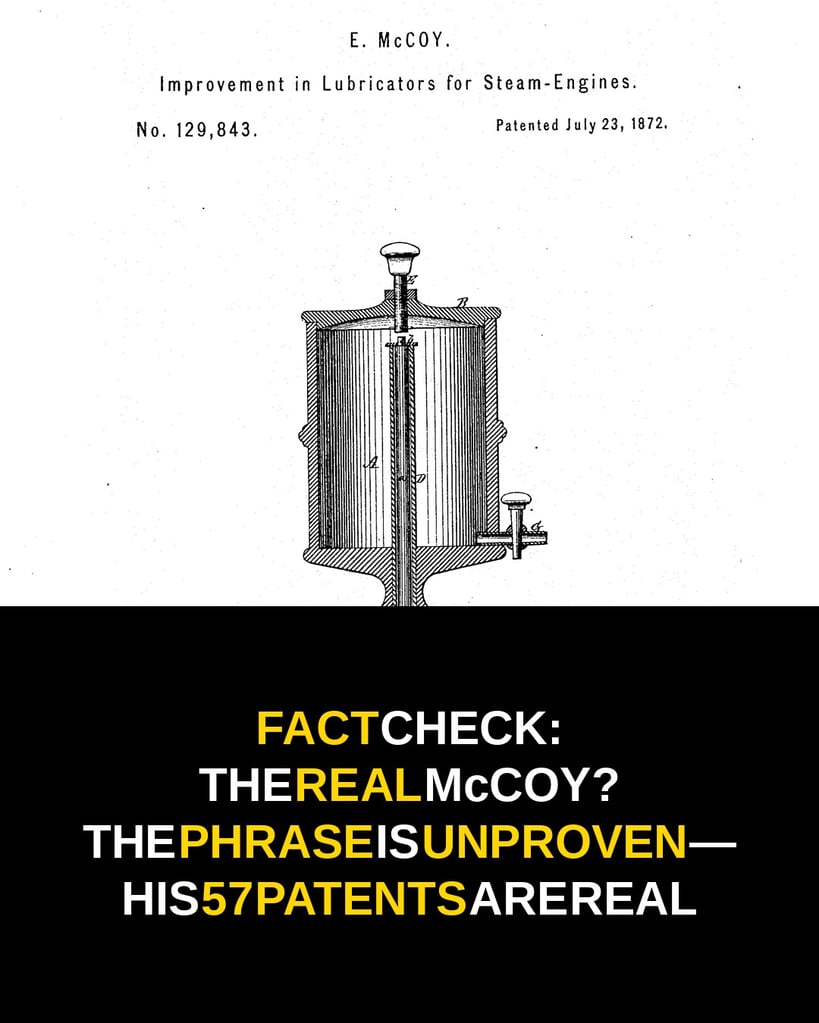
You’ve seen this one: “Elijah McCoy is why we say ‘the real McCoy.'” It’s shared with love, by people honoring a brilliant inventor. The lubricator story is a good story — and his quality was real. But because this page checks before it posts, here is the record: the phrase connection is unproven folklore. What is proven — 57 U.S. patents — needs no garnish.
The claim vs. the truth
The claim: Railroad engineers, fed up with imitation lubricators, refused anything but Elijah McCoy’s original device and demanded “the real McCoy” — and that’s where the expression for “the genuine article” comes from.
The truth: Nobody knows where the phrase comes from. The Smithsonian and the Canadian Encyclopedia both call its origin unclear. And the McCoy-the-inventor story has rivals with paperwork: a Scottish whisky slogan — “the real Mackay,” advertised by G. Mackay and Co. from 1870, before McCoy’s patent — plus a cattle baron named Joseph McCoy, boxer Kid McCoy, and Prohibition rum-runner Bill McCoy. The earliest traceable link between the phrase and McCoy the inventor is a 1966 Ebony advertisement — nearly a century after the phrase was already circulating. A good story. Not a proven one.
What he actually did on the railroad
The real record starts with a familiar insult: Elijah McCoy (1844–1929), born in Canada to parents who had escaped slavery on the Underground Railroad and trained as an engineer in Scotland, was hired by the Michigan Central Railroad only as a fireman/oiler — because he was Black. The engineer, employed as the help.
From that job he saw the problem nobody above him had solved: steam engines had to stop to be oiled, slowing every train. In 1872 he patented his automatic lubricator — U.S. Patent 129,843, the “oil-drip cup” — which oiled an engine’s moving parts while it ran. He kept improving it for decades, added a graphite lubricator for the new superheaters in 1916, founded his own manufacturing company in 1920, and accumulated 57 U.S. patents. Booker T. Washington noted McCoy held more patents than any Black inventor of his time.
That is the genuine article: a trained engineer the railroad wouldn’t let engineer, who revolutionized the railroad anyway — from the oiler’s seat. He doesn’t need a folk phrase. He has the patent record, in his own name, fifty-seven times over.
Notice what the correction actually protects: if the phrase claim collapses under one good question, careless tellers let the man collapse with it. Told accurately, he can’t be debunked. The lubricator worked, the patents are filed, and “the real McCoy” — whoever coined it — describes him whether he coined it or not.
Join the conversation
Be honest: were you taught the “real McCoy” story as settled fact? And does the truth — phrase unproven, 57 patents iron-clad — make Elijah McCoy smaller in your eyes, or bigger? Tell us below.
Source note: The Elijah McCoy correction — McCoy (1844–1929), born in Canada to parents who escaped slavery on the Underground Railroad and trained as an engineer in Scotland, hired by the Michigan Central Railroad only as a fireman/oiler because he was Black; his 1872 automatic lubricator, U.S. Patent 129,843 (the “oil-drip cup”), oiling a steam engine’s moving parts while it ran; decades of improvements, a graphite lubricator for superheaters in 1916, his own manufacturing company founded in 1920, and 57 U.S. patents in total, with Booker T. Washington noting he held more patents than any Black inventor of his time; the “real McCoy” phrase origin called unclear by the Smithsonian and the Canadian Encyclopedia, with rival candidates including the “real Mackay” whisky slogan advertised by G. Mackay and Co. from 1870 (before McCoy’s patent), cattle baron Joseph McCoy, boxer Kid McCoy and Prohibition rum-runner Bill McCoy, and the earliest traceable McCoy-the-inventor link being a 1966 Ebony advertisement; so the phrase connection is printed here as unproven folklore, never as fact — is from Smithsonian Magazine, USPTO / Inventors Digest patent data, and The Canadian Encyclopedia.

