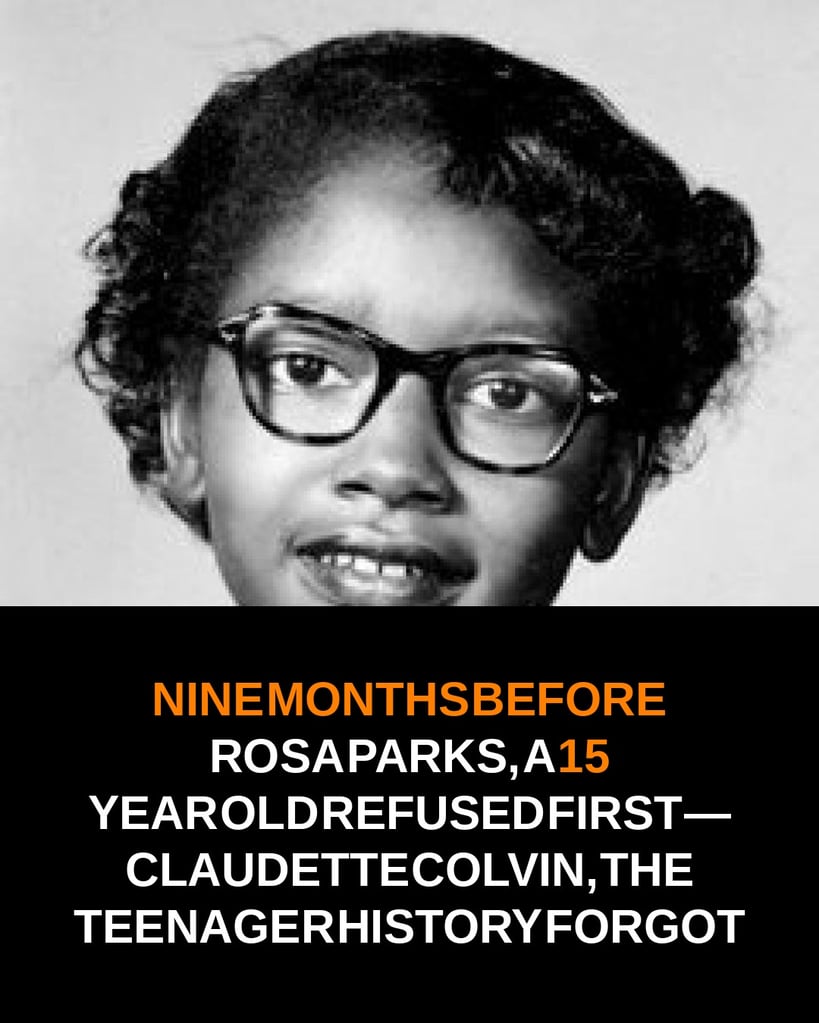
She was 15 years old, coming home from school, when she decided she had paid her fare and she was not moving. On March 2, 1955 — nine months before Rosa Parks — Claudette Colvin refused to give up her seat on a Montgomery bus, the first refusal in Montgomery that year. History wrote her out of the story for decades. She is still here to hear it told right.
Claudette Colvin, born September 5, 1939, was a Montgomery, Alabama, high-school student who had just been studying Black history in school when the moment found her. Ordered by the bus driver to give up her seat to a white passenger, she refused — she said she had paid her fare and staying seated was her constitutional right. A teenager, citing the Constitution, to power, in 1955 Alabama.
Two police officers dragged her off the bus, handcuffed her and jailed her in an adult jail. She was convicted and placed on indefinite probation. Let that land: the system put a 15-year-old schoolgirl in an adult jail, on indefinite probation, for sitting down.
Passed over — then pivotal
Movement leaders considered making Colvin the face of a boycott, but judged a pregnant teenager too vulnerable to attack — she became pregnant at 16. Rosa Parks, an NAACP secretary, became the test case instead, nine months later. Colvin’s stand was real, earlier, and paid for in handcuffs — and still, the movement she had just risked everything for decided her story couldn’t carry the fight.
But her stand came back around. In 1956, Colvin was one of the four plaintiffs in Browder v. Gayle — the federal case that actually ended bus segregation, upheld by the U.S. Supreme Court in December 1956. The teenager deemed too vulnerable to be the face of the movement became one of the names on the lawsuit that won it. Parks sparked the boycott; Colvin helped finish the law.
Her name stayed little-known for decades, until Phillip Hoose’s 2009 biography of her won the National Book Award and a new generation learned to say it. And then, at last, the record itself was set right: in November 2021, 66 years later, an Alabama judge expunged her record, ordering it shredded. The conviction that hung over a 15-year-old’s act of courage is gone — wiped away in her own lifetime, while she could know it happened.
Claudette Colvin is with us still, and her place in the order of events is now a matter of record: first in Montgomery that year, nine months before the name everyone knows, and a plaintiff in the case that ended bus segregation for good.
Join the conversation
She was 15, studying Black history in school, when she told a bus driver no — and paid for it in an adult jail. Were YOU taught Claudette Colvin’s name in school, honestly? And does the order matter — first in Montgomery, nine months before Parks? Tell us below.
Source note: Claudette Colvin’s story — born September 5, 1939; on March 2, 1955, at 15, nine months before Rosa Parks and as the first refusal in Montgomery that year, refusing a bus driver’s order to give up her seat to a white passenger, saying she had paid her fare and staying seated was her constitutional right, after studying Black history in school; being dragged off the bus by two police officers, handcuffed and jailed in an adult jail, then convicted and placed on indefinite probation; movement leaders considering her as the face of a boycott but judging a pregnant teenager (she became pregnant at 16) too vulnerable to attack, with Rosa Parks, an NAACP secretary, becoming the test case instead; serving in 1956 as one of the four plaintiffs in Browder v. Gayle, the federal case that ended bus segregation, upheld by the U.S. Supreme Court in December 1956; her name staying little-known for decades until Phillip Hoose’s 2009 biography won the National Book Award; and an Alabama judge expunging her record in November 2021, 66 years later, ordering it shredded — is from National Geographic, National Archives coverage, and AP (2021 expungement).