
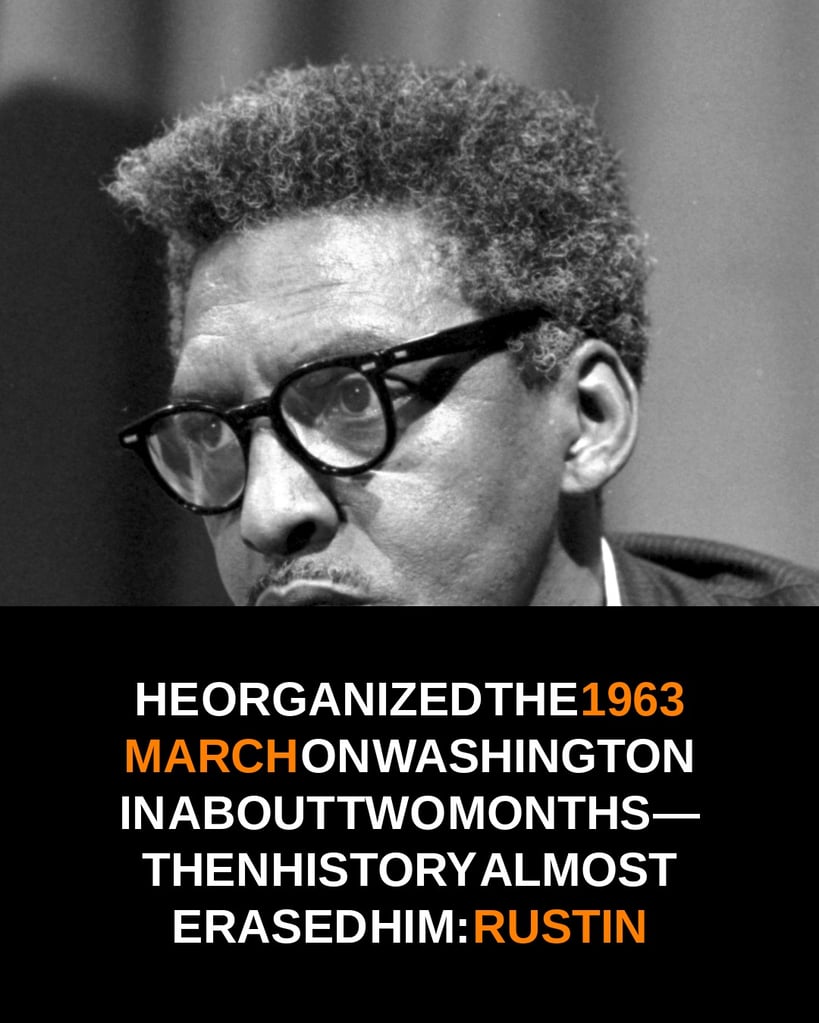
Roughly 250,000 people came to Washington on August 28, 1963, and everything worked — the buses, the water, the sound system. That did not happen by luck. Bayard Rustin planned the logistics in about two months, as A. Philip Randolph’s deputy director. The day ended with Dr. King’s “I Have a Dream” speech. The man who made the day run had been pushed to the movement’s background — and recognition, for him, came very late.
Bayard Rustin was born on March 17, 1912. By 1963, he was the chief organizer of the March on Washington for Jobs and Freedom, serving as A. Philip Randolph’s deputy director. His job was not the speeches. His job was everything underneath the speeches — the practical machinery that lets a quarter of a million people gather, be heard, and get home.
Eight weeks, a quarter of a million people
Rustin planned the logistics for roughly 250,000 people in about two months, down to the buses, the water and the sound system. Sit with the detail in that list. Buses, so people could arrive and leave. Water, because a crowd that size, outdoors, needs it planned, not improvised. A sound system, because a march nobody can hear is a march that fails at its purpose.
That is organising at its highest level: invisible when it works. When 250,000 people gather and the day holds together, the organiser’s success looks like nothing happened at all. It is the hardest kind of excellence to get credit for — and Rustin, for reasons that had nothing to do with his work, got even less credit than most.
Before Washington, Rustin had already shaped the movement’s method. He taught King the strategy of nonviolent resistance during the Montgomery bus boycott. So the organiser of the march had also, years earlier, helped teach its most famous voice the strategy that voice became known for.
Pushed to the background
In his lifetime, Rustin was pushed to the movement’s background because he was openly gay and had a youthful Communist association. Neither fact changed the buses, the water, the sound system, or the strategy he taught. But both were used to move him out of the frame while the work he organised stayed in it.
That is the erasure in this story, stated plainly. The man was not forgotten by accident. He was pushed aside, in his own lifetime, and history nearly kept him there. The march is remembered. Its organiser, for a long time, was not — and this piece exists to put his name back next to his work, where it belongs.
Recognition, at last
Recognition came late. Rustin received a posthumous Presidential Medal of Freedom in 2013 — awarded after his death, to a man who had organised one of the most famous days in American history fifty years earlier. And in 2020, California pardoned his 1953 conviction, an arrest from the era when his private life was policed.
A pardon in 2020 for a 1953 arrest. A medal in 2013 for work done in 1963. The honours are real, and so is the delay in both of them.
Bayard Rustin died on August 24, 1987, at 75. He had planned a day for 250,000 people in about two months, taught a movement its strategy, and waited — beyond his own lifetime — for his country to put his name back on his own work.
Join the conversation
The march took about eight weeks to organise, and its organiser waited decades for recognition. Had you heard Bayard Rustin’s name before today? Tell us below.
Source note: Bayard Rustin’s story — Bayard Rustin (March 17, 1912 – August 24, 1987, age 75); chief organizer of the March on Washington for Jobs and Freedom as A. Philip Randolph’s deputy director, planning the logistics for roughly 250,000 people in about two months, down to the buses, the water and the sound system, for August 28, 1963, the day that ended with Dr. King’s “I Have a Dream” speech; earlier teaching King the strategy of nonviolent resistance during the Montgomery bus boycott; being pushed to the movement’s background in his lifetime because he was openly gay and had a youthful Communist association; the posthumous Presidential Medal of Freedom in 2013; and California’s 2020 pardon of his 1953 conviction, an arrest from the era when his private life was policed — is from EBSCO Research Starters, Wikipedia (Rustin, sourced), and PhillyVoice / historical profiles. No cause of death is printed here because sources conflict. Dr. King appears in this piece as context only.

