Every school morning has a sound: bells, shouting, thousands of young voices in one place. On the morning of January 6, 2014, a 15-year-old boy standing outside his school gate heard something underneath it — a stranger with a story that didn’t add up, and a vest that told the truth. What he did next is the reason a school full of children came home that day.
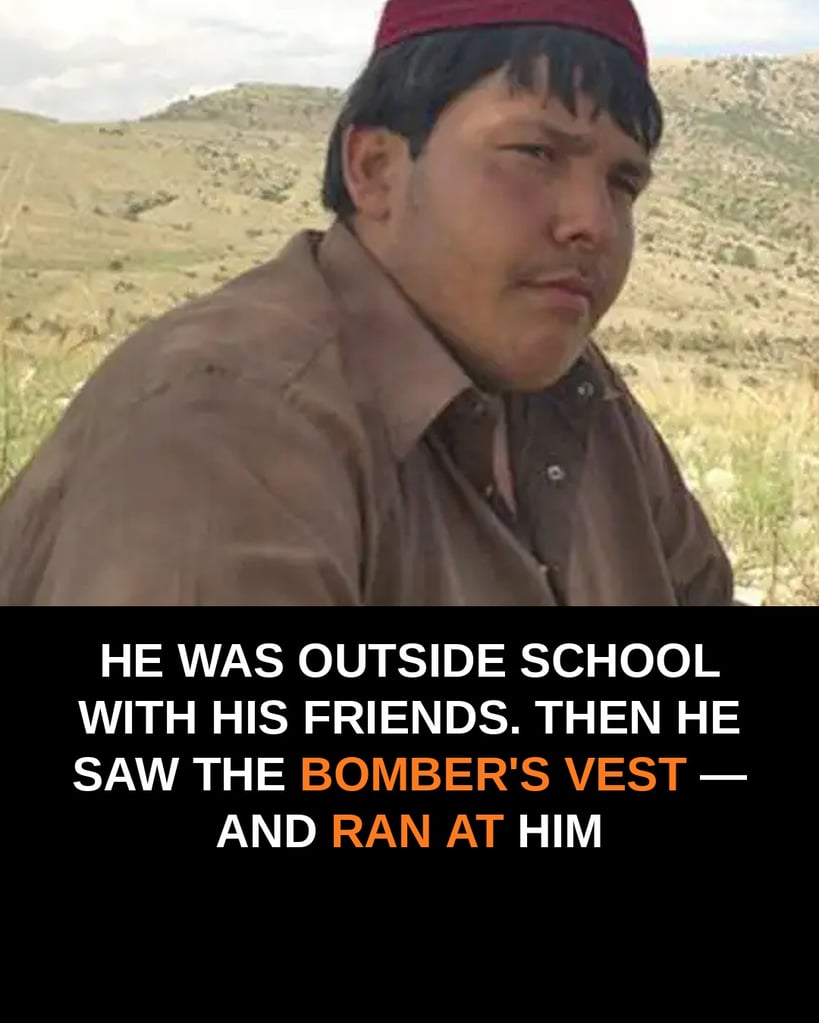
Aitzaz Hasan was a ninth-grader in Ibrahimzai, in Pakistan’s Hangu district. That morning he was outside his school gate with two friends, during morning assembly, when a man approached them claiming he wanted admission to the school.
The boys looked closer. And they spotted it: the detonator on the man’s vest.
Everything about the next few seconds divides into two directions. His friends ran inside. Aitzaz ran at the bomber.
The seconds at the gate
Aitzaz grappled with the man at the gate — a schoolboy, hands on a suicide bomber, holding the line between the stranger and the assembly beyond it. The vest detonated.
It killed them both. And no one else.
That last sentence is the whole story, and it is not a small one. As many as 2,000 students were inside that school. A bomber who reaches an assembly does not kill in ones and twos. Aitzaz understood the arithmetic standing at that gate — the detonator he had spotted, the crowd behind him — and he chose the direction that ended the count at two instead of letting it run into the hundreds. He was 15 years old.
His friends lived. The assembly lived. The school day, the school year, two thousand families’ ordinary evenings — all of it continued because one boy moved toward the danger instead of away from it, at an age when most of us are worrying about exams and being late.
How Pakistan honored him

Pakistan did not let the act pass quietly. The country posthumously awarded Aitzaz the Sitara-e-Shujaat — the Star of Valour — conferred on March 23, 2014, one of the nation’s honors for bravery, given to a schoolboy who would never grow up to wear it.
His school was renamed for him: Aitzaz Hasan Shaheed High School, so that every student who walks through that gate walks under the name of the boy who held it. And Herald magazine named him its Person of the Year for 2014 — ahead of every politician, celebrity and public figure in the country, a ninth-grader from Hangu took the title, because no one else’s year could stand next to his single morning.
There is a detail worth holding onto about how honors like these work. A medal conferred posthumously is a country admitting, in formal language, that it owes a debt it cannot repay. A school renamed is a debt paid forward — his name converted into the roof over the children who came after him.
Why we tell his story on this page
Our page tells hair stories, firsts, and kindness stories — and threaded through all of them is the same subject: ordinary people, often young people, carrying a weight nobody asked them to carry and refusing to put it down. Aitzaz Hasan carried the heaviest version of it there is. He had the same door to run through that his friends used. He knew what the vest was. He ran the other way.
Heroes are not people without an exit. They are people who see the exit clearly — and choose the gate instead.
Join the conversation
He was 15. His friends ran inside; he ran AT the bomber. Do schools do enough to teach children about Aitzaz Hasan — and what would YOU want said about a boy who held the gate for as many as 2,000 classmates? Tell us below.
Source note: Aitzaz Hasan’s account — a 15-year-old ninth-grader outside his school gate in Ibrahimzai, Hangu district, Pakistan, on January 6, 2014, with two friends during morning assembly; the approaching man claiming to seek admission; the detonator spotted on his vest; the friends running inside while Aitzaz grappled with the bomber at the gate, where the vest detonated killing both of them and no one else, with as many as 2,000 students inside — is from contemporary wire coverage of January 2014. Early reports varied on his age (14–17); 15 is the settled figure. Student headcounts vary — roughly 1,000 typical enrollment, with as many as 2,000 reported present that morning — so the “as many as 2,000” framing is used here. The Sitara-e-Shujaat, conferred March 23, 2014, is from award investiture records; the renaming of his school as Aitzaz Hasan Shaheed High School and his naming as Herald magazine’s Person of the Year for 2014 are from school renaming reports and the magazine’s announcement.
Tell us in the comments below - we read every single one, and the best takes get featured.