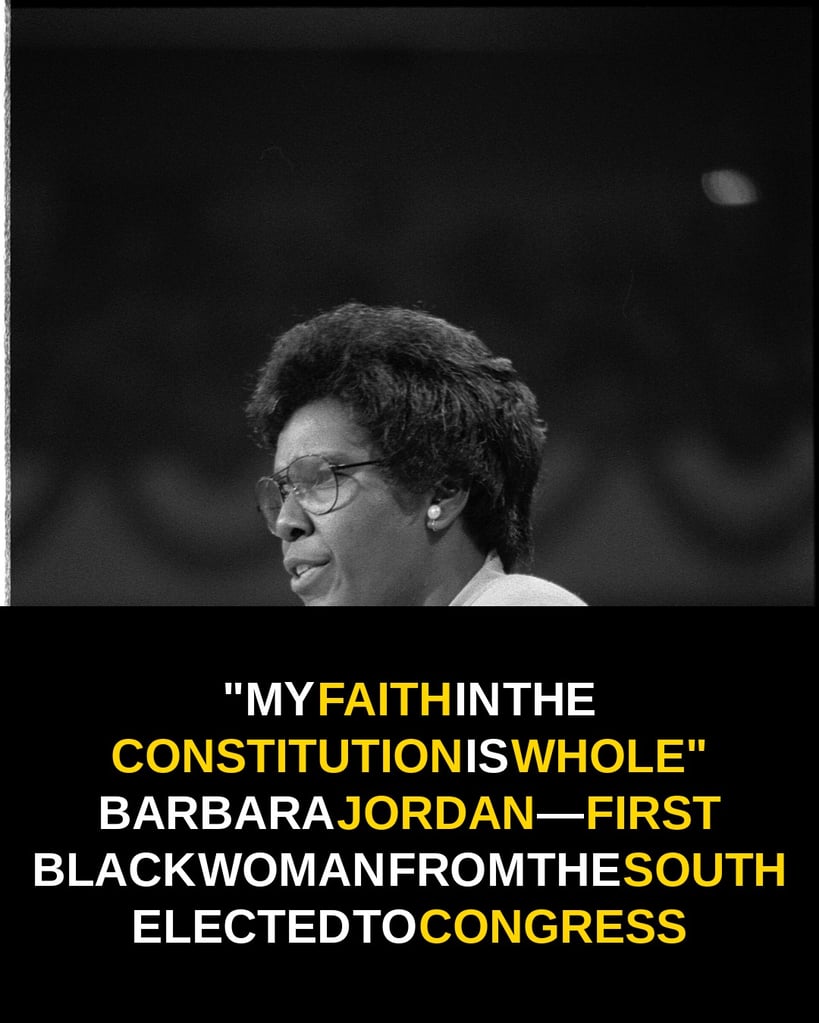
“My faith in the Constitution is whole, it is complete, it is total.” On July 25, 1974, a first-term congresswoman from Houston sat on the House Judiciary Committee, looked into the Watergate hearings, and delivered one of the most celebrated speeches in American political history. Her name was Barbara Jordan — and everything about her being in that chair was a first somebody had said would never happen.
Jordan’s road started in Texas, where in 1966 she was elected to the Texas Senate — its first Black member since 1883, and the first Black woman ever to sit in it. She was so commanding a presence that in 1972 she served a symbolic day as acting governor of Texas. That November, she was elected to the U.S. House of Representatives: the first Black woman from a Southern state to serve in Congress, and — alongside Andrew Young — one of the first two Black Southerners elected to Congress in the 20th century.
Sit with that geography for a moment. Not the North, where Black political careers had been possible for generations — the South, in 1972, within living memory of poll taxes, electing a Black woman to the United States Congress.
The voice of Watergate
Then came the night the whole country learned her name. On the Judiciary Committee during the Nixon impeachment inquiry, Jordan spoke with a gravity that cut through the noise of the scandal: “My faith in the Constitution is whole, it is complete, it is total.” She wasn’t performing. She was testifying — a daughter of Houston’s Third Ward explaining, to a president and a nation, what the founding document required of them both. The speech is still taught, still quoted, still the standard against which congressional seriousness is measured.
In 1976 she keynoted the Democratic National Convention — the first woman, and the first African American, to deliver a major-party keynote address. She retired from Congress in 1979 to teach at the University of Texas, shaping students instead of statutes, keynoted the convention once more in 1992, and died in 1996 — having spent one career doing what generations of Southern law had been designed to prevent.
Her Texas years alone would have made a career worth this page. First Black member of the Texas Senate since 1883; first Black woman ever to sit in it; and so commanding that in 1972 her colleagues made her acting governor for a symbolic day — a Black woman presiding over Texas, a state that within her lifetime had kept her people from the ballot with poll taxes. She then carried that authority to Washington and, on the Judiciary Committee in 1974, aimed it at a president. When she retired in 1979 it was to a classroom at the University of Texas, teaching the next generation the Constitution she had defended on live television — and when the Democrats needed a keynoter again in 1992, sixteen years after her first, they called Barbara Jordan.
Join the conversation
First Black woman in the Texas Senate. First Black woman from the South in Congress. The voice of Watergate. The first keynote of its kind. Did you learn Barbara Jordan’s name in school — and does any politician speaking today carry her kind of weight? Tell us below.
Source note: Barbara Jordan’s account — elected to the Texas Senate in 1966, its first Black member since 1883 and the first Black woman ever to sit in it, including a symbolic day as acting governor in 1972; elected to the U.S. House in November 1972 as the first Black woman from a Southern state to serve in Congress, one of the first two Black Southerners elected to Congress in the 20th century (with Andrew Young); her July 25, 1974 House Judiciary Committee statement during Watergate (“My faith in the Constitution is whole, it is complete, it is total”) becoming one of the most celebrated speeches in American political history; her 1976 Democratic National Convention keynote, the first by a woman and the first by an African American for a major party; her retirement from Congress in 1979 to teach at the University of Texas, her second keynote in 1992, and her death in 1996 — is from the Texas State Historical Association (Handbook of Texas), History.com, and PRX/PBS transcript archives.