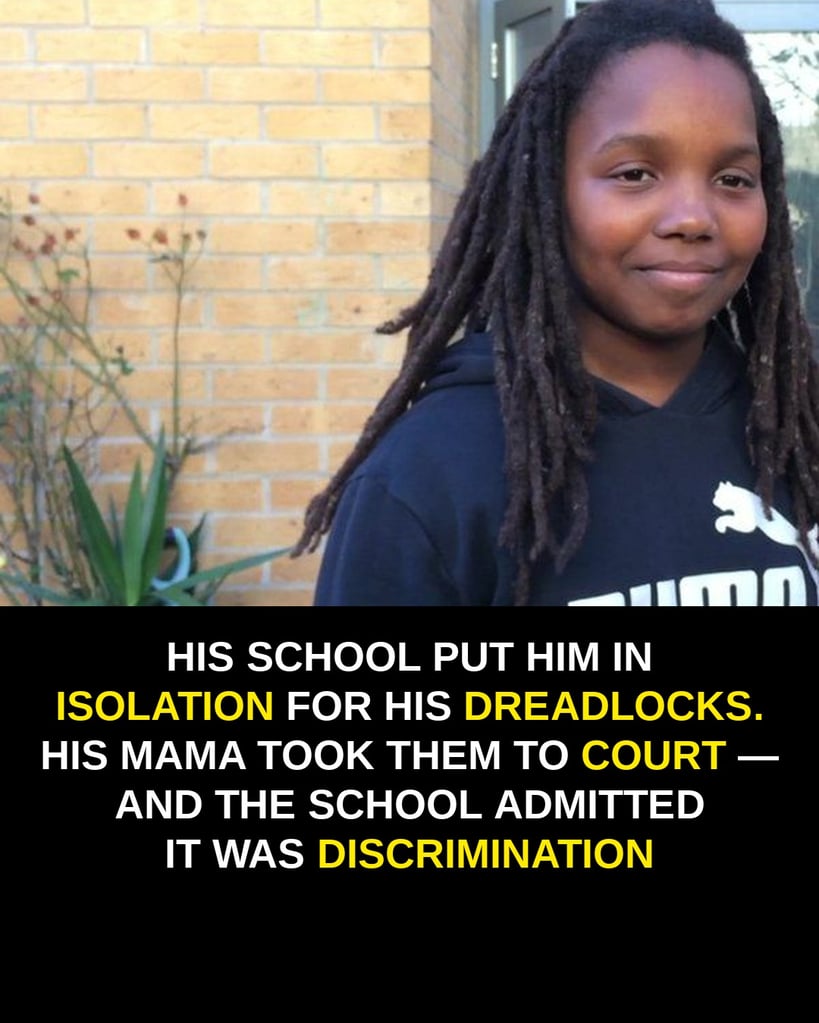
A boy’s first day at a new school is supposed to be nerves, new shoes, and finding your classroom. For 12-year-old Chikayzea Flanders, it was isolation — because of the hair growing out of his head, and the faith it belonged to.
In September 2017, Chikayzea arrived for his first day at Fulham Boys School in London wearing dreadlocks — the dreadlocks of his family’s Rastafarian faith. The school’s response was not a welcome. He was isolated from his classmates and told to cut them off.
Read that again. Not sent home for behavior. Not pulled aside for anything he had done. Separated from the other children, on day one, over locs that were an expression of his family’s religion.
A mother who refused to accept it
Chikayzea left the school for another one. But his mother, Tuesday Flanders, was not done — and neither was her son’s story.
She sued, with funding from the Equality and Human Rights Commission, Britain’s equality watchdog. That detail matters. This was not a social media argument or a petition that faded by Friday. This was a legal challenge, backed by the national body charged with enforcing equality law, arguing that a school uniform policy had been used to punish a child for his faith and his hair.
Cases like that are not easy for a family to take on. A parent going up against a school — its lawyers, its policies, its certainty that the rulebook is the rulebook — is a lonely fight. Tuesday Flanders took it anyway, because the thing her son was told to cut off was not a fashion choice he could swap out by Monday. It was his faith, worn the way his family wears it.
The settlement: the school said the word itself
In 2018, the case settled — and the settlement is why this story still matters.

The school accepted that enforcing its uniform policy in Chikayzea’s case had amounted to indirect discrimination. The County Court ordered a settlement payment, plus legal costs. The school had to review its policies. And Chikayzea was formally welcome to return — with his locs, tied up or covered.
He chose not to go back. That was his right, and honestly, after a first day spent in isolation, who could blame him? But look at what the settlement actually contains: an admission, money, a policy review, and a standing invitation for the boy to walk back through the gate wearing the very hair he was isolated for. That is not a quiet apology. That is a school, on the record, changing its position because a mother would not move from hers.
Why the win travelled further than one school
The story did not end at that school’s gates. The Equality and Human Rights Commission went on to use cases like Chikayzea’s in its national guidance against hair discrimination in schools — the guidance other schools across the country are pointed to when their own policies get challenged.
That is how one family’s fight becomes protection for children they will never meet. A boy in another city, walking into another first day with locs, braids, or an Afro, now stands behind a line his predecessor’s mother helped draw: a uniform policy does not get to erase your faith or your identity, and if it tries, that has a legal name.
For every parent who has ever been handed a “hair policy” that somehow only seems to land on children who look like ours — this is the case to know. The rulebook lost. The locs stayed.
Join the conversation
Should a school EVER be allowed to isolate a child over hair tied to his family’s faith — and if your child came home from day one in isolation, would you have taken the school to court the way Tuesday Flanders did? Tell us below.
Source note: Chikayzea Flanders’ account — age 12, isolated on his first day at Fulham Boys School in September 2017 for the dreadlocks of his family’s Rastafarian faith, told to cut them, leaving for another school, and his mother Tuesday Flanders’ EHRC-funded legal challenge — is from the Equality and Human Rights Commission’s press release of September 13, 2018. The 2018 settlement terms — the school’s acceptance that enforcing its policy amounted to indirect discrimination, the County Court-ordered settlement payment plus legal costs, the required policy review, and Chikayzea’s formal welcome to return with his locs tied up or covered — are as reported by the EHRC and EachOther’s news report of the settlement. His decision not to return, and the EHRC’s later use of cases like his in national guidance against school hair discrimination, are from the same sources.
Tell us in the comments below - we read every single one, and the best takes get featured.