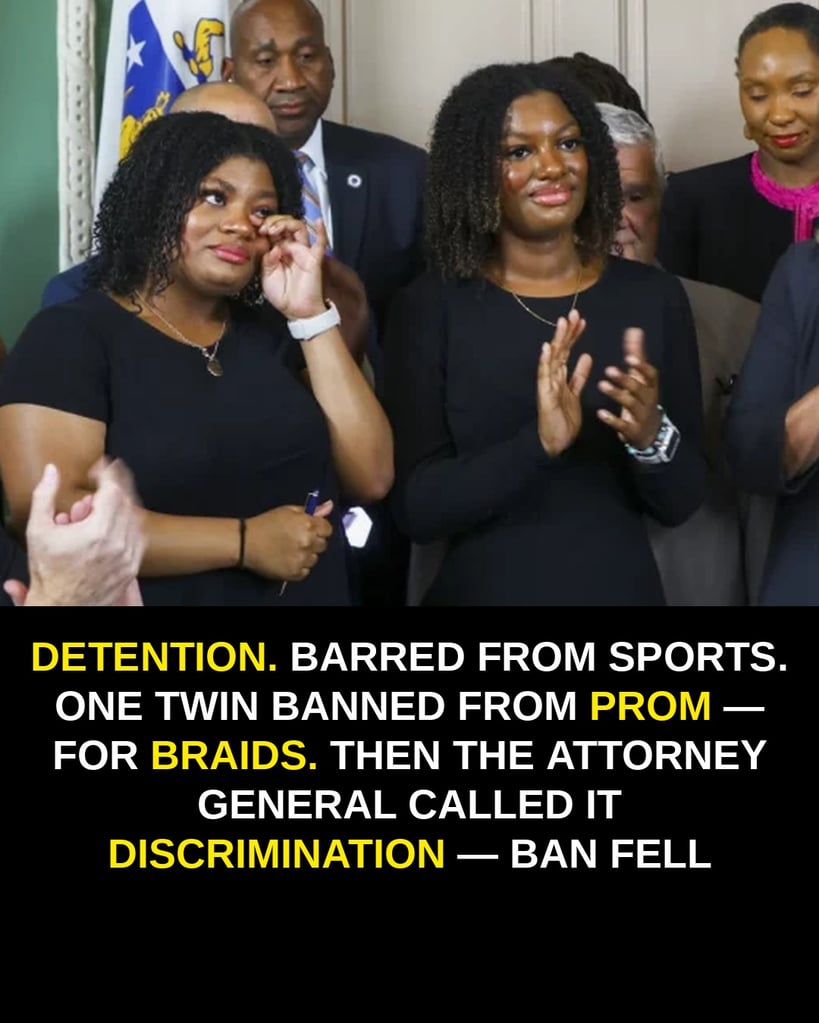
Detention. Barred from sports and activities. Threatened with suspension. One sister banned from prom. Their offense, in the spring of 2017, was braids — worn with extensions, the way Black girls have worn them forever.
Mya and Deanna Cook were 15-year-old twins at Mystic Valley Regional Charter School in Malden, Massachusetts. The school’s dress code banned hair extensions, and when the sisters refused to remove their braids, the punishments stacked up: multiple hours of detention, exclusion from extracurriculars and sports, suspension hanging over their heads — and for Mya, a ban from prom, the night a school year builds toward.
Two teenagers. Straight-A stakes. For braids.
The Attorney General reads the rulebook
The case did not stay inside the school office. Massachusetts Attorney General Maura Healey’s office reviewed the school’s hair rules and wrote what the twins’ family had been saying all along: the rules were discriminatory and violated state and federal law.
That letter changed the temperature of everything. A dress code is a powerful thing inside one building; it is a much weaker thing against the chief law enforcement office of the Commonwealth telling you, in writing, that it breaks the law.
How the ban actually fell — the honest timeline
This page checks endings, so here is this one exactly as it happened, because the viral version compresses it.
On May 21, 2017, facing the Attorney General’s finding, the school’s trustees lifted the no-extensions ban and let the girls resume their activities — but that first lift ran only through the end of that school year. By itself, May 21 was a ceasefire, not a surrender.
The surrender came next: in the school’s next student handbook, the ban was permanently eliminated. The new handbook no longer banned extensions — and it also dropped the code’s other hair policing: rules against hair worn over 2 inches in thickness or height, shaved sides, and hair coloring all went with it.
Ceasefire first. Then the rulebook itself was rewritten. That’s the whole victory, and it’s bigger than the compressed version — the twins didn’t just win their own spring back. The rules that punished them ceased to exist for every student who enrolled after them.
The law their case helped build
The Cook case did not end in Malden. It became one of the cases that helped prompt Massachusetts’ CROWN Act — legislation aimed at exactly this: hair discrimination dressed up as dress codes. Two 15-year-olds who refused to take their braids out ended up in the footnotes of a state law.
That is the pattern this page keeps documenting, because it keeps happening: a school writes a rule as if Black hair were a behavior problem, a child refuses to shrink, and the rule — not the child — is what ends up removed.
Join the conversation
Be honest: if your daughter came home with detention slips for her braids, would you tell her to take them out and keep the peace — or refuse, the way Mya and Deanna did? And which ending matters more to you: winning the spring, or rewriting the handbook? Below. 👇
Source note: Mya and Deanna Cook, 15-year-old twins at Mystic Valley Regional Charter School in Malden, Massachusetts, received multiple hours of detention in spring 2017 for refusing to remove braids with extensions, were barred from extracurriculars/sports, threatened with suspension, and Mya was barred from prom — per the ACLU of Massachusetts’ Cook v. Mystic Valley case page. Attorney General Maura Healey’s office wrote that the rules were discriminatory and violated state and federal law (ACLU of Massachusetts; NAACP Legal Defense Fund press release, May 2017; Boston Globe). The timeline is corrected per those sources: the trustees lifted the no-extensions ban on May 21, 2017, only through the end of that school year, with the girls resuming activities; the ban was then permanently eliminated in the next student handbook, which also dropped the rules on hair over 2 inches in thickness/height, shaved sides, and hair coloring. The case later helped prompt Massachusetts’ CROWN Act (Boston Globe handbook follow-up). Earlier viral versions implying the ban was permanently abolished in the single May 21 vote are compressed; this article gives the full sequence.