I used to think that if you worked hard enough, “enough” would eventually stop feeling uncertain. Enough food. Enough warmth. Enough stability to open the fridge without silently calculating what was left. But in our home, enough was never guaranteed. It was something I negotiated every day — with grocery lists, overdue bills, and quiet sacrifices nobody said out loud.
Tuesday dinners ran on a routine: rice, chicken thighs, carrots, and half an onion — just enough for the night, and maybe a little into the next day. As I cooked, I was already doing the mental math. Three plates. Maybe four, if we were careful.
“Mom, Lizie’s Eating With Us”
I was about to call everyone when the front door flew open. My 13-year-old, Sam, stepped in — and behind her was a girl I did not recognize. Sam announced that Lizie was eating with us. It was not a question. It was already decided.
Lizie lingered behind her, small for her age, sleeves pulled over her hands, shoulders curved inward, eyes kept low as if she did not want to be noticed. I forced a smile, told her of course, and to grab a plate. She hesitated, as though she needed the reassurance twice before moving.
At the table, something felt off. She did not eat like most kids — no rushing, no second helpings, no chatter. Everything was measured: one scoop of rice, one piece of chicken, two carrots. And she watched everything, every movement and every sound, like she was expecting something to go wrong. Dan asked how long she had known Sam. Since last year, she said softly. Sam jumped in to say Lizie was the fastest runner in class and never complained, which earned a brief smile that faded quickly. After dinner Sam handed her a banana and called it a house rule: nobody leaves hungry. The way Lizie looked at that banana — it meant more than it should have.
The Talk After She Left
Once she had gone, I told Sam she could not just bring people home when we were barely managing. She stood her ground. Lizie had not eaten all day, she said — what was she supposed to do? She had almost passed out in gym, and they had told her to eat better — but how was she supposed to do that when there was nothing to eat?
That stopped me. I had been stressing over stretching one meal — and this girl had nothing at all. Sam added, more quietly, that she had told Lizie to come back tomorrow. I exhaled and said okay. Then we would make more.
A Backpack Full of Red Stamps
The next day I cooked extra — not easily, but deliberately, making space on purpose. Lizie came back. Then again the next day, and the next. By the end of the week she had slipped into our routine: homework at the table, quiet dinners, helping with dishes as if she were trying to repay something nobody had asked for.
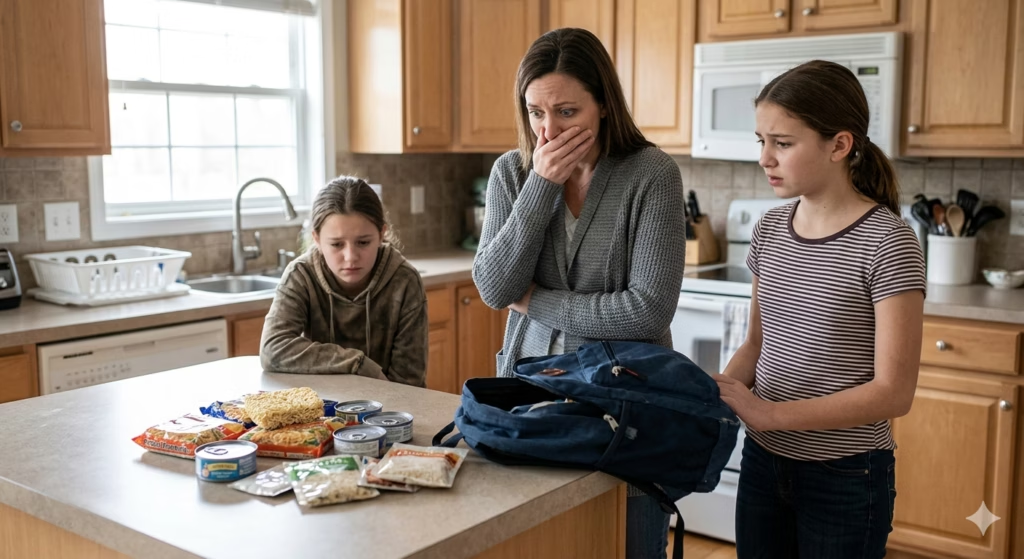
Everything changed the day her backpack fell open. Papers spilled across the floor — bills, loose coins, envelopes stamped in red. FINAL WARNING. EVICTION. I picked one up with suddenly unsteady hands and asked her what it was. She froze. Sam read over my shoulder and said Lizie had not told her it was this bad. Lizie’s voice cracked: her dad had said not to tell anyone. In that moment it all clicked — the way she ate, the way she moved, the constant tension in her body. She was not just hungry. She was scared.
Slow, Complicated, Real
We called her father that night. When he arrived, he looked like someone who had been holding everything together for too long, with nothing left to hold it with. He said he had thought he could fix it if he just worked more. Dan told him, quietly, that she needed more than that — she needed help.
What followed was not an instant solution. It was slow, complicated, and real: phone calls, meetings at school, trips to food banks, difficult conversations, pride set aside piece by piece. Nothing changed overnight. But things started moving — and sometimes, that is enough.
Weeks passed. Our fridge still was not full, and the bills did not disappear. But something shifted in me. I stopped seeing an extra plate as a burden, and started seeing it as a choice. Lizie changed too — she laughed more, sat at the table without shrinking into herself, and started acting like a kid again. One evening she told me she used to be scared to come here, but now it felt safe. That word stayed with me. Safe. Not perfect, not abundant — just safe. I packed her lunch for the next day, she hugged me tightly, and I told her she was family. I meant it.
The next night Sam walked in laughing, Lizie right behind her, asking what was for dinner. Rice, I said — and whatever I can stretch. But this time I did not hesitate. I set out four plates. And for the first time in a long time, “enough” was not something I had to calculate. It was something I chose.
Source note: Original story via ViralStrange (https://viralstrange.com/my-13-year-old-daughter-invited-a-hungry-classmate-over-what-fell-out-of-her-backpack-left-me-frozen-in-fear/). Retold in our own words for Critical Content; story as originally narrated, not independently verified.