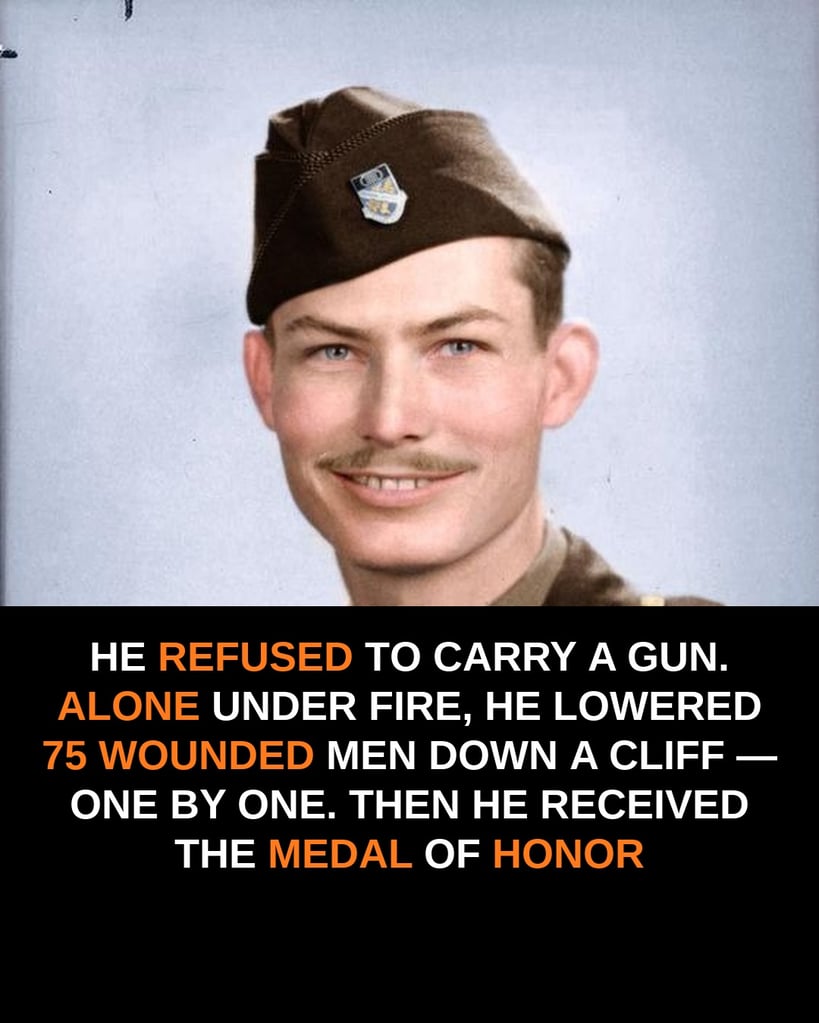
His own army called men like him a problem. His faith said he could serve — but he could not kill, and he would not carry a weapon. So Private Desmond Doss went up the most dangerous cliff in Okinawa carrying litters and rope instead.
Desmond T. Doss was a Seventh-day Adventist serving as an Army medic with the 307th Infantry, 77th Infantry Division. He would not touch a rifle. What he would do — what he insisted on doing — was run toward wounded men under fire and bring them back.
On the Maeda Escarpment in Okinawa, the cliff the Americans called Hacksaw Ridge, that conviction got its test.
May 5, 1945: everybody ordered down — one man stayed up
On May 5, 1945, Doss’s company was ordered to retreat from the escarpment under overwhelming fire. The wounded were left scattered across the top, in ground swept by enemy guns, where going back for them looked like a way to add your name to the list.
Doss refused the order’s logic. He stayed.
Alone on the ridge, he went from wounded man to wounded man. He dragged each one to the edge of the cliff, rigged a rope-supported litter, and lowered him down the escarpment to safety — then went back into the fire for the next one. One by one. For hours. The Army’s estimate of the men he rescued that day is approximately 75.
Seventy-five trips between a dying man and a cliff edge, by a medic with no weapon, in the open, because his religion forbade him to kill and his conscience forbade him to leave.
The medal, and the name he chose for himself
President Harry Truman presented Desmond Doss the Medal of Honor on October 12, 1945. He was the first — and only — conscientious objector to receive it in World War II: the nation’s highest award for battlefield valor, given to a man who never fired a shot.
One detail this page loves: Doss disliked the label “conscientious objector.” He called himself a “conscientious cooperator.” He had never objected to serving, to the uniform, or to the danger. He objected to one thing only — killing — and cooperated with everything else his country asked, including the parts most likely to get him killed.
That distinction is the whole man. It is easy to refuse a war from safety. Doss refused a rifle from inside the war’s worst cliff, and out-served nearly everyone holding one.
Join the conversation
Be honest: is Doss’s stand harder or easier than fighting back — staying on a ridge under fire, unarmed, seventy-five times? And what do you think of the name he chose for himself: cooperator, not objector? Tell us below. 👇
Source note: Desmond T. Doss’s service as a medic with the 307th Infantry, 77th Infantry Division, his refusal on Seventh-day Adventist grounds to kill or carry a weapon, his actions near Urasoe-Mura, Okinawa (April 29–May 21, 1945), and the May 5, 1945 rescue on the Maeda Escarpment (“Hacksaw Ridge”) are from the National WWII Museum’s profile and the full text of his Medal of Honor citation, also held by the U.S. Army / Army Medical Department Center of History & Heritage. The figure of approximately 75 men lowered down the cliff is the Army/Museum estimate, as the citation states it. President Truman presented the medal on October 12, 1945; Doss was the first and only conscientious objector to receive the Medal of Honor in World War II. His preference for the term “conscientious cooperator” is from his recorded remarks as carried in the Museum/Army histories.