
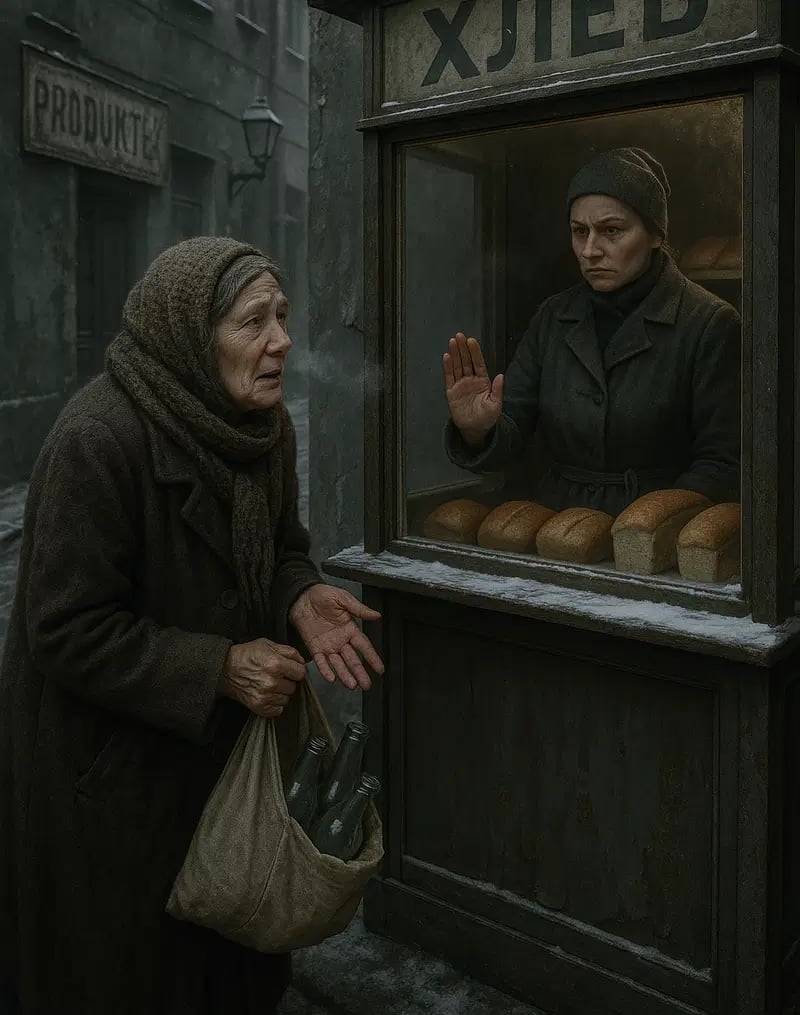
Please, my dear, have mercy! I haven’t tasted bread in three days, and I have no money left.
The elderly woman’s fragile voice trembled in the biting winter air. She stood before a modest bread stall, her coat threadbare, her face etched with deep lines. In her trembling hands she held a worn cloth bag, heavy only with empty glass bottles — her last chance to scrape together a few coins. Her eyes, reddened from the cold, brimmed with tears as she whispered again, “Please, dear, just a quarter loaf. I’ll pay you tomorrow.”
The Woman Behind the Counter Said No
The saleswoman barely glanced up. Her voice was flat and cold. This was a bread stall, not a bottle-return depot. The old woman should take her bottles to the collection point, get her refund, and then come back. Rules were rules.
The old woman faltered. She had not known the depot closed at noon. She had missed it. In another lifetime, she never would have imagined scavenging bottles to survive. She had once been a teacher — respected, eloquent, proud. But pride did not fill an empty stomach. She whispered, weaker, that she felt faint from hunger.
“No,” the saleswoman snapped. She could not give bread away; she barely earned enough herself. If she gave to everyone who asked, she would have nothing left. And the old woman should stop blocking the line.
The Brooch He Could Not Forget
Just then, a tall man in a dark coat approached, and the saleswoman’s tone transformed. She greeted Mr. Bennett sweetly: his favorite bread with nuts and dried fruit had just come in, and the apricot pastries were still warm. He asked for the nut bread and six pastries, handing over a large bill. As he waited for his change, his eyes drifted — and froze.
In the shadow of the kiosk stood the old woman. Something about her tugged at his memory. His gaze fell on the vintage flower-shaped brooch pinned to her worn coat. He knew that brooch.
Daniel Bennett headed a thriving home appliance company, a self-made man who had clawed his way up in the chaotic ’90s. At home, life was full: a loving wife, Laura, two energetic sons, and a baby daughter on the way. But that evening, buried in work, he took a weary call from Laura — the school had called about their son Ethan’s fight, and she told him she was exhausted, carrying everything alone while pregnant, and that the kids missed him. She missed him.
Later that night he came home to sleeping children. Laura offered to warm dinner; he declined, saying he had eaten at the office, and mentioned the apricot pastries and nut bread. Her smile was faint — the kids had not liked the bread much. At that moment, the old woman’s face, her eyes, the brooch flickered in his mind again. And suddenly it clicked. “Mrs. Carter?” he whispered.
The Teacher Who Never Let a Hungry Boy Feel Ashamed
Memories surged back. She had been his math teacher: patient, firm, and quietly kind. As a boy he had grown up poor, sometimes without bread on the table. Somehow she had noticed. Without ever embarrassing him, she had found him “odd jobs” — planting flowers, fixing fences — and when the work was done, there was always a warm meal waiting. He remembered her bread most of all: golden, crackling crust, a scent that wrapped him in comfort.
The next morning Daniel returned to the kiosk. The saleswoman shrugged — the old woman came by sometimes with bottles; she had not seen her today. For days he searched: near the depot, around the market, through side streets. At last he spotted her on a park bench, carefully counting coins.
She looked up, startled, and asked if she knew him. He told her: Daniel Bennett. She had been his teacher. Her eyes lit up. “Danny? Oh, my dear boy!” Her smile carried both joy and sadness.
He asked why she had not said something at the kiosk. She interrupted gently — she had not wanted to be a burden. He had his life; she was just getting by. They talked for hours. She had no family left, and her pension barely covered her rent. She lived by collecting bottles, too proud to beg — until hunger forced her to. “You once made sure I never went hungry,” Daniel told her. “Now it’s my turn.”
A Loaf Shared at Christmas
Within days, he arranged for her rent to be paid indefinitely, stocked her cupboards, and set up a monthly allowance. But beyond money, he gave her something greater: family. He brought his sons to hear her stories, and Laura to bake at her side. On Christmas Eve, Mrs. Carter sat at their table, wrapped in laughter and warmth.
When dessert arrived, Daniel placed before her a loaf of nut bread — the same kind from that day at the kiosk. “It’s not as good as yours,” he admitted, “but it’s the closest I could find.” Her eyes glistened. “It’s perfect, Daniel,” she whispered. “Because it’s shared.”
In the glow of the Christmas lights, Daniel understood: the greatest investments are not in contracts or companies — they are in people. The seed of kindness Mrs. Carter once planted in a hungry boy had returned to her, warm as fresh bread on a winter’s night.
Source note: Original story via ViralStrange (https://viralstrange.com/just-a-quarter-loaf-please-the-elderly-woman-pleaded-at-the-market/). Retold in our own words for Critical Content; story as originally narrated, not independently verified.