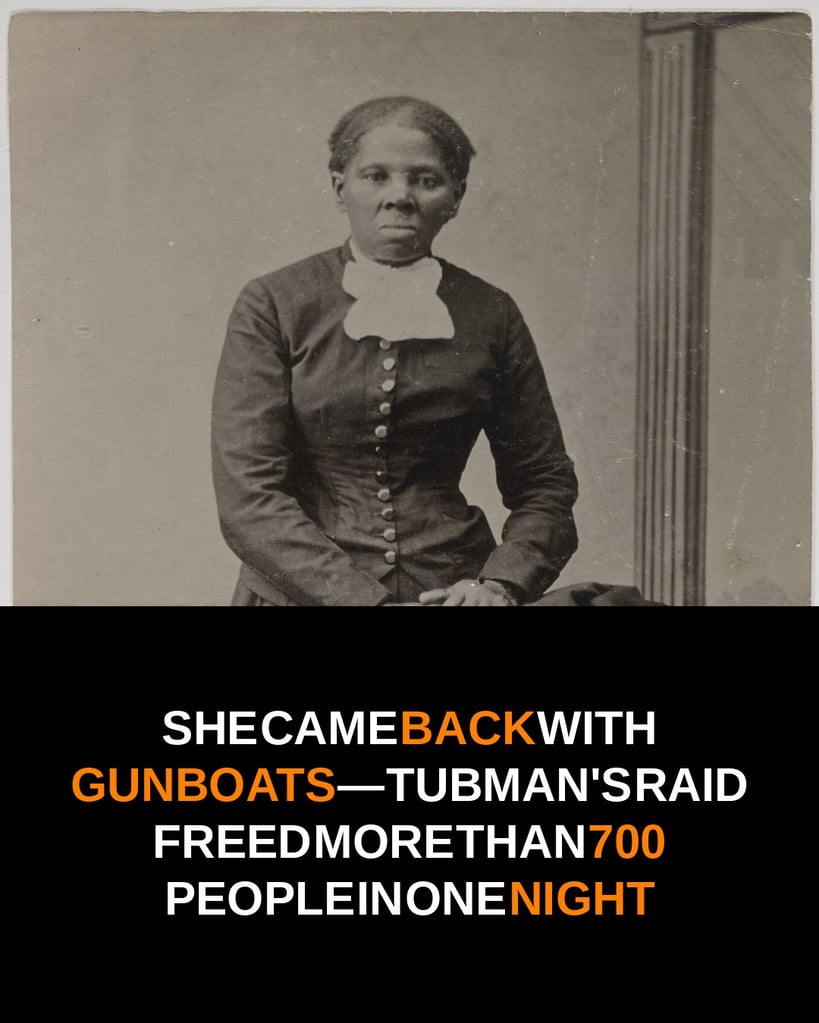
You know Harriet Tubman and the Underground Railroad. This is the other Harriet Tubman — the one in uniform. On the night of June 1–2, 1863, she planned and guided a Union gunboat raid up South Carolina’s Combahee River, and by morning, more than 700 enslaved people were free. One night. More than 700 souls. A woman the Confederacy priced at a bounty, steering the United States Navy.
Tubman was working as a scout and spy for the Union Army when she took on the Combahee. The raid ran alongside Colonel James Montgomery and the 2nd South Carolina Volunteers — but the intelligence was hers. She had scouted the river and pinpointed the Confederate torpedoes — the mines — planted to blow gunboats out of the water. Because she knew where every one of them sat, three gunboats could steam upriver safely, past defenses built to stop them.
Then the raid did what it came to do: it burned plantations and liberated the people held on them. More than 700 people, in a single night, walking out of bondage toward the gunboats — because the woman guiding those boats had spent years learning exactly how to move enslaved people to freedom, and now did it at military scale.
Why the number matters — and how we print it
Print the figure the way the strongest sources frame it: the National Museum of African American History and Culture and the U.S. Army say “more than 700” freed; the Gilder Lehrman Institute puts the number at 756. This page prints “more than 700” — the honest floor under a night no exact count survives for. What no source disputes is the shape of the achievement, and the museum’s framing of it: the raid made Tubman the first woman to plan and lead a major armed military operation in United States history.
Keep this number separate from her other famous one, because they are different kinds of courage. On the Underground Railroad, Tubman freed about 70 people across some 13 trips — one family at a time, in the dark, at the risk of her own capture. At the Combahee she did it with gunboats, in one night, ten times over. The conductor became the commander. The skills were the same: know the ground, know the water, never leave anybody behind.
It matters that the raid’s intelligence came from Tubman herself. Gunboats are powerful, but a river full of hidden torpedoes does not care how powerful you are — it cares what you know. Tubman had scouted that river in advance, the way she had scouted every road and crossing of her Underground Railroad years, and the knowledge in her head is what let three warships steam past weapons planted to sink them. Armies decorate firepower. The Combahee was won by reconnaissance, done by a woman the Army officially employed as a scout and spy — and every person freed that night walked out behind her information.
Join the conversation
Had you ever heard of the Combahee River Raid — or did school only teach you the Railroad? And which Tubman moves you more: the woman who walked 70 people out one trip at a time, or the one who freed 700 in a night? Tell us below.
Source note: Harriet Tubman’s Combahee River Raid — on the night of June 1–2, 1863, working as a scout and spy for the Union Army, Tubman planned and guided the raid in South Carolina alongside Col. James Montgomery and the 2nd South Carolina Volunteers; her advance scouting pinpointing the Confederate torpedoes (mines) in the river so three gunboats could steam upriver safely; the raid burning plantations and liberating the people held there, with the National Museum of African American History and Culture and the U.S. Army putting the number freed at “more than 700” and the Gilder Lehrman Institute of American History at 756; the NMAAHC framing of Tubman as the first woman to plan and lead a major armed military operation in U.S. history; and, as separate context, her Underground Railroad work freeing about 70 people across some 13 trips — is from the Smithsonian National Museum of African American History and Culture, the U.S. Army, and the Gilder Lehrman Institute.