
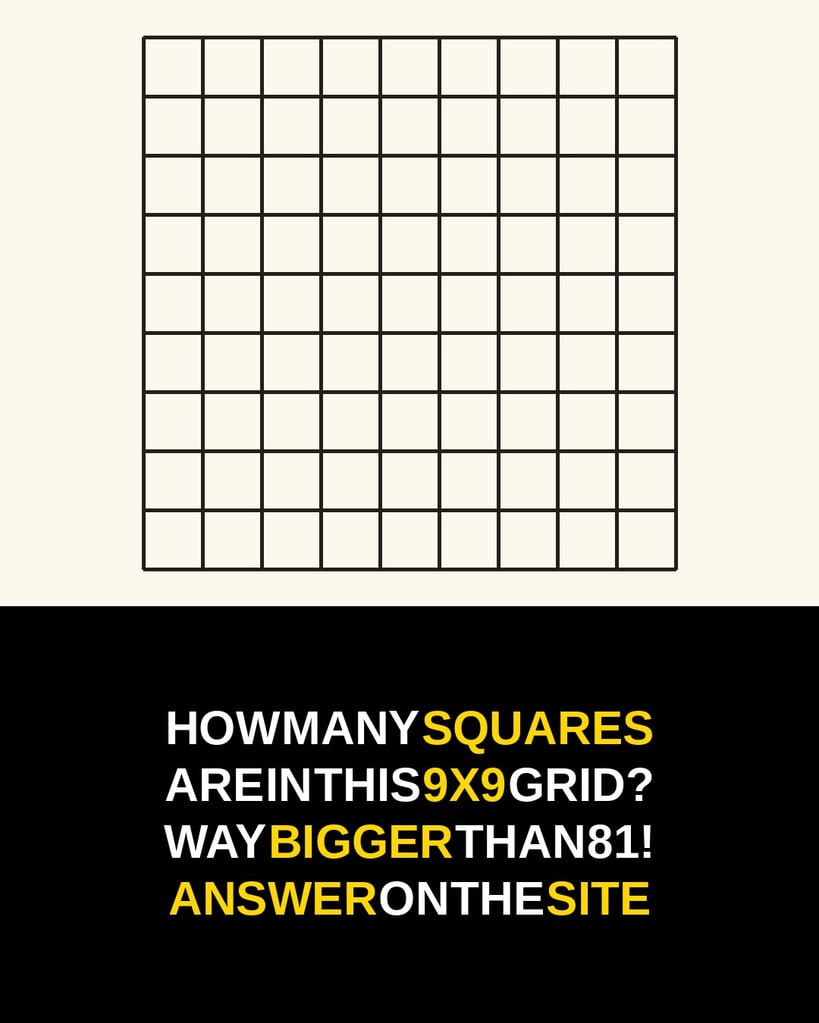
The answer is 285 squares.
If you said 81, you counted only the little cells — and the grid was hiding more than three times that many squares inside itself. A 9×9 grid contains squares of EVERY size, from the tiny 1×1 cells all the way up to the whole board. Count them size by size:
- 1×1 squares: 9 × 9 = 81
- 2×2 squares: 8 × 8 = 64
- 3×3 squares: 7 × 7 = 49
- 4×4 squares: 6 × 6 = 36
- 5×5 squares: 5 × 5 = 25
- 6×6 squares: 4 × 4 = 16
- 7×7 squares: 3 × 3 = 9
- 8×8 squares: 2 × 2 = 4
- 9×9 squares: 1 × 1 = 1 (the whole grid itself!)
Now add them up: 81 + 64 + 49 + 36 + 25 + 16 + 9 + 4 + 1 = 285.
See the pattern that makes it provable? Every time the square grows by one, its count drops to the next square number down — because an n×n square can start in (10 − n) columns and (10 − n) rows. The two traps are stopping after the 81 little cells, and forgetting the biggest square of all: the whole grid counts too, and it’s worth exactly 1.
Did you land on 285, or did the medium sizes slip past you? Be honest in the comments — and watch our page for tomorrow’s counting game.

